MOFA calls for peace ahead of UN meet
BID FOR INCLUSION: The Ukraine war, the conflict in the Middle East and climate change show that substantive reforms are needed within the UN, an official said
By Lee I-chia / Staff reporter


The Ministry of Foreign Affairs (MOFA) yesterday unveiled its three key messages ahead of the UN General Assembly, including a call for preserving peace in the Taiwan Strait as it stressed that any action undermining the “status quo” in the region is a breach of the UN Charter.
The 81st session of the UN General Assembly opens at UN headquarters in New York on Tuesday next week. Its General Debate is to take place from Sept. 22 to Sept. 26 and on Sept. 28, under the official theme “Restoring Trust, Managing Transformation: A United Nations That Delivers for All.”
Deputy Minister of Foreign Affairs Baushuan Ger (葛葆萱) told a news conference in Taipei that the theme reflects the challenges that the international community is facing: widening divisions among major economies and great powers, and ongoing conflicts that have eroded the public’s trust in multilateral international mechanisms.
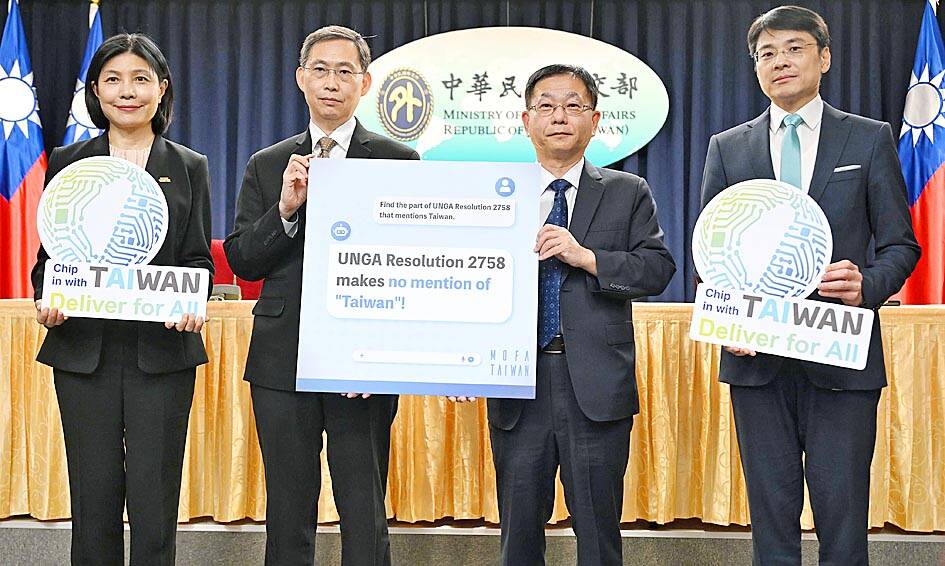
From left, Ministry of Foreign Affairs Department of International Information Services Director-General Chang Hsiu-chen, Department of International Organizations Director-General Jonathan Sun, Deputy Minister of Foreign Affairs Baushuan Ger and ministry spokesman Hsiao Kuang-wei hold placards at a news conference in Taipei yesterday.
Photo: Chang Chia-ming, Taipei Times
Challenges such as the Russo-Ukrainian war, the conflict in the Middle East, threats to energy and global supply chains, and climate change underscore the necessity and urgency of substantive reforms within the UN, he said.
“As a member of the international community, Taiwan faces the same global challenges as other nations in addition to continuous threats from China, which is escalating tensions across the Taiwan Strait and in the region,” Ger said.
Taiwan needs to participate in multilateral mechanisms, not only to safeguard the rights of Taiwanese and national interests, but also because it has the capacity to contribute to the solution of many issues concerning humanity, he said, adding that the nation is willing to share its experiences with the world.
“However, 23.5 million Taiwanese are still excluded from the UN system due to China’s distortion of the UN Resolution 2758,” Ger said.
China claims the resolution equates to its self-proclaimed “One China” principle, attempting to erase that Taiwan is a sovereign country, improperly depriving the nation of its legitimate right to participate in the UN system, he said.
China has increased its threats in the Taiwan Strait and the Asia-Pacific through “gray zone” tactics such as military intimidation, cyberattacks and economic coercion to unilaterally alter the regional “status quo.”
Beijing also enacted the Ethnic Unity and Progress Promotion Law in July to extend its long-arm jurisdiction and transnational repression, violating global democratic values and causing serious international concerns, he said.
“Peace and stability in the Taiwan Strait are crucial to global security and prosperity,” Ger said, adding that Taipei remains committed to safeguarding cross-strait peace, defending its sovereignty, upholding democracy with like-minded partners and pragmatically promoting its international participation.
He said that Taiwan’s three key messages are:
First, the nation’s meaningful participation in the UN system, allowing it to achieve its sustainable development goals, as “the UN 2758 does not preclude Taiwan’s meaningful participation in the UN system,” he said.
Second, Taiwan stresses its firm commitment to “maintaining the status quo and safeguarding peace and stability across the Taiwan Strait,” he said, adding that the international community and democratic partners support maintaining the “status quo,” while the Taiwanese public backs it strongly.
Third, Taiwan is committed to resolving disputes peacefully and upholding the international legal order, he said.
Any “attempt to or action to disrupt the status quo in the Taiwan Strait violates the UN Charter’s principle of prohibiting the threat or use of force, and requires the peaceful settlement of international disputes,” Ger said.
This year, the MOFA would also ask Taiwan’s diplomatic allies’ permanent representatives to the UN to jointly sign a letter to strongly convey Taiwan’s message to UN Secretary-General Antonio Guterres and speak up for Taiwan during the General Debate, he said.
Minister of Foreign Affairs Lin Chia-lung (林佳龍) would submit an op-ed titled: “Restoring Trust: Taiwan’s Rightful Place in the Free World” to global media to explain the nation’s stance, Ger said.
In addition, MOFA would host side events and local promotional campaigns in New York during the UN General Assembly, while the Legislative Yuan would again dispatch a cross-party delegation of lawmakers to demonstrate strong public support for the government’s efforts, he added.
KioskNews shows a cleaned-up reading view extracted from the publisher’s page — the original always lives on their site, not ours.