China slams Japan’s Takaichi over Yasukuni ritual offering, warns of ‘remilitarisation’
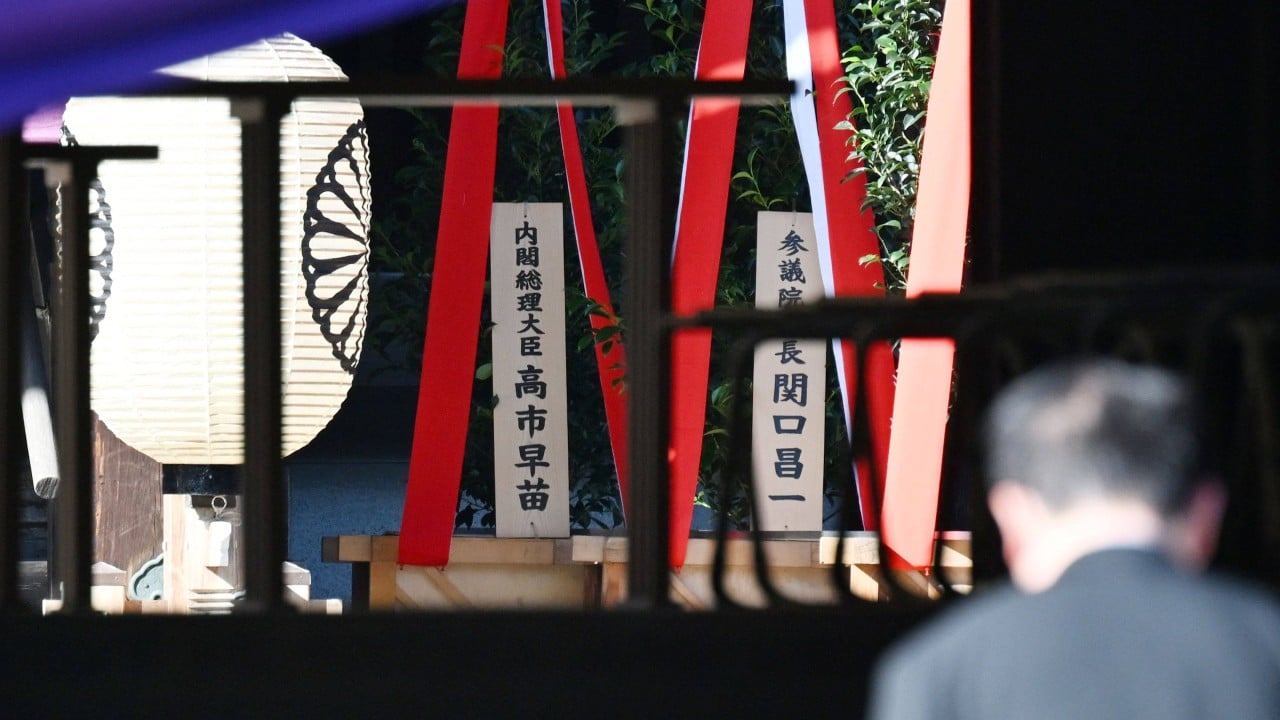
China has condemned Japanese Prime Minister Sanae Takaichi for sending a ritual offering to Tokyo’s war-linked Yasukuni Shrine, a move that threatens to cast an even longer shadow over the strained ties between Beijing and Tokyo.
At the start of Yasukuni’s three-day autumn festival on Saturday, Takaichi sent a ritual tree-stand offering to the shrine in her capacity as prime minister, although she did not visit in person.
Minoru Kiuchi, minister in charge of economic growth strategy, visited the controversial site the same day, Japan’s Kyodo News reported.
In a statement late on Saturday, the Chinese embassy in Japan strongly condemned the move.
Describing the shrine as a “spiritual tool and symbol of Japanese militarism”, the embassy said that any attempts by Japanese political figures to pay homage at Yasukuni – under whatever pretext – amounted to an effort to whitewash war crimes and pave the way for accelerating “remilitarisation”.
Properly understanding and treating history was an essential prerequisite for Japan’s post-war return to the international community, the political foundation for its relations with neighbouring countries and a benchmark for whether Japan abided by its commitment to peaceful development, the embassy said.
Wu Yingjie, a Japanese studies research fellow at the University of International Business and Economics in Beijing, said Takaichi was following in the footsteps of many of her political predecessors.
“Takaichi’s approach follows the balancing act maintained by most previous Japanese prime ministers – abstaining from personal visits to avoid severe international backlash while making ritual offerings to satisfy domestic right-wing allies,” Wu said.
The Yasukuni Shrine honours around 2.46 million Japanese war dead, including 14 Class-A war criminals convicted by international tribunals following World War II. Asian nations that suffered under Japanese wartime aggression, notably China and South Korea, have consistently protested against visits and offerings by Japanese leaders.
06:06
Place of controversy: Japan’s Yasukuni Shrine
Wu noted that Beijing’s latest condemnation aligned with its established diplomatic position and echoed its criticisms in August, when it accused Japan of challenging the post-World War II international order.
On August 15, the anniversary of Japan’s surrender in World War II, Takaichi similarly skipped a personal visit and sent an offering instead, although Defence Minister Shinjiro Koizumi and three other cabinet members visited the shrine in person.
In response to those offerings and visits, China’s foreign ministry explicitly branded Yasukuni a “war criminal shrine”.
On Thursday, ministry spokeswoman Mao Ning again described the site as a “de facto war criminal shrine”, while commenting on a new documentary by Japanese public broadcaster NHK detailing the covert 1960s decision to enshrine Class-A war criminals.
The latest friction deepens a frost in relations that began last November, when Takaichi suggested in parliament that a military attack on Taiwan could constitute a “survival-threatening situation” for Japan, potentially justifying military intervention.
High-level governmental dialogues between China and Japan have largely ground to a halt since.
Japanese PM ‘open’ to talks with China
Beijing sees Taiwan as part of China to be reunited by force if necessary. Most countries, including the United States and Japan, do not recognise Taiwan as an independent state, but Washington is opposed to any attempt to take the self-ruled island by force and is committed to supplying it with weapons.
However, Takaichi has signalled her willingness to visit China despite the diplomatic strain.
She said on Friday that she intended to be in China for the Asia-Pacific Economic Cooperation summit in Shenzhen next month, parliament permitting.
However, Wu cautioned that a high-level bilateral meeting was unlikely to materialise unless Tokyo made a fundamental shift in its rhetoric on Taiwan.
KioskNews shows a cleaned-up reading view extracted from the publisher’s page — the original always lives on their site, not ours.