Thailand and Myanmar agree to monitor border rivers
Arsenic and other heavy metals from Shan State mines creating pollution crisis
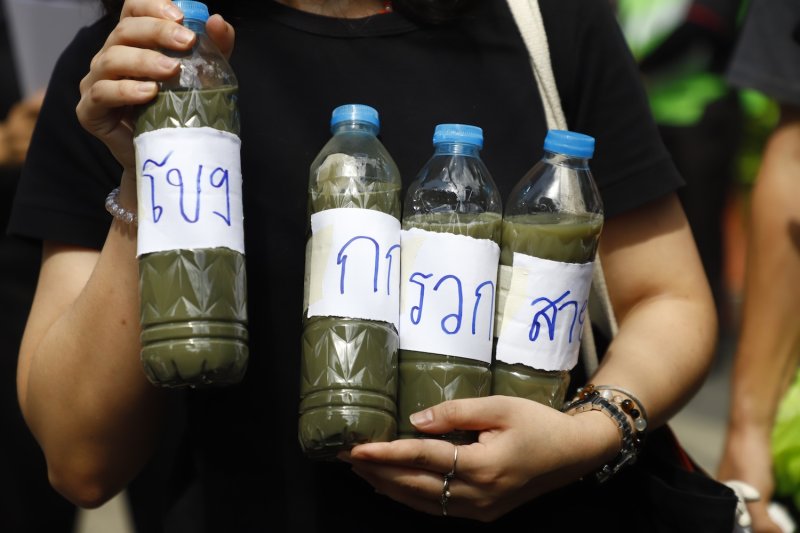
Thailand and Myanmar agreed on Wednesday to establish six water-quality monitoring stations to investigate heavy-metal contamination in rivers along their shared border, as concern over pollution grows in northern Thailand.
Mining activity in Myanmar, primarily to extract gold and rare earths, has led to the release of toxic chemicals into rivers flowing into Thailand, potentially contaminating water sources for hundreds of communities.
More than 2,400 mines — many of them illegal and unregulated — across mainland Southeast Asia could be releasing deadly chemicals such as cyanide and mercury into river water, according to the US-based Stimson Center.
Thailand’s Pollution Control Department said tests from March to September 2025 detected arsenic and other heavy metals in water and sediment samples collected from the Kok River and its tributaries, as well as the Sai, Ruak and Mekong Rivers.
The Kok flows from Shan State in Myanmar into Chiang Rai province, while the Sai and Ruak form parts of the border.
At the first meeting of a Thai-Myanmar working group set up to tackle the pollution, both sides agreed to install four monitoring stations along the Kok River and two along the Sai River, according to a Thai government statement.
“Both sides agreed to exchange water quality monitoring data through designated departments at least twice a year to facilitate regular information sharing and enhance coordination,” the statement said.
The initial phase would focus on two areas: water-quality monitoring and assessments of its impact on public health, said Raweewan Bhuridej, permanent secretary of the Ministry of Natural Resources and Environment.
Monitoring contaminants in river sediments, fish and vegetables would be considered in a later phase, alongside efforts to improve testing and analytical capacity, she said.
Thailand said earlier that it plans to stop exporting chemicals used in rare earth mining to Myanmar and designate its side of the Kok River a “pollution control zone” to tackle toxic contamination.
Dealing with China
Thai investigations have focused on mining in war-torn Myanmar as a potential source of contamination, including areas in eastern Shan State under the control of a Chinese-backed militia, according to UN experts.
In the remote hillsides of Shan State, Chinese miners opened new rare earth mines under the protection of the United Wa State Army militia group, Reuters reported last year.
China said then that Chinese firms operating abroad are required to “abide by local laws and regulations and actively fulfil their social responsibilities”.
Beijing has offered technical support, including information sharing, joint surveys and the establishment of a joint laboratory, said Ms Raweewan.
“China is prepared to support cooperation between Thailand and Myanmar,” she said.
Myanmar is one of the world’s largest sources of rare earths that are primarily exported to China and turned into magnets that power critical goods like wind turbines, medical devices and electric vehicles.
Key rare earth mining belts, including the Shan State areas bordering Thailand, are outside the control of Myanmar’s military-backed government, which continues to fight ethnic armed groups on multiple fronts.
Ms Raweewan said authorities would meet the governor of Tachileik, opposite Chiang Rai, on Thursday to discuss information-sharing and issuing alerts about incidents that could affect water quality.
KioskNews shows a cleaned-up reading view extracted from the publisher’s page — the original always lives on their site, not ours.