Like taxing blood donors: Bank boss reveals biggest gripe
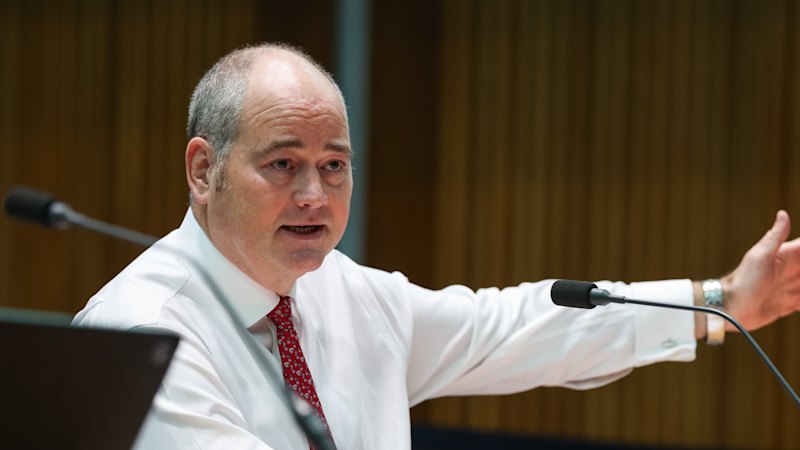
The head of one of the nation’s largest banks has likened state payroll taxes to “taxing people who give blood” in a full-throated plea to the nation’s politicians to slash red tape and government spending.
But the chief executive of Australia’s biggest home lender, Matt Comyn, has cautioned borrowers that interest rates will remain higher as the world deals with the AI construction boom, geopolitical disruption and economic shocks that seem to be accelerating in number.
NAB boss Andrew Irvine and Comyn gave evidence on Friday to a parliamentary hearing into the banking sector that has been dominated by the state of the economy, government spending and the housing market.
The British-Canadian Irvine, who took over as the head of the NAB in 2024, said he continued to be stunned that a country as large as Australia with a population of less than 30 million could have a housing crisis.
“It’s honestly like we’re playing poker with a handful of aces and we’re losing. How is that possible? I find it so disappointing,” he said.
Irvine said the level of regulation across the country, especially when it came to construction, was way too high.
He then turned his attention to the tax system, particularly state payroll taxes.
“[It’s] the most atrocious, abominable tax. It would be like taxing people who give blood,” he said.
Irvine said that in the early 2000s, government spending as a share of the economy was a “world-class” 23 per cent. Now it was around 29 per cent which, while lower than most nations, has grown strongly under both sides of politics.
He said lower spending, which Treasurer Jim Chalmers has signalled will form a part of his mid-year budget update next month, would take pressure off inflation and interest rates while allowing the private sector to grow.
“It is undoubtedly true that additional public sector spending, in an environment where we have poor productive supply capacity, is unhelpful,” Irvine said.
“Public spending in and of itself is crowding out private sector spending and that is problematic. I would point out it’s not just the federal government, it’s all levels of government, state government, local councils, it’s everything.”
Comyn noted that lower government spending would reduce inflation pressures across the country, but warned it would not be a panacea for all the issues facing Australia.
He said the surge in spending in areas such as AI meant the very low interest rates of the 2010s – when the cash rate in Australia fell to 0.75 per cent ahead of the pandemic – were gone.
“The outlook for interest rates is higher than it has been for the past decade,” he said.
Comyn said while Australian government debt – which on Friday fell below $1 trillion – was much lower than most other nations, it was important for fiscal discipline.
He said a suite of policy reforms were needed to boost productivity which would then help Australia deal with an increasingly shock-prone global economy that was straining under pressures stretching from the AI construction boom to demographic change to geopolitical tensions.
“I think the structural forces that are shaping geopolitics make it far less predictable,” he said.
“Living within your means as a company and country is important … there are much more significant and more frequent shocks likely to affect the economy.”
Comyn also suggested the Reserve Bank, which has lifted the cash rate five times this year, may have erred in cutting interest rates last year, saying it could have waited longer to ensure inflation was going to stay within its 2-3 per cent target band before easing monetary policy.
Westpac’s chief economist, Luci Ellis, on Friday said the RBA may be done with interest rate rises as the economy slows more quickly than anticipated by the Reserve.
She said the fallout from this year’s steep fall in house prices would weigh on the broader economy and inflation well into next year. The recent drop in oil prices, which are now below what the RBA forecast only a week ago, would also aid in reducing price pressures across Australia.
“[Monetary] policy is clearly restrictive, and the risk of overdoing the inflation correction is growing,” she said.
“By the time we get to February, we think there will be more evidence that the domestic economy is slowing materially, and the inflation outlook with it.”
There was further confirmation of the slowdown in the domestic economy from shoe retailer Accent Group which on Friday revealed that “elevated fuel prices, interest rate rises and general consumer confidence” had started to hit sales.
KioskNews shows a cleaned-up reading view extracted from the publisher’s page — the original always lives on their site, not ours.