Trump has made billions from crypto. It just backfired on him
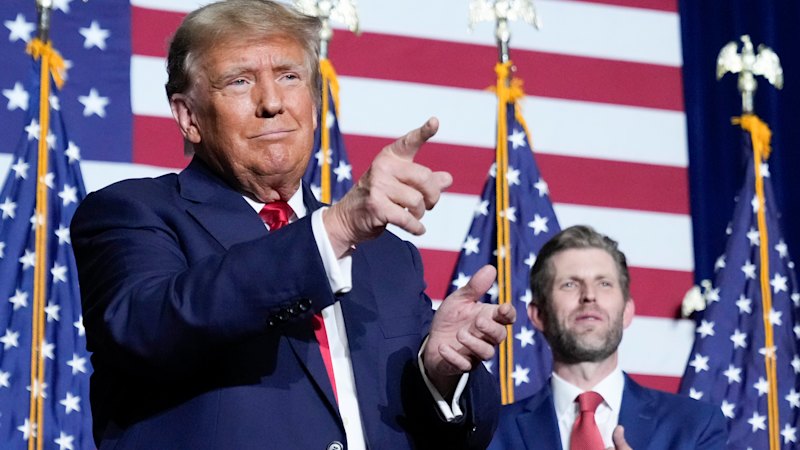
A crypto-boosting bill that would have brought cryptocurrencies into the mainstream of US finance failed in the US Senate on Tuesday, dealing the sector and its promoter-in-chief, Donald Trump, a serious setback.
The Clarity Act, which would have created the first comprehensive regulatory framework for crypto assets, needed 60 votes to be passed. It attracted 49, with the Democrats and several Republicans voting against it.
The failure of the Senate to pass the legislation, more than a year after it sailed through the House on party lines, came despite intense lobbying from the White House and the crypto sector, which spent more than $US100 million ($140 million) lobbying in support of the legislation – after spending multiples of that amount backing Trump and crypto-supportive candidates in the 2024 election campaigns.
It failed in the Senate primarily for two reasons.
One – and the one the Democrats were most focused on – was Trump’s lucrative crypto holdings. The other was the potential impact on US banks, particularly the smaller community banks.
The Democrats wanted changes to the bill to prevent US presidents and other public officials from holding and trading crypto assets. Trump, of course, made more than $US1.4 billion from his crypto interests last year.
“All President Trump wants is time to crime,” Democrat senator, Ruben Gallego said after the vote.
“This legislation failed squarely because Republicans refuse to say no to the president.”
Republicans had tried to amend the bill to prevent federally elected officials and their spouses from issuing their own cryptocurrencies (as Donald and Melania have) and to force divestment of their crypto assets, but Democrats believed the language had sufficient loopholes to enable Trump, or any future president, to circumvent the restrictions. (Trump’s view of divestment and blind trusts is that he could fulfil any requirements by handing control of his investments to his sons).
The other sticking point for the passage of the bill was its impact on banks.
While the Genius Act regulating stablecoins that was passed last year – legislation that was supposed to complement the far broader Clarity Act – prevents those promoters from offering interest to stablecoin investors, ostensibly stopping them from competing with bank deposits, the Clarity Act would have allowed them to offer “rewards.”
Banks, particularly the smaller community banks, were concerned that the incentives that were permitted would allow crypto companies to effectively offer a yield on stablecoins (crypto assets backed dollar-for-dollar by safe and liquid assets, like US Treasury securities) and attract funds out of the highly-regulated banking system into the largely unregulated crypto universe, potentially impacting the banks’ liquidity and ability to lend.
With the US midterm elections looming, the crypto lobby is fearful that the Democrats may take control of the House, and even the Senate and a generational opportunity to create a crypto-friendly legislative framework for the sector might be lost.
The US regulatory agencies that cover cryptocurrencies – the Securities and Exchange Commission (SEC) and the Commodity Futures Trading Commission (CFTC) – are already rushing to create regulations that would give the sector much of what it wants, but those regulations could just as easily be torn up by a less crypto-supportive administration.
The Biden administration was sceptical of crypto. Its SEC chair, Gary Gensler, described the markets for crypto assets as the “Wild West” and “rife with fraud, scams and abuse” and sought to impose quite stringent regulations on the sector. Gensler was an early casualty of the change of administration, with the leadership of the SEC displaced by more Trump and crypto-supportive appointees.
Trump, a sceptic himself in his first term – he, too, described crypto as a “scam” – became a enthusiastic convert during his 2024 campaign, perhaps swayed by the sheer scale of the funds that crypto companies deployed in support of his campaign.
He went from a cynic to the sector’s most ardent supporter, declaring on his return to the White House that he would make the US “the crypto capital of the world,” even as he and his family plunged, very profitably, into the crypto markets.
There are, it should be said, strong arguments for why the sector should be regulated.
With the US midterm elections looming, the crypto lobby is fearful that the Democrats may take control of the House, and even the Senate and a generational opportunity to create a crypto-friendly legislative framework for the sector might be lost.
There isn’t a legislative framework for a sector that has $US2.6 trillion of assets today (the crypto market was capitalised at nearly $US4 trillion a year ago) and where the stablecoin segment alone might, if Treasury Secretary Scott Bessent’s prediction were borne out, be worth $US3 trillion by 2030. The Clarity Act, or a version of it, would provide legitimacy and greater certainty for the issuers and investors.
To the extent that there is regulation today, the question of who regulates has descended into a turf battle between the SEC, which wants to impose similar and similarly intrusive regulation to the rules applying to more conventional securities, and the CFTC, which favours a significantly more laissez-faire approach.
The Clarity Act would have created the regulations and defined the regulatory responsibilities. Not surprisingly, given the intensity of the crypto sector’s lobbying, the legislation awarded the primary responsibilities to the CFTC, even though it is a far smaller agency than the SEC, with far more limited resources and, unlike the SEC, little experience in regulating retail-facing products.
While the blockchain technology that underpins the crypto universe is unique, innovative and potentially transformative, much of what sits on the technology is derivative, mirroring financial traditional products and their features – but without the regulatory rules and costs and public disclosures of their traditional counterparts.
In effect, much of crypto is based on regulatory arbitrage, which is why bankers, and others, would argue that if a crypto asset looks like a bank deposit, or a financial security, it should be regulated as if it were issuing that deposit or security.
The crypto sector won that argument when Trump re-entered the White House, but its failure to get its legislation through the Senate means the debate might well be reopened if the Democrats are successful in November, or indeed, in 2028.
The Market Recap newsletter is a wrap of the day’s trading. Get it each weekday afternoon.
More:
KioskNews shows a cleaned-up reading view extracted from the publisher’s page — the original always lives on their site, not ours.