‘Unshackle the economy’: Labor MP pushes Chalmers on growth, speculates on PM retirement
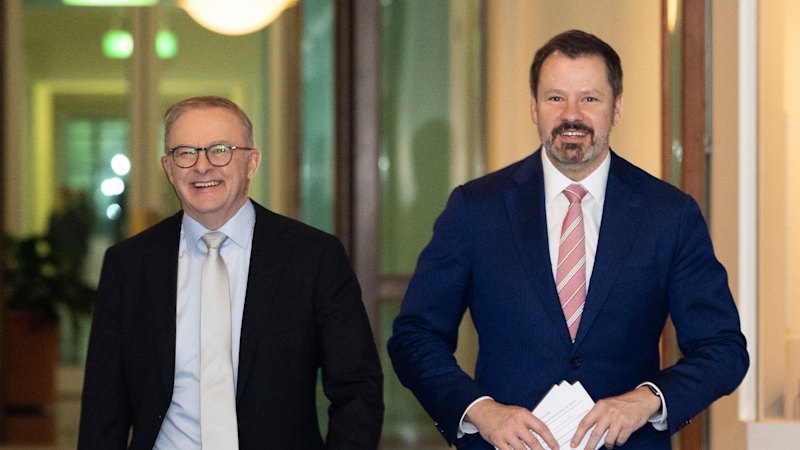
Labor MP Ed Husic has called for a new growth agenda to “unshackle the economy” as Anthony Albanese and Jim Chalmers come under pressure to boost living standards, calling for large tax cuts, a corporate tax shake-up and open debate within Labor to reverse a drop in real wages.
He also called for the prime minister to ensure rank-and-file members could vote on the party’s next leader if he resigned from the top job next year or after the election, due by 2028, making him the first MP to openly speculate about Labor’s future after Albanese’s dominant reign ends.
Husic, a western Sydney MP who has become a critic of Albanese and the government after being dropped from cabinet last year, said he wanted to see “much bigger tax cuts” for low- and middle-income earners as the treasurer dangles the prospect of tax relief after this year’s tighter budget.
The 56-year-old declared “we need to have a growth agenda” to rebuild the 5 per cent hit to real wages since the pandemic. Albanese needed to loosen up Labor’s stage-managed internal culture to allow for ideas on how to stimulate growth, he added.
“I think the country can do better and have an optimistic view about how we can grow the place,” he said in an interview.
“I get approached by people in the street who’ve seen some of the things I’ve said online. They say, ‘You get where I’m at because I feel like … my nose is just above water, and it’ll only take one big bill to knock me off my feet.’
“I don’t think people should live in that level of anxiety. They’d be frustrated when they think that both the major parties don’t have a solution or an answer for them. That’s why they entertain One Nation. The major party that can come up with a way to make life better for everyday Australians and rebuild their incomes, I think will be in the strongest position.”
Husic’s message for his party adds to a growing array of party-aligned figures advocating for major reform and critiquing the Albanese government’s economic model. Union icon Bill Kelty has accused Labor of insulting voters with its rhetoric on the health of the economy. Former prime minister Paul Keating has consistently called for lower income taxes. Albanese’s former economics adviser Alex Sanchez said this year that Labor had lost sight of growth. Lachlan Harris, a former adviser to Kevin Rudd, argued that centre-left parties would ultimately wither if they failed to create prosperity.
This masthead has reported on concerns inside Labor’s caucus and cabinet on Labor’s management of productivity and inflation, which has remained elevated and led to a 15-year-high cash rate. Chalmers has promised fresh savings in the December budget update and some MPs are hoping for new ideas over summer on how to boost living standards without stoking inflation.
Husic got offside with Chalmers when, in 2024, the then-industry minister called for a lower company tax rate to drive up Australia’s mediocre rate of business investment.
Husic said on Monday that Albanese was one of the “dominant political figures of our time” and may have the rare luxury of picking the time of his departure from politics.
“If you do it more than 12 months from the next election, you’ve got that opportunity [to hold a vote],” he said.
“I think it’s important the next leader is selected by a wider base because it triggers instantly a debate about the direction of the party within the context of those big issues confronting Australia.”
It is widely expected that Albanese, who retains a winning position despite a drop in polls, will contest the election.
Labor’s primary vote has dropped from 34.5 per cent at the election to 29 per cent. It still retains a winning position because the Coalition has collapsed to 23 per cent while One Nation is at 25 per cent.
Husic proactively speculated on Albanese’s retirement when asked if he would ever throw his hand up should rank-and-file members be allowed to vote on the next leader.
He said: “I don’t see myself being part of that.” But Husic’s advocacy on issues such as AUKUS and the war in Gaza means he has gained popularity among Labor’s non-factional rank-and-file. Some of his critics in the caucus believe his agenda makes him a better fit for the Greens, a claim he rejects.
Local branches have voted on the leadership only once – after the 2013 election – since Kevin Rudd changed party rules to give them a vote.
Husic also proposed a policy similar to the 2019 Shorten-era Australian Investment Guarantee, which would have allowed a business to immediately deduct 20 per cent off any new eligible asset worth more than $20,000. Labor’s current instant asset write-off is only available for assets worth less than $20,000.
Australia’s productivity problem should be addressed by business leaders as well as politicians, Husic said. He pushed back against the orthodoxy that wages should not rise well above inflation, saying above-inflation wage rises were needed to rebuild real incomes.
“Don’t tell me that a CEO on the ASX 100 who gets $6 million can’t find a way for average Australians earning $100,000 to do better,” he said.
Cut through the noise of federal politics with news, views and expert analysis. Subscribers can sign up to our weekly Inside Politics newsletter.
KioskNews shows a cleaned-up reading view extracted from the publisher’s page — the original always lives on their site, not ours.