2,200-hour work year leaves Singapore couples little time for babies despite $55,000 support
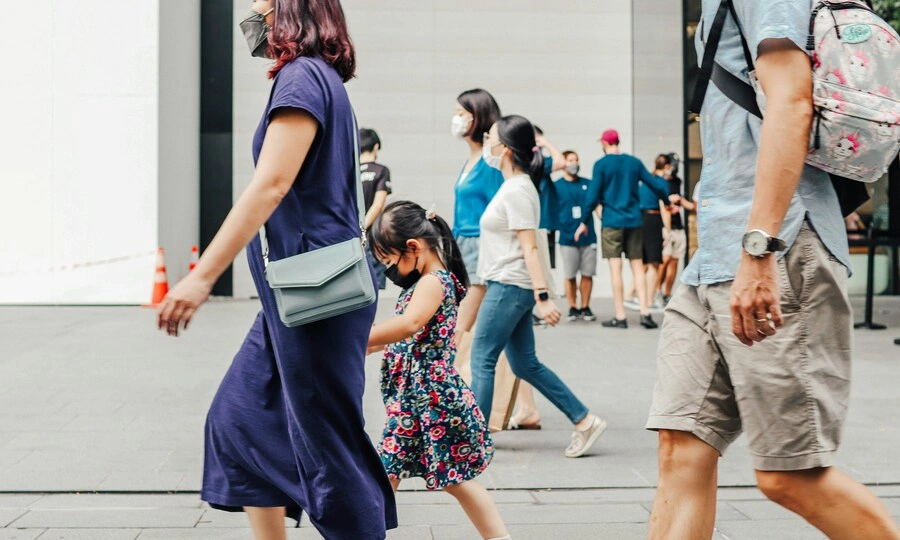
Singapore has pledged nearly S$70,000 (US$54,700) in support for every child, but long working hours and education pressure are keeping many young couples from becoming parents.
Newlyweds Lin Xueni and Chen Yongsheng have always had children on their list of life plans, but in Singapore that is not an easy goal to reach.
"When it comes to raising children, the financial burden is one of the main considerations," Chen told DW.
Singapore's total fertility rate fell to a record low of 0.87 in 2025, according to the Singapore Department of Statistics, and fewer than 30,000 babies were born that year. The rate was 0.97 in 2024 and 1.24 a decade earlier.
The rate is among the lowest in the world and only slightly higher than South Korea's.
Prime Minister Lawrence Wong announced a set of measures in his National Day Rally speech on Aug. 23, including a new child support package that, combined with existing benefits, is worth nearly S$70,000 for each Singapore citizen child from birth to age 17.
Under the package, parents will receive a S$10,000 ($7,800) cash gift in the child's first year and up to S$10,000 in a Child Development Account, on top of existing benefits such as a S$5,000 grant for the child's MediSave medical savings account.
The child will then get S$2,000 a year from ages 1 to 16 and a S$10,000 top-up to a post-secondary education account at 17. The package replaces the existing Baby Bonus and Large Families schemes, CNA reported.
"The Singapore government is really trying very hard to raise the birth rate," Lin said of her first reaction to the news.
Singapore has raised its baby bonuses and family subsidies repeatedly over the years, yet the birth rate has kept falling.
Wong said in June that his government would lean less on incentives and focus instead on making family life easier, Bloomberg reported.
Tan Ern Ser, a sociologist at the National University of Singapore, told DW that cash and government incentives are necessary conditions that improve couples' external circumstances but are not necessarily what moves them to have children.
Couples decide to have children when they feel secure and confident about raising them, he said, adding that parents also need time, energy and enough quality time with their children.
Long hours, little time
Full-time employees in Singapore averaged 44.3 paid hours a week in 2025, Ministry of Manpower data show, or more than 2,200 hours a year, compated to roughly 1,750 hours in developed countries.
Long hours have come to be seen as normal in Singapore workplaces, said Kalpana Vignehsa, a senior research fellow at the university's Institute of Policy Studies, DW reported.
Couples considering parenthood ask whether they would really have time for a child and what the point of having one is if they would rarely see it, a problem she said money cannot solve.
The pressure falls hardest on working women, who weigh the opportunity cost of having children, including the effect on their careers, income and retirement savings, Kalpana said. Most of that cost is still borne by mothers.
Society does not fully recognize the value of caregiving, she said, so women with careers of their own ask whether they are willing to bear that cost.
Singapore's competitive parenting culture adds to the hesitation. From after-school tuition to the Primary School Leaving Examination (PSLE) at age 12, children grow up being compared and tested, and parents feel they must invest heavily in time and money for each child.
Young adults who grew up in that system weigh whether they want the next generation to bear the same pressure.
Kalpana said parents face pressure not only from education but also from society's expectations of what a good parent is, and that when the bar seems too high, some people will naturally opt out.
KioskNews shows a cleaned-up reading view extracted from the publisher’s page — the original always lives on their site, not ours.