Australia fight back in rollercoaster start to deciding Test against South Africa
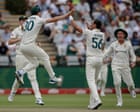
For a time, it was heading up there with the worst. David Gower at Leeds in 1989, when Australia topped 600 and declared. Nasser Hussain in Brisbane, 2002, when Australia were 364 for 2 by the end of the day. Edgbaston 2005, where England lamped 407 from 80 overs. Those were the looming comparisons for captains deciding to bowl at the toss, after Pat Cummins did the same in the third Test at Cape Town, only for South Africa’s openers to smash 140 by lunch. Yet, by day’s end, Australia had taken 10 for a further 189, Mitchell Starc destroying the tail with four wickets in six balls, all out 329 constituting a serious Australian comeback.
What a rollercoaster. The Australian setup has looked frazzled this tour: confused player selections for the squad, then for the XIs, confused shot selection in the middle, players bouncing around the order with nightwatch duties and injury absences. Here they chose to leave out their best player from the second Test, Scott Boland, for Nathan Lyon, and were forced to leave out their best player of the last decade, Steve Smith, for Josh Inglis, as well as dropping Nic Maddinson and Beau Webster for Cameron Green and Cooper Connolly. The last time a touring Australian side made four non-disciplinary changes was in the West Indies in 1984.
So it tracked that there was confusion in Cummins’ decision, as well. He has been a bowl-first enthusiast relative to captaincy convention, this being the ninth time he’s made that call in 25 opportunities, and perhaps was banking on there being more juice in the surface on morning one than on afternoon two. But with locals describing a Cape Town surface that is known to run easy, and on a morning of bright sunshine with plenty more predicted, surely the safest move was to try to build a score?
That’s what Aiden Markram and Marques Ackerman did, Markram setting the tone with some early blows, then Ackerman following his lead until surpassing it. Starc and Josh Hazlewood bowled poorly, too short and too wide on too many occasions, and with no swing and no lateral movement from the pitch, Markram laid into front-foot drives, back-foot punches, and even a shockingly audacious smash from Hazlewood on the up. When Cummins came on to play enforcer, Markram pulled him for six. Lyon, the spinner, was bowling by the 12th over rather than waiting to influence day five.
Before long, Ackerman took over. Happy to hook whenever the opportunity came, he cleared fine leg for six from Cummins and belted Lyon out of the arena over midwicket. When Starc returned for a later spell, Ackerman smashed 18 off one over, hitting four boundaries in a row. Australia were shambolic, Travis Head dropping one of the easiest catches of his life at cover, spliced to him by Markram from Starc, then Lyon letting a return catch go through in the first over after lunch. With the score on 158, South Africa were 13 short of the record opening stand against Australia for a team being sent in, and the tourists looked set for a dismal day.
It was Lyon who found a way through. With Ackerman determined not to temper his approach on 95, he ran at Lyon only to be outfoxed, a wider and slower ball evading his bat to bring about his stumping. Markram also perished while forging on, pulling a Hazlewood ball that had bounced nowhere high enough out to long leg, the first of many false shorts to short balls that found the hands of a fielder. That opened the door for Lyon to bowl Bavuma, past the defensive outside edge, and Connolly to get his first Test wicket by burrowing past Matthew Breetzke’s inside edge, lbw on review.
David Bedingham had played beautifully, driving with precision, and finally reached 50 having been out for 46 and 49 earlier in the series. But he went no further, also caught at fine leg hooking, Hazlewood dancing over the boundary and back to complete it, followed by Wiaan Mulder top-edging a hook at Starc for nought. Wicketless for 158 had become 216 for six.
So it was time for South Africa’s rollercoaster to climb up again. Marco Jansen, so often the Australians’ chief cause of frustration, took them on once more, flaying the ageing ball for another half-century after his match-turning 85 in the second Test. With Ryan Rickelton alongside him, they added 95 in good time.
after newsletter promotion
But the first over with the new ball brought about the rollercoaster’s death-drop finale. Now with cloud cover at the end of the day, the ball began to swing, and Starc went back to his roots. No wobble seam, no bouncers, just left arm, over the wicket, inswinging menace. Rickelton nailed on the back pad, fourth ball of the over, for 42. Jansen two balls later, trying to drive, curling back to kiss the outside of off stump, bowled for 52.
First ball of Starc’s next over, Gerald Coetzee was bowled off his pads, backing away from that inswing, and while Kagiso Rabada survived the hat-trick ball, he was smashed in line with leg stump from the one that followed. South Africa had lost four wickets for two, Starc finished with 6 for 72, and a day of Test cricket containing almost everything one could ask for was called to a close. The jury might remain out overnight if asked to decide who should be happier. Look for a verdict later this week.
KioskNews shows a cleaned-up reading view extracted from the publisher’s page — the original always lives on their site, not ours.