US turns to low-cost Blackbeard hypersonic missiles to overwhelm Chinese defences
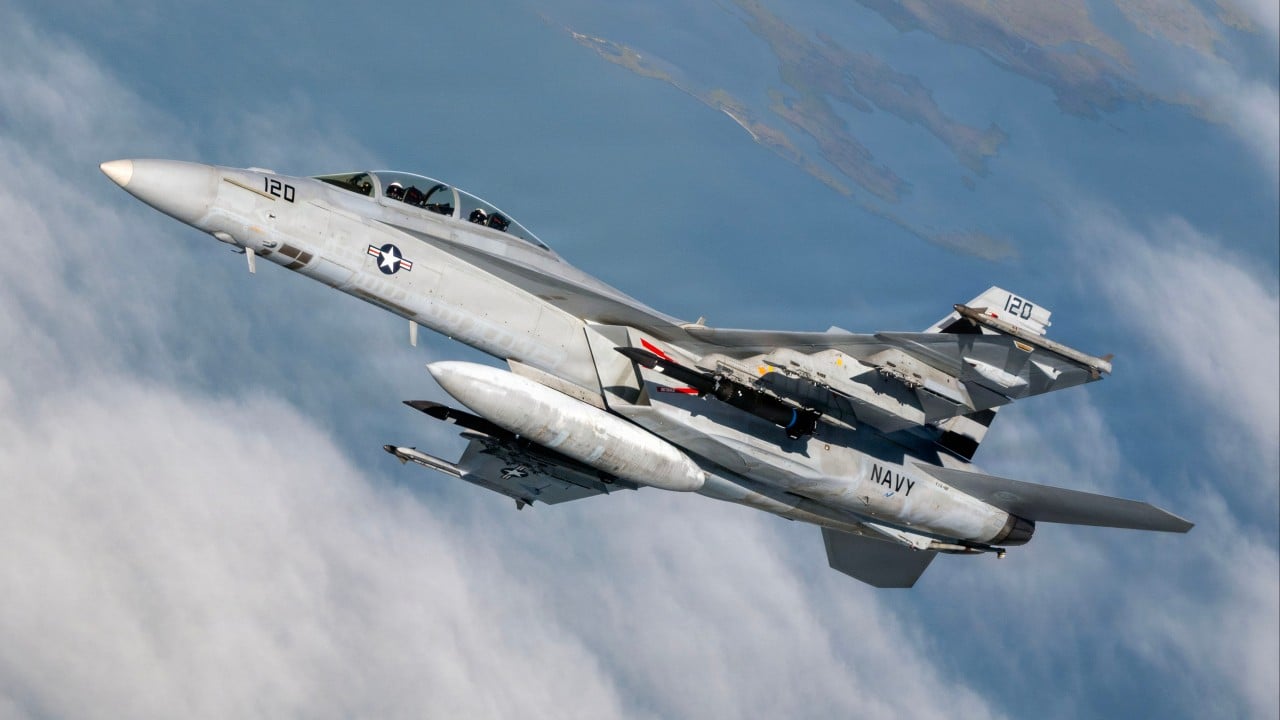
The US Navy aims to field a relatively low-cost hypersonic missile on its carrier-based fighters, a weapon that could pose a new challenge to the air defences protecting Chinese warships and coastal military installations, experts said.
California-based defence company Castelion’s Blackbeard is designed to fly at more than five times the speed of sound and strike ships and land targets. Unlike more expensive hypersonic weapons, it is being developed with an emphasis on affordability and mass production.
In May, the Pentagon sought congressional authorisation and funding to buy more than 12,000 Blackbeard missiles for deployment across the armed services over five years. US Navy projections put the average gross unit cost at about US$385,000 in the financial years 2028-31.
In contrast, the cost of Lockheed Martin’s larger Long-Range Anti-Ship Missile (LRASM) is estimated in US Air Force budget figures for the 2024 financial year to be about US$3.25 million.
The price difference could allow US forces to build much larger stockpiles and launch repeated attacks against Chinese warships, forcing them to expend defensive interceptors and potentially making it easier for larger, more powerful anti-ship missiles to hit their targets, experts say.
The Blackbeard could also threaten Chinese coastal anti-ship missile batteries and air-defence systems, although experts differed over whether American carrier-based aircraft could get close enough to strike such targets.
According to the US Naval Institute (USNI), the navy ordered 50 pre-production missiles in June and a further 444 in September and is seeking early operational capability this year – though budget projections and a Castelion announcement in April pointed to 2027.
USNI News reported that an F/A-18E/F Super Hornet showed in September that it could carry two Blackbeard missiles. The US Navy is planning to equip each Super Hornet to carry up to four missiles, it said.
The push for larger inventories reflects concerns about how quickly American forces could run short of long-range precision weapons in a conflict involving Taiwan, a continuing point of friction between Beijing and Washington.
Beijing sees Taiwan as part of China to be reunited by force if necessary. Most countries, including the US, do not recognise Taiwan as an independent state, but Washington is opposed to any attempt to take the self-governed island by force and is committed to supplying it with weapons.
In war games published in 2023, the Washington-based Centre for Strategic and International Studies (CSIS) found that US forces exhausted their simulated LRASM stocks within the first week in every iteration of a hypothetical attack on the island.
Meanwhile, Chinese military researchers have examined the various ways they could counter potential large-scale US precision strikes, according to Christopher Sharman, director of the US Naval War College’s China Maritime Studies Institute (CMSI).
Sharman pointed to a 2023 article published by the People’s Liberation Army journal Air Force Military Studies that examined more than a dozen conflicts involving US and allied long-range strikes. CMSI published an English translation in August.
The PLA authors recommended attacking US forces before they launched their weapons, jamming satellite navigation signals and coordinating drones, fighters and air-defence systems, Sharman said.
09:58
Will Batanes become the next South China Sea flashpoint?
However, publicly available information did not establish whether the PLA had adopted those recommendations, he added.
The bigger question was not just “whether individual warships can intercept incoming missiles”, but whether the Chinese navy could “maintain an effective, integrated defence across the fleet” during a coordinated attack.
Sharman stressed that he was speaking in a personal capacity and his comments did not necessarily reflect the views of the US government, Defence Department or the Naval War College.
Peter Jones, a retired Australian vice-admiral and adjunct professor at UNSW Canberra, said hypersonic missiles forced defending forces to “detect, track, assign weapons about five or more times quicker” than against conventional subsonic anti-ship missiles.
A “layered defence” that would draw on the networked capabilities of ships and aircraft in a task group offered the best chance of countering such attacks, according to Jones. “Whether the latest Chinese destroyers can engage these missiles is unclear,” he noted.
Much would depend on the Blackbeard’s flight path and radar signature, as well as the effectiveness of Chinese radars, defensive weapons and electronic warfare systems, Jones said.
Another uncertainty is how much damage a Blackbeard strike could cause. The US Navy’s requirements specified a desired payload of about 34kg (75lb), although the missile’s actual warhead weight remains unconfirmed.
Timothy Heath, China expert and founder of security research firm Perceptum, said Blackbeard could be useful for “striking sensors such as radars that support anti-air missiles”.
Damaging those radars could make it easier for larger, more powerful anti-ship missiles used alongside Blackbeard to hit their targets, he suggested.
02:20
US accuses mainland China of targeting Taiwan leader’s family in surveillance case
While Heath emphasises the missile’s supporting role, Lyle Goldstein, director of the Asia Programme at Washington-based think tank Defence Priorities, sees greater potential for Blackbeard to disable a warship on its own.
Calling it “a significant leap in US Navy capability”, Goldstein argued that the force of a high-speed impact could be “just as or more important than the warhead”.
Even one strike could cause “mission kill”, leaving a ship unable to fight and forcing it to return for repairs, he said.
Goldstein also argued that combining lighter and heavier missiles with long-range attack drones could make defending warships “especially challenging”.
Yet both Goldstein and Heath identified a major obstacle to employing the Blackbeard near Taiwan: the vulnerability of US carriers and carrier-based aircraft.
“The main limitation is the launch platform,” Heath said, noting that manned carrier-based strike aircraft were “expensive and vulnerable”. Beijing’s attacks could force US carriers farther from Taiwan, potentially beyond the missile’s effective range, he added.
Goldstein was more cautious, expecting US carriers to “operate on the margins of any conflict in the western Pacific”, potentially putting mainland Chinese targets beyond the reach of the Blackbeard.
But he predicted a possible role for the missile against PLA Navy warships operating farther into the Pacific Ocean and potentially threatening American logistics around Guam.
In contrast, Heath saw greater potential for attacks on Chinese coastal missile and air-defence systems, arguing that launching Blackbeard from carrier-based aircraft would “dramatically expand the flexibility and range with which the missile can be used”.
The Blackbeard’s effective range and ability to strike moving warships have yet to be publicly shown.
KioskNews shows a cleaned-up reading view extracted from the publisher’s page — the original always lives on their site, not ours.