Reject nuclear referendum, groups say
PRICEY DEBATE: An anti-nuclear power activist said that NT$1 billion was spent on the last nuclear power referendum, and this year’s would cost NT$800 million
By Jake Chung / Staff writer, with CNA


A coalition of environmental and legal groups yesterday urged people to vote “no” in the Nov. 28 referendum on nuclear power, saying that the Chinese Nationalist Party (KMT) and the Taiwan People’s Party (TPP) were exploiting the issue to mobilize supporters in the nine-in-one local elections.
The referendum asks voters whether they support the government using nuclear power to boost the economy, with the aim of abolishing the “nuclear-free homeland” energy policy.
National Nuclear Abolition Action Platform spokeswoman Tsui Su-hsin (崔愫欣) told reporters at a news conference in front of the Legislative Yuan in Taipei that few countries hold nuclear referendums in such quick succession.
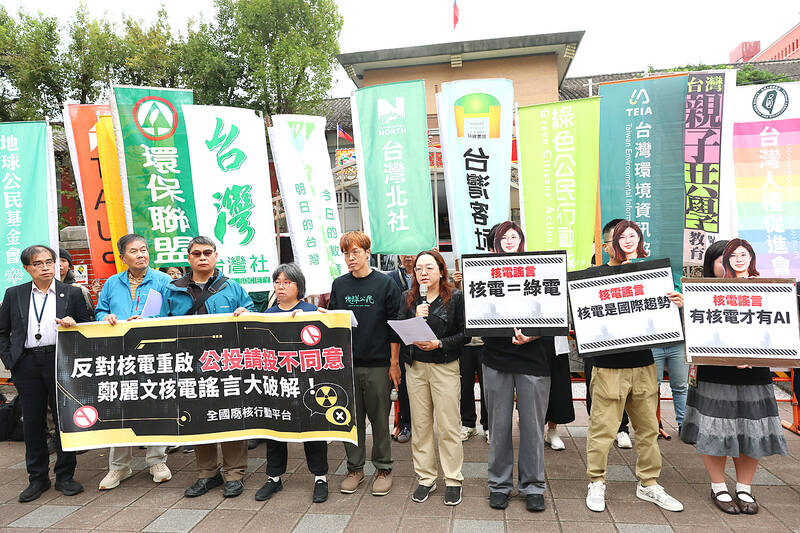
Members of groups that oppose a referendum calling for the abolishment of the government’s “nuclear-free homeland” energy policy hold a news conference in front of the Legislative Yuan in Taipei yesterday.
Photo: CNA
Last year’s vote on restarting the Ma-anshan Nuclear Power Plant cost NT$1 billion (US$30.43 million), and this year’s is expected to cost NT$800 million, she said, adding that the repeat referendums are delaying a real discussion on energy policy.
Citizen of the Earth, Taiwan spokesman Teng Yu-yu (鄧宇佑) called the latest referendum a “political stunt” by KMT Chairwoman Cheng Li-wun (鄭麗文), urging her to attend the referendum presentation to defend her position in person.
Tsai Ya-ying (蔡雅瀅), an attorney for the Wild at Heart Legal Defense Association, urged people who oppose nuclear power to vote on the referendum question, as the proposal needs “yes” votes equal to at least one-quarter of eligible voters and more “yes” than “no” votes.
Because the referendum is being held alongside the elections, supporters might be more likely to reach the required number of “yes” votes, so abstaining could reduce the number of “no” votes and help the proposal pass, she said.
Taiwan Environmental Protection Union president Hsieh Chih-cheng (謝志誠) called the referendum unnecessary, lacking legitimacy and “full of lies.”
Taiwan has been nuclear-free for more than 520 days, with tight power supplies reported on 31 of those days, he said.
Economic growth has not suffered as a result, he added, rejecting claims that nuclear power is needed to boost the economy.
Northern Taiwan Society president Chiang Ming-hsiung (江銘雄) said the KMT should not reduce complex energy choices to “nuclear power means development.”
Nuclear power can be discussed as an option, but safety risks, aging reactors, waste disposal, decommissioning costs, and Taiwan’s geography and seismic conditions must be examined, he said.
Ting Chun-ho (丁俊和), an attorney with the Environmental Jurists Association (環境法律人協會), dismissed as baseless claims that the nation’s artificial intelligence industry requires nuclear power.
More than 21,000 spent nuclear fuel assemblies remain stored at nuclear power plants, he said.
The Act on Sites for Establishment of Low Level Radioactive Waste Final Disposal Facility (低放射性廢棄物最終處置設施場址設置條例), enacted in 2006, has yet to result in the selection of a site, Ting added.
The association has drafted a 12-chapter, 106-article bill on the siting and disposal of high-level radioactive waste, he said, urging all parties to submit their own versions.
The platform urged KMT and TPP representatives to address nuclear safety, waste storage and costs at five televised presentations beginning today, and called on Cheng to appear.
KioskNews shows a cleaned-up reading view extracted from the publisher’s page — the original always lives on their site, not ours.