Germany’s far-right AfD triumphs, aims fire at chancellor
‘SCARED’: The victory of the AfD, labeled a ‘right-wing extremist’ in Saxony-Anhalt, has raised concern among other parties, migrants and minorities
German Chancellor Friedrich Merz’s conservatives yesterday licked their wounds after a crushing state election defeat in the ex-communist east, as the triumphant far-right Alternative for Germany (AfD) launched a withering attack against him.
AfD national coleader Alice Weidel — basking in the almost 44 percent landslide in Saxony-Anhalt — charged that “no chancellor before has been as unpopular as Friedrich Merz, who has become a major burden on Germany’s prosperous development.”
Merz was huddling with his Christian Democrats (CDU), including defeated state premier Sven Schulze, whose party scored 17 percent, an outcome widely blamed on voter anger against the ruling coalition at a time of economic stagnation.
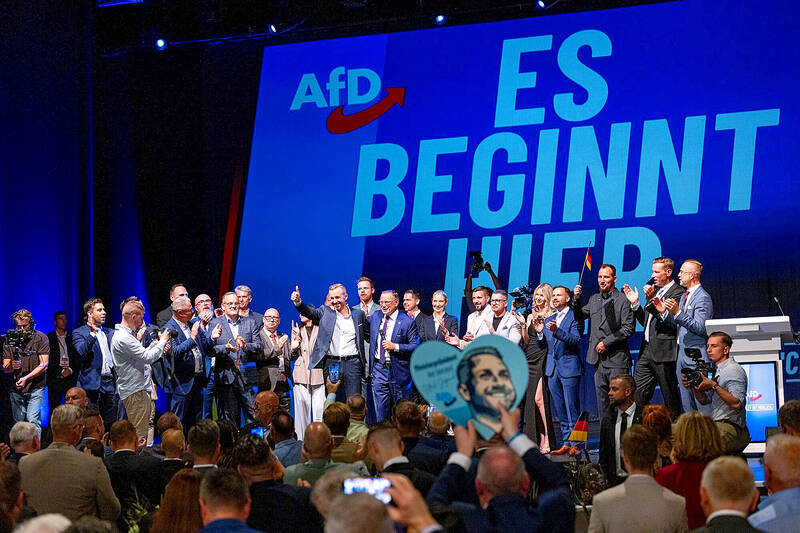
Alternative for Germany (AfD) party leaders and members celebrate following the announcement of results of the Saxony-Anhalt regional elections in Magdeburg, Germany, on Sunday.
Photo: Bloomberg
The AfD’s lead candidate in the state, 35-year-old Ulrich Siegmund, said that voters had sent “a signal to Berlin” and took pleasure in mocking 70-year-old Merz, calling him “a very good campaigner” for the AfD.
He said that although his party had narrowly missed out on an absolute majority, it was now reaching out to other parties and individual lawmakers in an effort to build a stable ruling coalition.
“It is a very clear government mandate,” Siegmund said.
While the result sparked jubilation among the AfD’s followers, the prospect of the first far-right government taking charge of a German state since World War II has deeply unsettled other parties, migrants and minority groups.
The AfD in Saxony-Anhalt is labeled a “right-wing extremist” group by Germany’s domestic intelligence agency, and some of Siegmund’s staff are former members of a since-banned neo-Nazi organization.
“I’m scared,” said a 28-year-old man who came from Afghanistan in 2015 and who asked not to be named.
“I have two children here,” he said in Magdeburg, Saxony-Anhalt. “What will happen if I have to leave?”
AfD national coleader Tino Chrupalla sought to dispel such fears, saying that “no one needs to be afraid of us.”
He told Deutschlandfunk radio that his party is not against people with a migrant background, “provided they are integrated, speak German ... and contribute to the economy here.”
Weidel struck a more combative tone, attacking the Merz government and predicting that her party would take power in 2029 national elections.
“The people in this country do not want things to continue as they are,” she said, demanding an end to “illegal migration, open borders, skyrocketing rates of crime committed by foreign nationals, and a refusal to carry out deportations.”
Weidel also slammed Germany’s “disastrous energy policy” and “rampant deindustrialization that is breaking Germany’s backbone.”
Pressure has grown on Merz not just from the far-right, but also from within his coalition, which has struggled to reboot a stagnant economy and has argued over social policy, especially pensions.
The visibly dejected CDU state Premier Schulze on Sunday said that his campaign was not always helped by national government policies, saying that “we often faced headwinds, and that wasn’t always easy.”
Daniel Guenther, the CDU premier of Schleswig-Holstein state, labeled the AfD win “a shocking moment for our country.”
“For the first time since the end of World War II, the AfD — a party whose state branch is classified as right-wing extremist — is close to securing an absolute majority,” he said.
The AfD, founded in 2013 as a euroskeptic protest party, soon transformed into an Islamophobic and anti-immigration party, railing against the open-door policy of former CDU chancellor Angela Merkel.
Merz has vowed to return the CDU to its conservative roots and launched a crackdown on irregular immigration while trying to turn the economy around.
Political scientist Oliver Lembcke of Ruhr University Bochum said: “We are witnessing a tectonic shift in the party system.”
Merz took office with the promise of pushing back the AfD, yet the party has grown stronger, despite the CDU’s shift to a more conservative course.
“This confronts Merz with a question of renewed urgency: What strategy can the CDU use to reverse this trend?” Lembcke said.
KioskNews shows a cleaned-up reading view extracted from the publisher’s page — the original always lives on their site, not ours.