NTU-built electric aircraft completes first phase of flight tests in Germany
SINGAPORE – For the first time, an electric aircraft designed, engineered and built in Singapore has completed its first phase of flight tests in Cochstedt, Germany.
The electric vertical take-off and landing (eVTOL) aircraft prototypes were built by a team of over 20 students and alumni, as well as Professor James Wong from Nanyang Technological University (NTU).
The 8m-wingspan variant and a 3m version are research technology demonstrators and are not currently designed to carry passengers, the university said in a statement on Aug 25.
During the tests spanning 2½ weeks in July, the smaller 3m prototype gained two hours’ worth of flight mileage, while the 8m prototype flew for a combined duration of 42 minutes across 19 flights.
The larger variant reached an altitude of 92m, while the smaller one reached 60m and a speed of around 120kmh.
These tests were conducted in a flight area measuring 1.2km by 2.4km at the German Aerospace Centre, bigger than any free open space available for flight testing in Singapore.
At the end of the testing period, the 8m prototype encountered a hard landing and could not be repaired in time for the team to evaluate its forward propulsion.
It is now being shipped back to Singapore and will arrive here in October.
While the team has not secured regulatory certifications from the Civil Aviation Authority of Singapore to operate its aircraft here, they have done some tests at Kranji racecourse under tethered conditions, with a rope securing the aircraft to the ground.
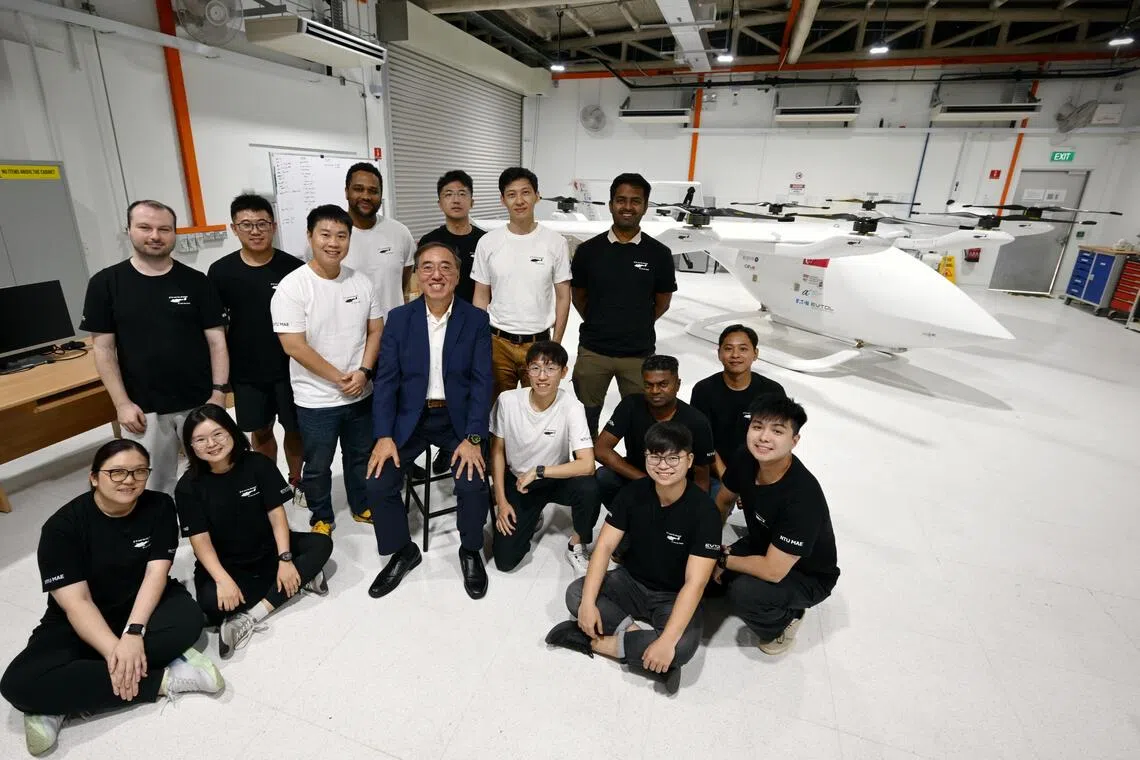
Professor James Wang and his team with a prototype of the 8m eVOTL aircraft.
ST PHOTO: NG SOR LUAN
The team will continue running tests to improve the aircraft’s autonomous flight capabilities and ranges, said Wang, director of the university’s evTOL aircraft research and innovation centre.
Speaking to the media on Aug 25, Wang said the team is also looking into using hydrogen to power these aircraft and enhance their battery capacity.
The goal is to create an aircraft that can be scaled to different sizes, including a variant with a 14m wingspan that can ferry five people and a 3m version for carrying cargo, he added.
Calling the flight tests successful, Wang said the team has already developed the means and know-how to engineer, manufacture and build an eVTOL in Singapore.
To start commercial operations in Singapore, Wang said the team would need to secure $975 million from investors, recruit the right talent and gain enough support from the Government.
It has received $25 million in funding from the Government so far.
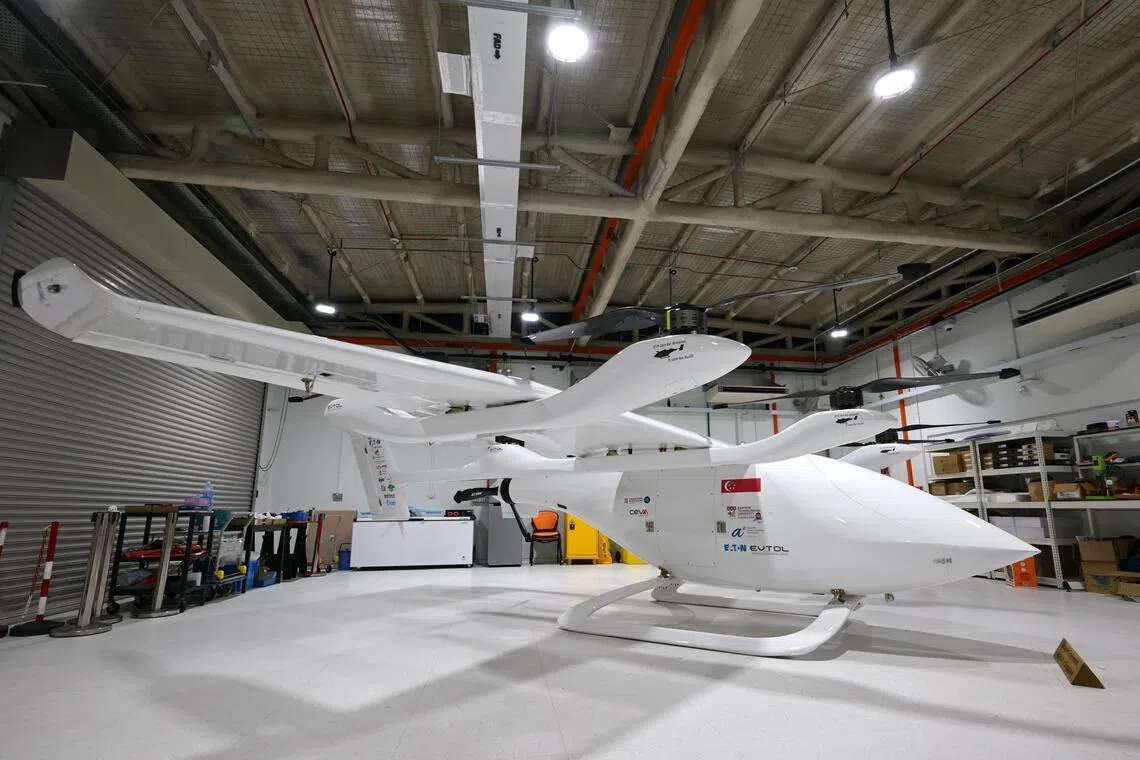
A prototype of the 8m eVOTL aircraft.
ST PHOTO: NG SOR LUAN
Prof Wang previously worked at aviation firms Sikorsky Aircraft and AgustaWestland. During his stint at AgustaWestland, he designed and invented the world’s first experimental eVTOL.
He said eVTOL aircraft will take eight to 10 years to enter commercial operation in Singapore, like commercial jets, which would be by 2035.
The aircraft built by NTU was first unveiled to the public at the Singapore Airshow 2026 in February.
Esther Loi is a journalist at The Straits Times, where she covers transport issues.
KioskNews shows a cleaned-up reading view extracted from the publisher’s page — the original always lives on their site, not ours.