The 10 Most Important Albums of All Time, Ranked

Jeremy has more than 2900 published articles on Collider to his name, and has been writing for the site since February 2022. He's an omnivore when it comes to his movie-watching diet, so will gladly watch and write about almost anything, from old Godzilla films to gangster flicks to samurai movies to classic musicals to the French New Wave to the MCU... well, maybe not the Disney+ shows.
His favorite directors include Martin Scorsese, Sergio Leone, Akira Kurosawa, Quentin Tarantino, Werner Herzog, John Woo, Bob Fosse, Fritz Lang, Guillermo del Toro, and Yoji Yamada. He's also very proud of the fact that he's seen every single Nicolas Cage movie released before 2022, even though doing so often felt like a tremendous waste of time. He's plagued by the question of whether or not The Room is genuinely terrible or some kind of accidental masterpiece, and has been for more than 12 years (and a similar number of viewings).
When he's not writing lists - and the occasional feature article - for Collider, he also likes to upload film reviews to his Letterboxd profile (username: Jeremy Urquhart) and Instagram account.
He has achieved his 2025 goal of reading all 13,467 novels written by Stephen King, and plans to spend the next year or two getting through the author's 82,756 short stories and 105,433 novellas.
Maybe the album, as a way of buying and consuming music, peaked in popularity and influence around the 1960s and 1970s, but artists do still release albums, and music does continue to be enhanced when it’s part of a coherent album, with certain tracks bouncing off others and all. So, for now, albums seem to be sticking around.
If not for some of the groundbreaking albums mentioned below, though, the album, as a means of expression, might not continue to hold the same sway it does today, well into the 21st century. All these albums are among the most important and influential of all time, with all of them being at least a few decades old. Also, there has been an attempt to celebrate/highlight a few different genres here (not all of them, but some variety was seen as a probably good thing here).
10 'Pet Sounds' (1966)
The Beach Boys
To kick things off with something incredible, and an album that’s now six decades old(!), here’s Pet Sounds. It’s an album by The Beach Boys, but is one where Brian Wilson was at the forefront of things, to a greater extent than most other Beach Boys albums he was involved with, outside maybe Smile, which was infamous, at least for a time, for being almost more of a Brian Wilson album than a Beach Boy album.
Rambling aside, Pet Sounds is so effortlessly beautiful, as an album, however you want to classify it. It all defies genre a bit, and it changed the game in terms of what emotions (and just how many emotions) could be mined from something that was sort of pop (again, hard to define it cleanly). Pet Sounds does so much within its 36 minutes, and contains some of the absolute best songs The Beach Boys ever recorded, with all of them all adding up to one remarkable whole, too.
9 'It Takes a Nation of Millions to Hold Us Back' (1988)
Public Enemy
It feels right to go over a few genres with this whole ranking, including hip-hop. If you look into the early classics, you'll find some albums from the early 1990s that are masterpieces, like Illmatic and Enter the Wu-Tang (36 Chambers), and then two undeniably important ones that came out in the final year of the 1980s: Paul's Boutique by The Beastie Boys and Straight Outta Compton by N.W.A.
All honorable mentions. Very honorable. But It Takes a Nation of Millions to Hold Us Back, by Public Enemy, came out a year earlier than those last two albums, and it was one of the first classics of a period that’s seen as the Golden age of hip-hop (the second half of the 1980s until the mid-to-late 1990s). And It Takes a Nation of Millions to Hold Us Back does still hold up on its own, without taking its place within the whole hip-hop genre into account, but once you do consider that place within said genre, it understandably becomes even more admirable.
8 'Kind of Blue' (1959)
Miles Davis
Jazz, do you like it? If you don’t, or you’ve never given a full album a shot, then Kind of Blue is a kind of excellent place to start. Whether it really is the best jazz album of all time, or even the best Miles Davis album… look, it’s a contender, either way. Maybe not. But it does keep on coming back to importance, and the critical acclaim helps for sure, yet it’s the significance and influence you also can’t really ignore.
This is more or less the jazz album to which all others are compared. Also, if you want to look at albums broadly, as a means of creative expression, Kind of Blue was an early undeniable classic in the overall history of the album. Even if not explicitly a concept album, there is a definite mood and feel evoked and maintained here throughout the entirety of Kind of Blue, so it’s not hard to see how other artists (those who dabbled in jazz or otherwise) might've taken inspiration from it.
7 'Blue' (1971)
Joni Mitchell
As you might expect from the title, Blue (by Joni Mitchell, not to be mixed up with that just-mentioned kind of blue album) is not exactly the happiest of albums. It’s got a mellow feel, considering it’s an album that’s filled with songs about love, so sure, that would make it a break-up album, if you want to label it such. It might well be one of the definitive break-up albums (Rumours by Fleetwood Mac is a contender, though), and it did a lot for the singer-songwriter genre.
Is that a genre? No, it’s probably more a label. Okay. Joni Mitchell is a singer-songwriter, one of the best of all time, in fact, and Blue was both a fairly early effort from her and also her single strongest album overall. The music here is largely simple and beautiful, and then all the lyrics are effortlessly moving. It’s a perfectly written and assembled album, and marked a new gold standard for singer-songwriters; what such artists, like Mitchell, could indeed be capable of.
6 'Blonde on Blonde' (1966)
Bob Dylan
Bob Dylan got a bit more playful with Blonde on Blonde, compared to some of his previous albums, which had been a bit more socially conscious, and before a certain point, a bit heavier on the folk than the rock in “folk rock.” With Blonde on Blonde, there’s a nice balance between bigger/weightier ideas and more personal thoughts, and also a balance struck between the sides of Dylan he’d shown up until that point, musically and in terms of genre.
It’s like a best-of album in that regard, but not because it compiles his best songs… they're all new songs, or were in 1966, but they just so happen to be among the best Bob Dylan had written and recorded up until that point. Also, Blonde on Blonde did quite a bit to further the idea of the double album as a concept, since there was nearly 75 minutes of music here and all of it was essentially excellent; real bar-raising kind of moment, even if Blonde on Blonde didn’t technically invent the idea of the double album (before Blonde on Blonde, some compilation albums were doubles).
5 'Hounds of Love' (1985)
Kate Bush
Yes, yes, “Running Up That Hill (A Deal With God)” is an overwhelmingly popular song now, even more so than it was back in the 1980s, but it is – and always has been – an incredible song. Great pop music should be popular and all. What’s nice to find, when listening to the rest of Hounds of Love, is how great all the songs that aren’t “Running Up That Hill (A Deal With God)” just so happen to be.
This album represents Kate Bush at her best, not to mention simultaneously her most ambitious and approachable all at once, which sounds contradictory, but that is Hounds of Love; that is what it manages to do. Hounds of Love houses some of the best music of all time, of any era, and it’s also amazing how different the two sides of the album are, all the while complementing each other perfectly. That’s a big part of making it such a great artistic achievement, and then more broadly, it also pushed forward just what a solo artist could do writing, performing, and producing all their own songs (she did a bit of everything when assembling Hounds of Love, not performing literally every single instrument, but still taking on a fair few).
4 'Thriller' (1982)
Michael Jackson
It’s fitting that Thriller has a name that makes you think of movies, since this album ultimately was a real blockbuster in a way that plenty of genuinely successful blockbusters would likely still be envious of. It’s everywhere. Thriller is inescapable. If you’ve somehow never owned it, or specifically looked for it on streaming or something, you’ve still likely heard most of its songs in one context or another.
Every song here is great and single-worthy, except for perhaps “The Girl Is Mine,” but that was still a single anyway. That song’s hard to like, but everything else here is about as perfect as pop gets, and Thriller does indeed stand as Michael Jackson’s greatest achievement, critically on top of commercially. There was a redefining of what a broad and approachable album could achieve here, and that’s why it’s still worth praising Thriller, even if millions upon millions of celebratory things have been said about it already, in the 40+ years since it first came out.
3 'Sgt. Pepper's Lonely Hearts Club Band' (1967)
The Beatles
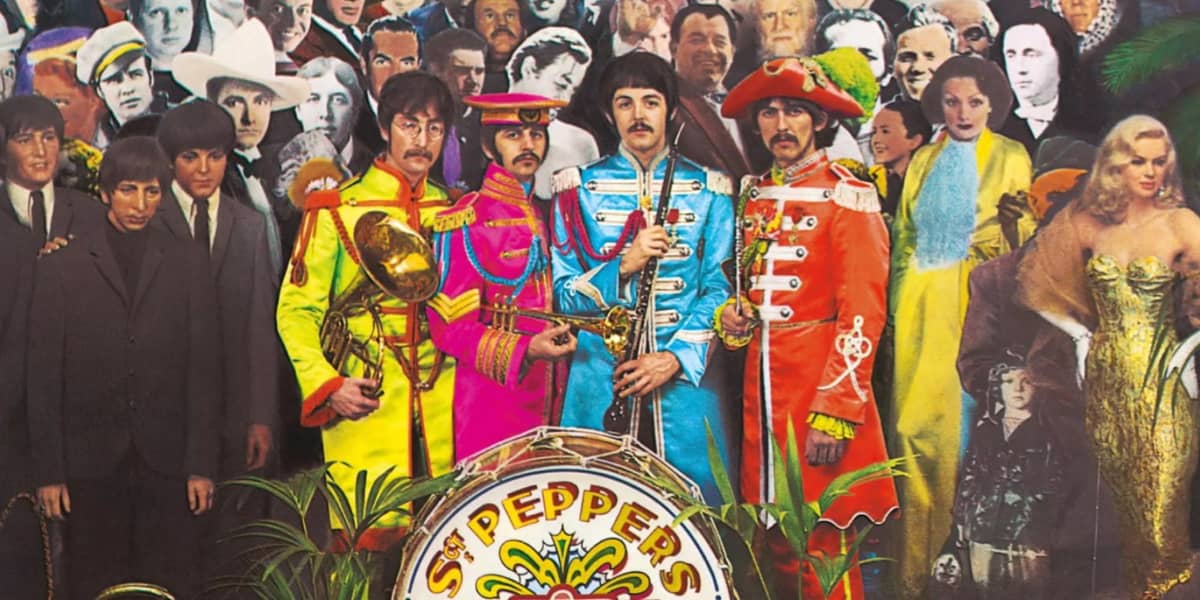
The boring pick for the title of “most culturally important Beatles album,” here’s Sgt. Pepper’s Lonely Hearts Club Band, and it being here isn't necessarily a suggestion that it’s the best of the Fab Four’s. Well, it’s at least up there, but a good deal of the acclaim and overwhelming hype around Sgt. Pepper’s Lonely Hearts Club Band has to do with it being so out-there and forward-thinking with its production and what it did as a concept album.
There’s also that cover. Honestly, it plays a role in the overall significance of this one. Even with it kind of ditching its concept early on, Sgt. Pepper’s Lonely Hearts Club Band still feels incredibly coherent, with The Beatles really doubling down on what worked in the already consistent albums they'd previously put out, like Rubber Soul and Revolver. Some will say it’s all a bit overrated anyway, but for its time, this was genuinely strange and groundbreaking rock music, and a quintessential/important release from perhaps the most quintessential rock band of the 1960s.
2 'The Dark Side of the Moon' (1973)
Pink Floyd
With influential Pink Floyd albums, you can probably pick The Dark Side of the Moon or The Wall as equally worthy contenders. Well, or pick the much weirder The Piper at the Gates of Dawn if you want to be a bit of a contrarian, because that was even more radical, but it was a little too esoteric, to the extent that you can’t really see it paving the way for as many artists as some of those later groundbreaking Pink Floyd albums.
The Dark Side of the Moon is an album that feels all-encompassing, touching upon an overwhelming number of things to paint a portrait of how life is overwhelming, stressful, and despair-filled.
Anyway, The Dark Side of the Moon is an album that feels all-encompassing, touching upon an overwhelming number of things to paint a portrait of how life is overwhelming, stressful, and despair-filled. Nothing here feels good lyrically, in other words, unless you get swept up in how beautiful the whole thing sounds, which is worth something. It’s almost as quintessential as concept albums get, doing a whole lot without even needing to be a double album (though The Wall did use that extra space to tell what was technically a more intricate story).
1 'The Velvet Underground & Nico' (1967)
The Velvet Underground and Nico
For a little while, maybe The Velvet Underground were the kind of band few people had heard of, but nowadays… well, not so much, to say the least. It was a crowded year for rock music, so The Velvet Underground & Nico being more of a cult album, perhaps overshadowed to some extent at the time, isn't outrageous.
Honorable mentions should also go out to the previously mentioned Sgt. Pepper’s Lonely Hearts Club Band, and then also the self-titled album by The Doors, yet it’s The Velvet Underground & Nico that felt more influential and important if you're looking more than years (so, decades, essentially) beyond its release. Too many alternative and/or indie acts to count have some Velvet Underground in their DNA. Search your feelings, you know it to be true.
KioskNews shows a cleaned-up reading view extracted from the publisher’s page — the original always lives on their site, not ours.