Anthropic, Salesforce CEOs say companies need help using AI, while Nvidia’s Huang says no new laws needed
Anthropic PBC chief executive officer Dario Amodei and Salesforce Inc CEO Marc Benioff said companies have just begun taking advantage of artificial intelligence (AI) tools and need more help to gain the greatest benefits for their businesses.
The power of AI is barely diffused through the economy, with only 5 percent to 10 percent of the current value of the technology being used, Amodei said on Tuesday during an appearance with Benioff at Salesforce’s annual Dreamforce conference in San Francisco.
Implementation of AI at large businesses — like the kind Salesforce mostly serves — remains far away from the futuristic vision professed by executives like Amodei.
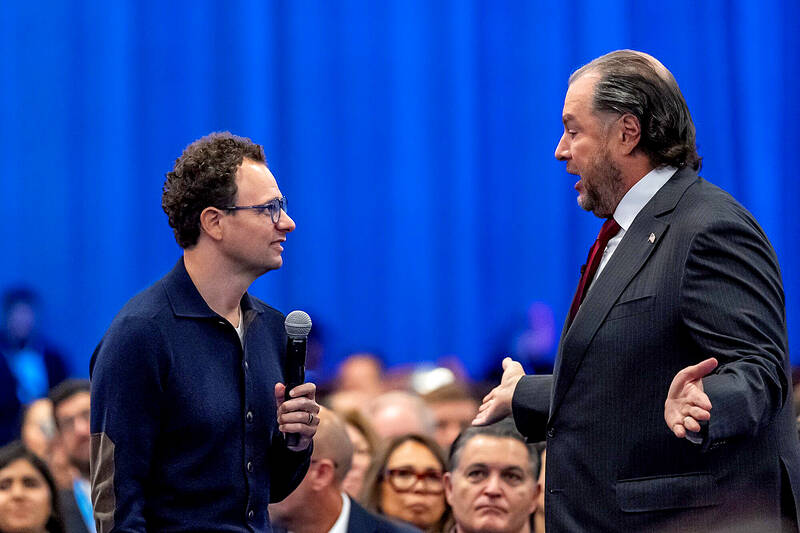
Anthropic PBC chief executive officer Dario Amodei, left, speaks with Salesforce Inc CEO Marc Benioff at the Dreamforce conference in San Francisco, California, on Tuesday.
Photo: David Paul Morris, Bloomberg
Amodei’s comments about AI’s benefits came just a few days after he authored an essay raising the potential risks of the technology and suggesting the pace of development needed to be slowed. Those comments, which were endorsed by executives of rival AI companies such as OpenAI CEO Sam Altman and SpaceXAI CEO Elon Musk have led to discussions by policymakers and within the industry about ways to prevent AI from slipping beyond human control.
Jensen Huang (黃仁勳), CEO of leading AI chipmaker Nvidia Corp, told the Dreamforce audience that “market forces” will regulate the safety of AI.
“We don’t need new laws — we don’t need new regulations,” Huang said. The CEO added that there’s a “false choice” about AI development being either safe or fast, reiterating a point he’s made previously.
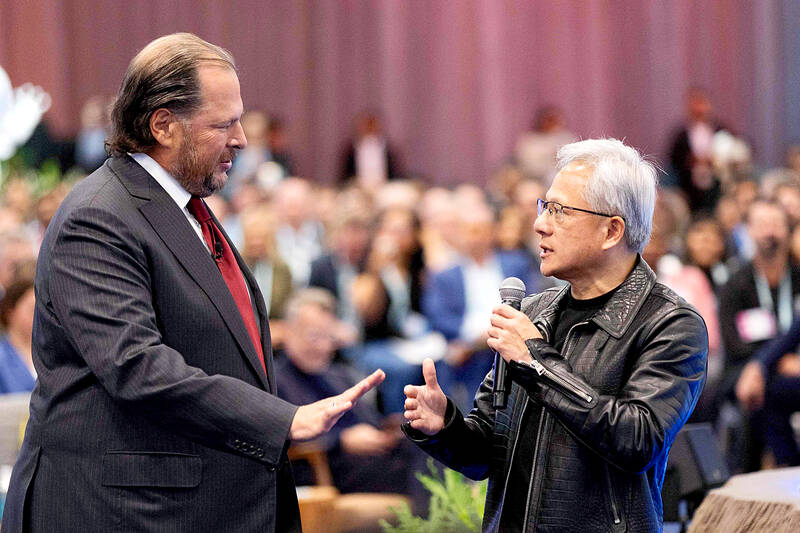
Salesforce Inc chief executive officer Marc Benioff, left, interacts with Nvidia Corp CEO Jensen Huang at the Dreamforce conference in San Francisco, California, on Tuesday.
Photo: Benjamin Fanjoy, Getty Images via AFP
“You can definitely have both at the same time,” he said during a conversation with Benioff. “You pace yourself until you’re confident you’re releasing something that the market would appreciate. The market forces are already there.”
Huang said that companies can decide not to release things that are harmful.
“Safety is paramount,” he said. “In a lot of ways, it’s job one. However, safety is an engineering problem.”
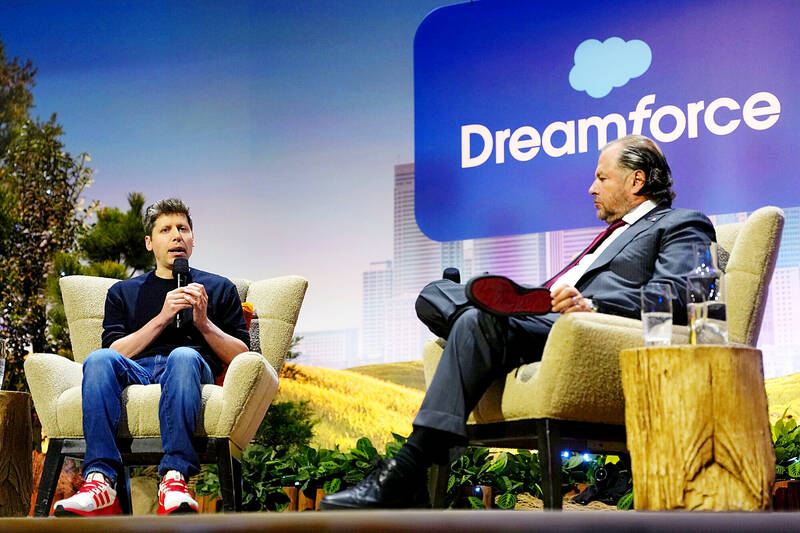
OpenAI chief executive officer Sam Altman, left, speaks with Salesforce Inc CEO Marc Benioff at the Dreamforce conference in San Francisco, California, on Tuesday.
Photo: David Paul Morris, Bloomberg
If we reach a point when “the company is out of control and the product’s not going to be safe, take a pause and make sure you get it right,” he said.
OpenAI’s Altman, during a conversation later on Tuesday with Benioff at the conference, also said AI companies can be relied upon to oversee the safe development of the technology.
“I am very confident in our company’s ability — our industry’s ability — to do this safely,” Altman said.
While OpenAI is working with Anthropic and Google’s DeepMind lab to address safety issues, Altman said AI companies should be able to safely improve AI models on their own.
“I’m disappointed by how it’s been framed,” he said.
Meanwhile, Meta Platforms Inc CEO Mark Zuckerberg said AI labs should rely on independent evaluators and advisers to ensure that models are safe.
“Engaging independent evaluators and advisors is industry best practice,” Zuckerberg wrote on Tuesday in a post on X.
Some company officials have voiced support for decelerating the pace of AI development and advocated working together to achieve consensus. Meta decided on its own to slow work on the Muse AI tool, rather than ask peers to also check their own progress first, Zuckerberg wrote.
“Meta delayed shipping Muse for several months to focus on safety and security,” he wrote. “We didn’t call for everyone else to do this before we would. We just did it as part of our day-to-day work because it was clearly the right thing for people and for us.”
KioskNews shows a cleaned-up reading view extracted from the publisher’s page — the original always lives on their site, not ours.