Korea’s potential growth rate set to rise back-to-back this year and next: IMF
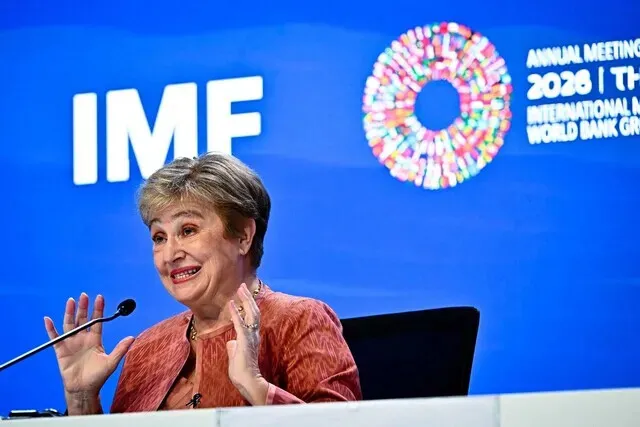
IMF Managing Director Kristalina Georgieva speaks at the fund’s annual meeting in Bangkok, Thailand, on Oct. 17, 2026. (AFP/Yonhap)
South Korea’s potential growth rate is expected to rise for a second consecutive year in 2027, following an increase in 2026, according to an International Monetary Fund estimate.
If the forecast holds, it will mark the first back-to-back annual gains in 40 years since the “three lows” boom of 1986-1987, when low interest rates, low oil prices and a weak won fueled rapid economic growth.
This suggests the semiconductor boom is doing more than providing a short-term economic boost; it is also strengthening the economy’s underlying fundamentals.
At the same time, the high reliance on growth in the area of artificial intelligence suggests certain challenges remain, including the expansion of investment and hiring into industries outside of semiconductors, along with efforts to relieve polarization through improved household incomes.
According to the IMF’s October World Economic Outlook Report published on Sunday, Korea’s potential growth rate was projected to rise from 1.94% in 2025 to 2.14% this year and 2.20% next year. This means it is expected to follow up its improvement of 0.20 percentage points this year with an additional rise of 0.06 percentage points in 2027.
The figures were based on the IMF’s previous projections for the real gross domestic product (GDP) growth rate and the GDP gap ratio, which represents the difference between real and potential GDP.
The potential growth rate indicates the growth rate that is attainable through the use of all factors of production — including labor and capital — barring factors sparking inflation. It has been referred to as an indicator of a national economy’s basic intermediate- to long-term strength.
It is seen as unusual for the number to rebound at a time when workforce inputs and total factor productivity are declining amid an ongoing population aging trend. Korea’s potential growth rate had been dropping steadily since reaching its 2010 level of 4.05%, with levels in the 2%-3% range since 2018 and the 1%-2% range since 2020.
Analysts suggested the IMF’s projection of two consecutive years of rising potential growth rates reflected increased plant and equipment investment in semiconductors and other areas, along with improved productivity due to increased AI use.
Among the 27 countries that allowed for similar calculations, Korea’s ranking improved from 12th last year to 7th this year and next year. The only Group of Seven country with a higher potential growth rate than Korea’s was the US, with the UK, France, Japan and Germany all remaining in the 0%-2% range.
The National Assembly Budget Office similarly predicted last month that Korea’s potential growth rate would increase from 2.14% in 2025 to 2.22% this year and 2.28% next year.
But a potential destabilizing factor is the fact that these optimistic predictions are almost entirely reliant on the growth of AI and the semiconductor boom that it has powered.
In particular, hiring has recently shown no signs of registering a turnaround. For the months of January to September this year, the number of people employed was up by 116,000 from a year earlier — the lowest rate of increase in the six years since employment experienced negative growth in 2020 amid the effects of the COVID-19 pandemic.
Wholesale and retail sales, hospitality and construction — an area closely associated with domestic demand — all showed declines of over 30,000 positions when compared with the same period last year. Employment of younger people has continued to decrease for 47 straight months, as factors such as the accelerating use of AI have transformed how companies hire and how employees do their jobs.
A situation where per capita value-added increases due to technological advancements and equipment investments by the semiconductor industries and other areas can result in the potential growth rate increasing without a major rise in labor inputs — a situation that increases the risks of side effects such as polarization.
“The potential economic growth rate could drop again if the semiconductor boom ends, and even if the immediate growth indicators are good, the poor employment situation means that most of the public is struggling,” said Joo Won, the director of economic research at the Hyundai Research Institute.
“If we fail to find post-semiconductor growth drivers, we won’t be able to sustain the current indicators,” he predicted.
The Ministry of Finance and Economy said it was planning a “full-scale response marshalling the capabilities of every ministry to ensure that the fruits of growth are spread around through jobs.”
KioskNews shows a cleaned-up reading view extracted from the publisher’s page — the original always lives on their site, not ours.