‘When I cut these women out I feel like I’m freeing them’: the feminist collage artists taking scissors to the patriarchy
When Valerie Solanas sold her SCUM Manifesto in 1967 it was priced at 10 cents for women and $1 for men. Artist Justine Kurland considered doing something similar with her “man books”: sell them off cheap to undermine their cultural weight. But knowing that people would just flip the books for a profit, instead she took a knife to what she calls the “problem of language and history and inheritance” in photography. She went through her own library of canonical male photographers, cut up the books and made collages from the spoils. Kurland called the project SCUMB (Society for Cutting Up Men’s Books), after Solanas’s manifesto.
The same idea underpins What Rose from the Cut, a group show at Graces Mews Gallery in south London. Co-curated by Kurland, the V&A Parasol Foundation curator of women in photography Fiona Rogers, and collector Sarah Miller Meigs, the show brings together more than 40 artists working in collage, photomontage and assemblage, across three generations. All the artists share a simple aim: to make something new out of something already there. The result is no one thing: the show is erotic, sentimental, irreverent and sobering, often all at once. “There is something very specific to the idea of what it is to tear something apart,” Kurland says. “There are so many things that collage immediately does right out the door.”
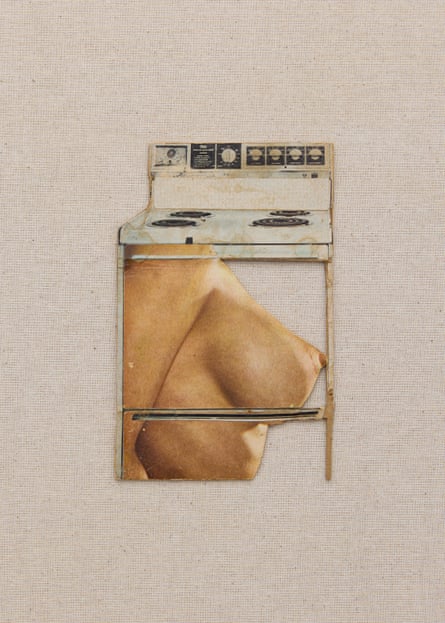
Graces Mews is showing the third version of Kurland’s 99 Nude Collages on the Wall (2026). The work is made up of figures cut from photographer and artist Lee Friedlander’s 1991 book Nudes, collaged into small clusters and pinned to the wall in one big crowd.
For Kurland it’s an act of repair, a kind of vigil. “I have spent more time with those figures than Lee Friedlander ever has. I know every single person’s body by heart. When I’m cutting those women out, I feel like I’m freeing them from Lee Friedlander’s gaze – and probably capturing them in my own lesbian fantasy.” Kurland has cut up hundreds of copies of Nudes, and the work was less punk than she wanted it to be. “I have this teeny little X-Acto [precision knife] and a magnifying glass so I can cut each pubic hair. I’m like a little termite chewing at the foundation of the institution.”
Divine Southgate-Smith’s film I Wore Your Tongue So Loud Against Me (2024), meanwhile, stretches the idea of cut and paste. The artist’s interest in archives started with a childhood devouring films. Split across four frames, I Wore Your Tongue … runs in a “loop in which time is compressed, merging multiple timelines and geographies. The gaze is released from a single point of view.”
The silent montage uses found footage, from wildlife documentaries to films that shaped Southgate-Smith, such as Chris Marker’s Sans Soleil (1983) and Pier Paolo Pasolini’s Notes Towards an African Orestes (1970). The Pasolini was especially important to them: “A record of something unfinished, not quite a film but a film about making a film,” Southgate-Smith says. “There’s a scene where Pasolini, after his return from Africa, shows his footage to a group of African students at the University of Rome, and one by one they gracefully object to the Africa he had imagined.”
Elsewhere, a glass case of political zines, including Spare Rib, Riot Grrrl, Bad Attitude and Shrew, puts the artists alongside activists and grounds the work in protest. Kurland and Rogers reject the split between fine art and everyday image-making, which fits with how they see collage: as something that refuses to rank things as high or low.
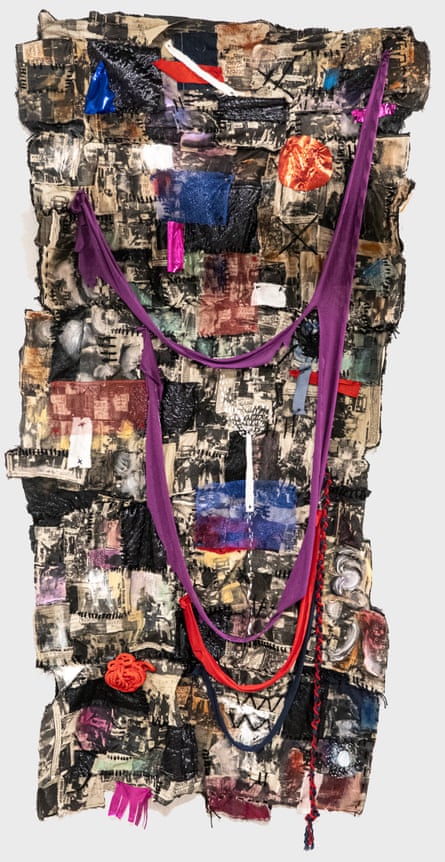
Helina Metaferia’s Tapestry (Arokin) hangs from the ceiling next to Lubaina Himid’s playful 16-part series Chatterbox (2018), in front of a case of rare Martha Rosler collages (1966-72). Metaferia’s work pushes back against the systems that have left women and non-binary people out of history. The tapestry features “silk-screen prints on fabric from 1980s Outwrite Women’s Newspapers and Grassroots Black Community News”, taken from the Black Cultural Archives in London.
“In all of the work, I am co-imagining with these archives, facilitating space for Black and Brown femmes to have agency and be respected,” Metaferia says. She also “activates” her tapestries in public performances, wearing them as regalia inspired by her Ethiopian heritage. It takes the histories they hold beyond the gallery walls.
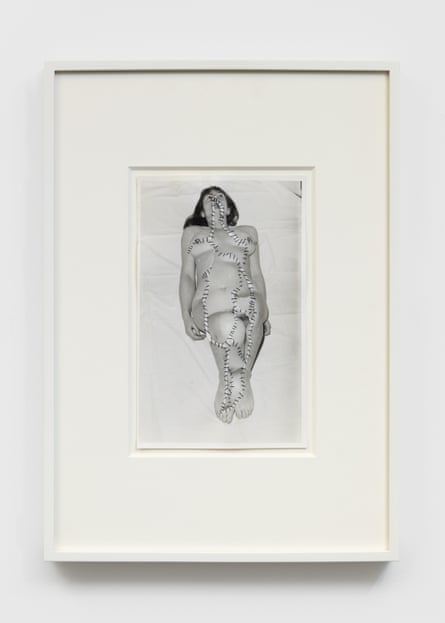
The tactility of the work in the exhibition swings from one extreme to the other. Metaferia’s tapestry hangs next to Tee Corinne’s 1981 book Yantras of Womanlove. In its kaleidoscopic photomontages the cuts are almost invisible. These diagrams of energy (the book’s apt subtitle) look seamless, without beginning or end. It serves as a sharp contrast to Annegret Soltau’s Schwanger [Pregnant] and Auf dem Geburtstisch I [On the birth table I] (both 1978), where the cut is violent and impossible to miss. Even so, the work still feels like repair, in the way it faces up to life in a female body. In this exhibition, no two cuts are the same.
What Rose from the Cut is at Graces Mews Gallery, London, to 30 January.
KioskNews shows a cleaned-up reading view extracted from the publisher’s page — the original always lives on their site, not ours.