Can Doing Good Create Business Value?
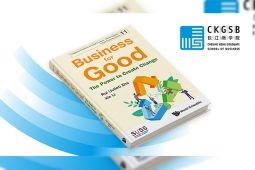
New Book Shows How Companies Can Move ESG Beyond Compliance to Value Creation
Beijing (ANTARA/PRNewswire)- As sustainability reporting moves into a new phase across Greater China, companies face a question that disclosure rules alone cannot answer: can doing good also create business value?
The Book Business for Good: The Power to Create Change addresses this question. Written by Rui (Juliet) Zhu, Professor of Marketing and Director of the Research Department on ESG and Social Innovation at Cheung Kong Graduate School of Business (CKGSB), the book defines Business for Good as integrating social value into an enterprise's core strengths so that social progress can also generate commercial value. Rather than treating responsibility as something done only after profits are made, it argues that solving real social problems can be built into the business itself.
The argument is grounded in a decade of teaching and research at CKGSB and tested against more than 2,300 alumni projects in their companies. Two practical tools translate the research into action. The Business for Good Triangle Theory brings together co-benefit philosophy, institutional safeguards and strategic integration, while the Action Map identifies 35 entry points across environmental, social and governance dimensions for organisations of different sizes to find a practical place to begin.
"Business for Good is not about choosing between profit and purpose, but about integrating social value into what a company already does well, so that solving real problems can also create commercial value. The challenge for companies today is to move beyond compliance and build systems in which doing good becomes part of how the business succeeds," noted Professor Zhu.
For international readers, the book offers a window into Chinese business practice that is globally relevant but still relatively underrepresented in English-language ESG literature. Alongside global companies such as Patagonia and LEGO, it examines Chinese enterprises including Haidilao and the recommerce company ATRENEW, documenting successes, failures and course corrections. Drawing on behavioural psychology, Zhu argues that sustainability programmes often fail when they work against human behaviour; better design can make responsible choices easier to adopt and sustain.
Business for Good: The Power to Create Change is available on Amazon, World Scientific online bookstore, and other online platforms.
The author is available for interview and commentary on ESG and sustainable business strategy.
KioskNews shows a cleaned-up reading view extracted from the publisher’s page — the original always lives on their site, not ours.