NASA plans to launch three massive rockets for the Artemis 3 crewed lunar test mission
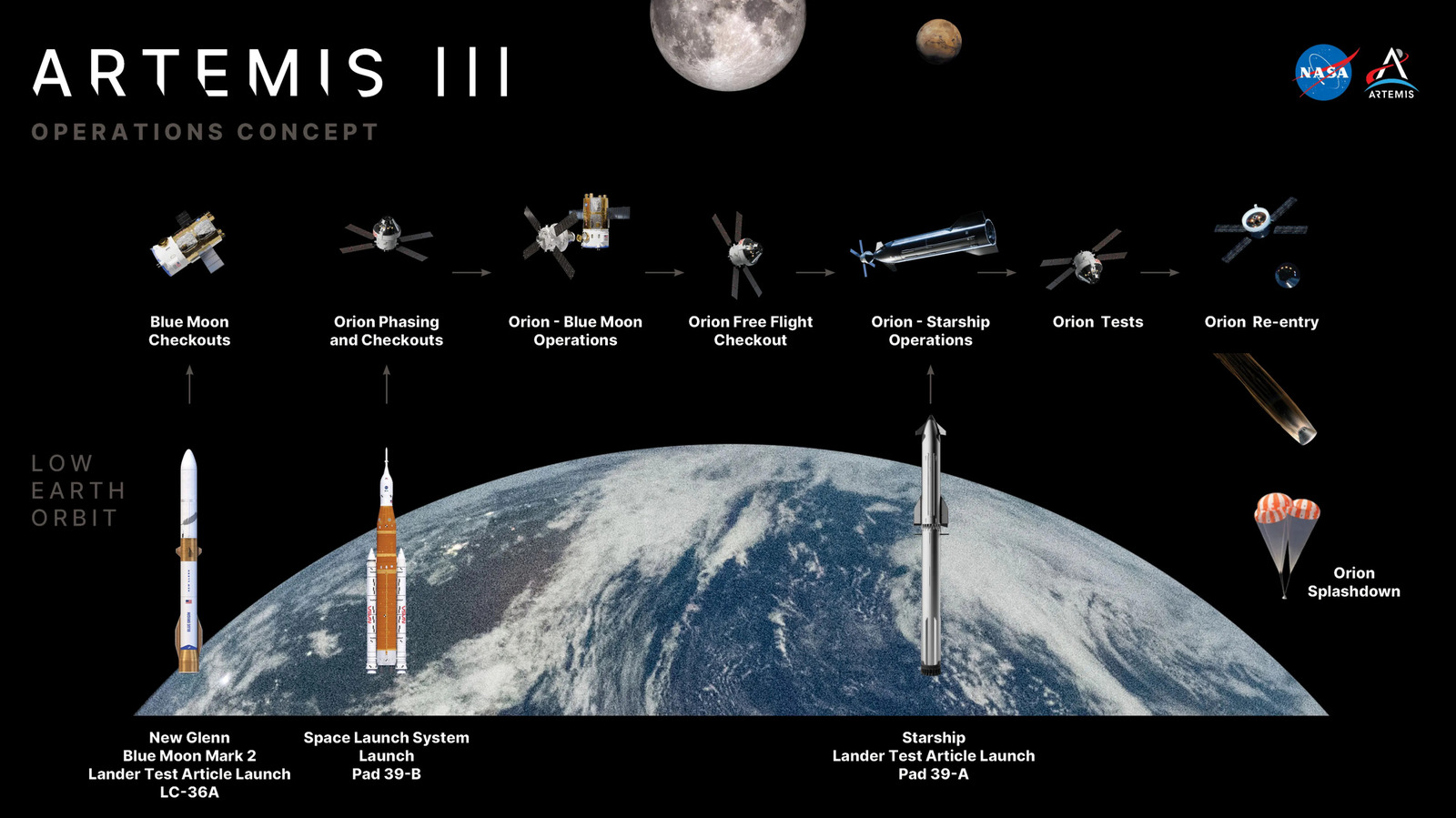
Blue Origin, SpaceX and NASA are launching heavy-lift rockets within a short timeframe for the mission.
NASA
Earlier this year, NASA made some major changes to its Artemis program that would push back the next crewed moon landing to 2028. Artemis 3 was supposed to be the agency's first crewed moon landing since the Apollo 17 in 1972, but under the overhauled program, it will now involve testing at least one moon lander instead. Now, the agency has revealed its detailed plans for Artemis 3, which will launch three spacecraft on three different heavy-lift rockets from Florida within the span of two weeks.
Artemis 3 will officially begin when Blue Origin launches the New Glenn with a test version of its Blue Moon Mark 2 lander into low Earth orbit, about 273 miles above Earth's surface. After that, NASA will launch Space Launch System (SLS) with the Orion crew capsule on top, carrying NASA astronauts Randy Bresnik, Frank Rubio and Andre Douglas, as well as European Space Agency astronaut Luca Parmitano. Orion will settle into an orbit at an altitude of around 345 miles before rendezvousing with Blue Moon Mark 2. The New Glenn launchpad exploded back in May during a hotfire test, but the company is working to make it usable again by the end of this year.
The crew will make sure everything is in order for a couple of days before they open the hatch between the two spacecraft and enter Blue Origin's lander. They will verify its ability to maintain proper atmosphere and pressure and test its software, flight-control systems and life-support functions. The astronauts will then return to Orion, which will undock from Blue Moon Mark 2 so it can position itself for the next rendezvous.
The last part of the mission will see SpaceX launching Starship version 3, which had its first flight back in May. It will fly with a docking system mounted at the vehicle's forward end, so it can also dock with Orion. This rendezvous will be shorter and last just two hours. The crew will not go inside the Ship capsule and will only verify how Orion interacts with it, docks and undocks when they're linked in space. Once the rendezvous is done, the crew will have around five additional days that they can spend in orbit before they head home.
NASA says the separate docking approaches will "demonstrate how Orion interfaces with two very different commercial lander architectures during a single mission." Artemis 3 will also help NASA evaluate the new Orion Crew Survival System suits, custom-made for deep-space missions. It's not quite clear when Artemis 3 will launch, exactly. NASA Watch reported last month that NASA Administrator Jared Isaacman sent an agency-wide memo admitting Artemis 3 is three months behind schedule. In the best-case scenario, the mission will launch in the summer of 2027 so the agency can have two moon landing opportunities for Artemis 4 in 2028.
KioskNews shows a cleaned-up reading view extracted from the publisher’s page — the original always lives on their site, not ours.