The ‘Hacienda Hunters’: Uncovering Mexico’s hidden history
In 2007, Jim and Carol Cook left Oregon and established themselves in Ajijic, on the shores of Lake Chapala, beginning an exploration of Old Mexico.
“We started out looking at colonial ruins,” Jim Cook said, “and quickly discovered that there were 5,000 years of history behind what we were investigating. It was like peeling an onion: whatever you found had many more layers beneath it.”
The ‘Hacienda Hunters’
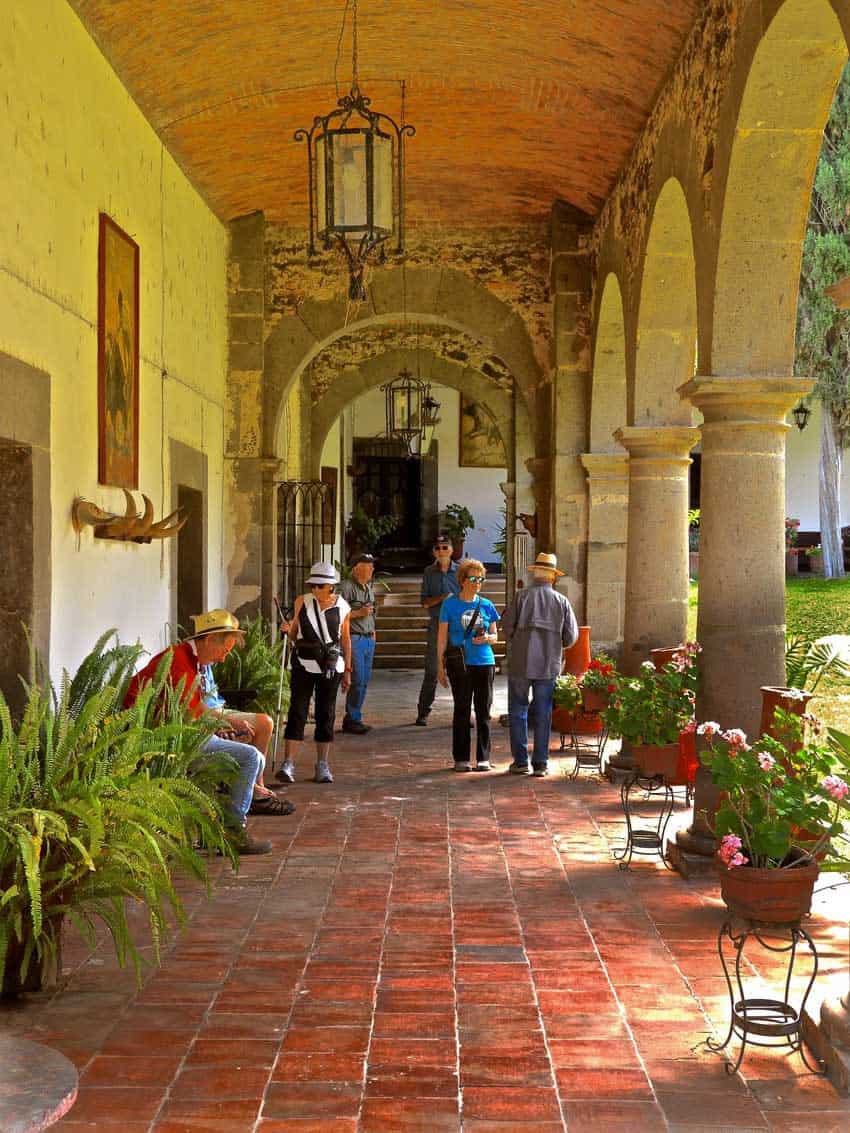
“We quickly discovered there was no end of haciendas all around us,” Cook said. “Every pueblito, it seemed, had originally been associated with a hacienda.”
In some cases, parts of the haciendas had been transformed into municipal buildings or the former chapel had become the local church. In others, the old hacienda was wonderfully preserved as is, Cook said. “Inevitably, the present-day owners would welcome us foreigners with open arms, take us on a tour and quite often insist that we had to come back for another visit.”
Soon the Cooks and their friends came to be known as the “Hacienda Hunters,” and the results of Jim Cook’s historical research began appearing on a blog called Jim and Carol’s Mexico Adventure, set up in the style of a photo journal.

Nearly 4 million visitors
The photos are excellent, soft focus, and sometimes feel more like Matisse paintings than anything else. Because almost every paragraph is accompanied by a photo, readers feel as if they are right there, walking along with the “Hacienda Hunters” every step of the way.
This reporting approach was applied not only to haciendas, but also to archaeological sites and historical ruins — first in Jalisco and then all over Mexico. Nineteen years later, the website has grown huge, with roughly 569 posts and countless photographs, and has been visited by 3,938,679 people.
The fortified hacienda of Santo Tomás
One of the sites that most impressed Cook was the ex-Hacienda de Santo Tomás, near a town with the delightful name of Hostotipaquillo, located among rugged mountains in a remote corner of Jalisco.
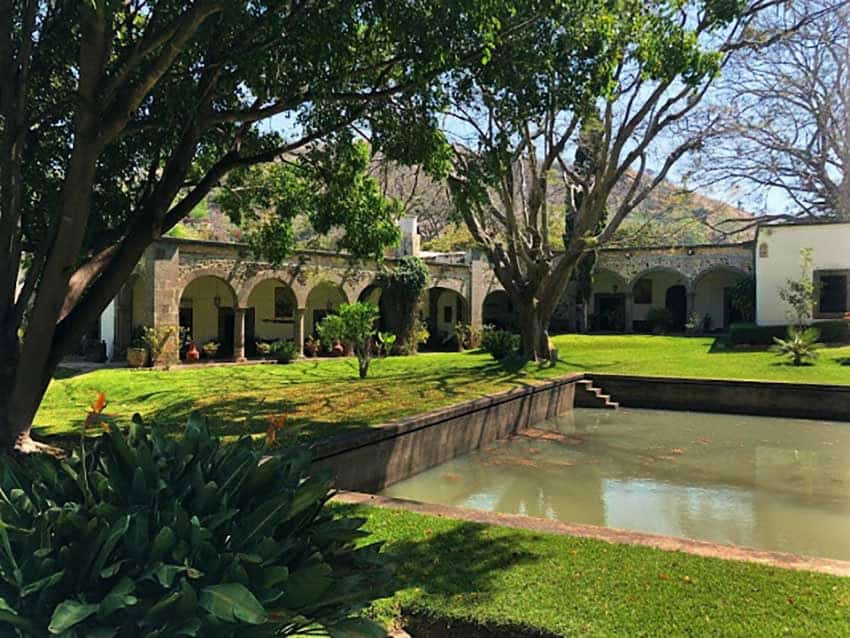
“Santo Tomás is really a jewel,” Cook said. “Because it had been part of the Hostotipaquillo mining district, it was almost like a castle, with a very high wall around it and with bastions that had gun slits. When we got there, we walked into the courtyard and started looking around. The next thing we knew, we ran into one of the owners. Rather than being upset with us, he was delighted that we were interested in his hacienda, and allowed us to completely explore and photograph everything.”
On the blog, Cook describes the courtyard, the administrator’s house and “an aqueduct that ran along above the hacienda, then down a sluice way, and dropped into an area that used to have a huge water wheel.”
If you were to visit the Hacienda de Santo Tomás on your own, you might wander through its big patio thinking nothing of it, but if you read Cook’s comments on the blog, you will see that patio in a totally unexpected light:
Mercury poisoning
“Once the silver ore was delivered by pack mules from the mines, it was crushed into a thick powder by the grinders connected to the water wheel,” Cook wrote. “It was brought to this patio and spread out on the cobblestones to form a large, flat, circular pancake. Using the hooves of horses, the ore was then mixed with mercury, copper sulfate and a salt water brine. After several weeks of mixing, the silver amalgamated with the mercury and could be recovered for the next step.
“The lifespan of the workhorses that were used to mix the mercury into the ore was probably fairly short,” he continued. “The chemical is very toxic to animals as well as humans. The horses trudged around a post centered in the pancake of ore spread out in the patio. This process occurred over a period of weeks, during which the horses’ legs were in direct contact with the mercury. They would have also breathed it in through their lungs. When workhorses were not available, human workers were sometimes used in the same way.”
The most beautiful Maya ruins
When Jim and Carol began exploring the Maya world, they again showed their talent for finding delightful jewels in the middle of nowhere, largely forgotten by bustling crowds of tourists.
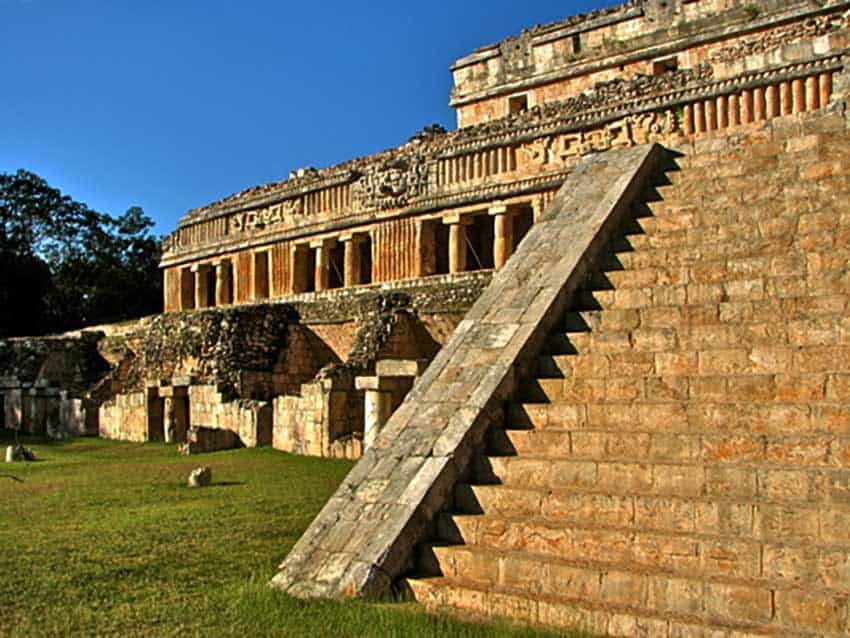
There is, for example, the Puuc Route. “This refers to the Puuc Hills, which are the only elevated part of the Yucatán Peninsula near Mérida,” Cook said. “It’s a daylong tour, but it’s got some absolutely knock-your-socks-off ruins to see.
“Although the Puuc tour visits some of the Maya world’s most beautiful ruins, it apparently attracts few people,” Cook said. “The result is that the better-known sites are overrun by mobs of tourists, with other mobs of local vendors nipping at their heels. By contrast, during most of our Ruta Puuc stops, there were not more than 10 people present, including the caretakers.”
85 hands on the wall
The first stop along the Puuc Route is Loltún Cave, which Cook said was occupied for around 10,000 years. Among the jewels of Loltún Cave are 85 ancient handprints.
Cenote hunters’ love for exploring the Yucatán Peninsula inspires new guidebook
Cook noted on the blog: “The technique is called negative painting. The artist places his hand on the wall and then blows pigment, probably through a hollow tube made of wood or bone, to create an outline. I was transfixed by the idea that these were the handprints of an actual person who may have lived as much as 10,000 years ago. More than encountering a fragment of a spear point or even a human bone, these prints connected me with a particular person across an almost incomprehensible span of time.”
After 19 years in Ajijic, the Cooks have returned to Oregon, but their blog remains available to all those still living the Mexico adventure.
John Pint has lived near Guadalajara, Jalisco, for more than 30 years and is the author of “A Guide to West Mexico’s Guachimontones and Surrounding Area” and co-author of “Outdoors in Western Mexico.” More of his writing can be found on his website.
KioskNews shows a cleaned-up reading view extracted from the publisher’s page — the original always lives on their site, not ours.