AI tool developed to assess earthquake damage
By Yang Yuan-ting and Jonathan Chin / Staff reporter, with staff writer


Researchers have developed an artificial intelligence (AI) tool for assessing potential earthquake damage and gauging the seismic coefficient of structures, officials and scientists said yesterday.
The government and National Taiwan University’s Department of Civil Engineering trained the AI tool on 8,000 images of quake-damaged buildings taken in Taiwan and abroad, the National Center for Research on Earthquake Engineering (NCREE) told a news conference.
The tool uses images to generate a suggested structural damage severity rating to aid engineers, said Tsai Hung-yin (蔡宏營), president of the National Institutes of Applied Research, which oversees the center.
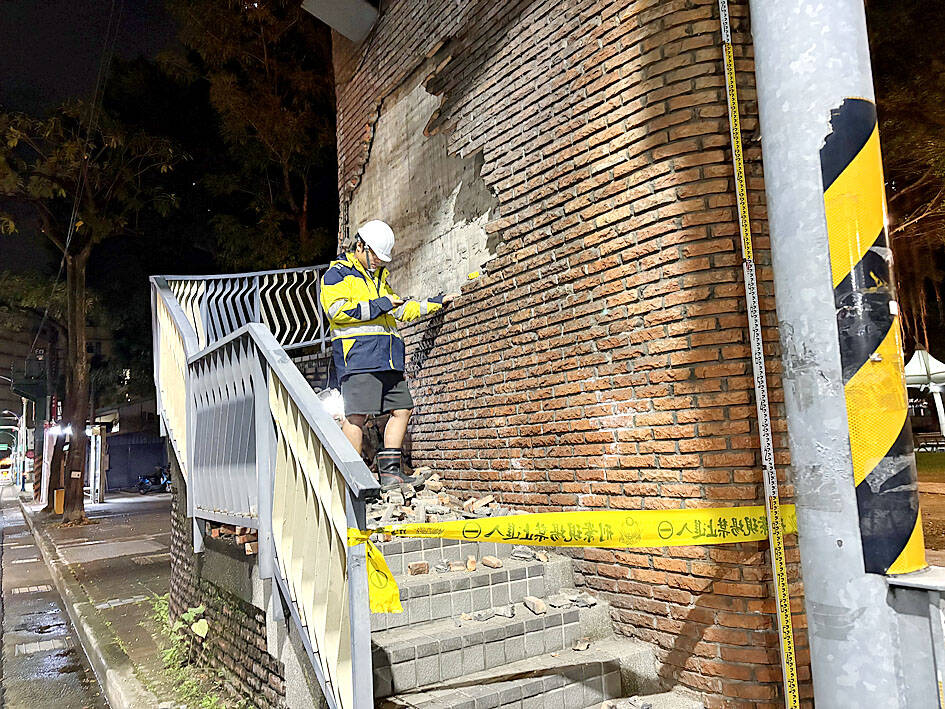
A contractor commissioned by the Sinjhuang District Office works to clear fallen bricks from a wall in New Taipei City on Dec. 27 last year.
Photo: Huang Cheng-chia, Taipei Times
The powerful quake in Tainan and Chiayi last year that damaged 4,291 buildings revealed the need to improve efficiency in performing post-tremor damage assessments necessary for reconstruction, he said.
The AI model makes preliminary assessments in one second, compared with 30 seconds to a minute a human evaluator requires, NCREE Director Ou Yu-chen (歐昱辰) said.
Certified structural engineers who use the tool are 15 times faster than their unassisted colleagues in evaluating building damage, Ou said.
A publicly available version of the tool, called “safe and seismic-resistant home AI” (安全耐震我的AI), would enable ordinary people to estimate their structure’s ability to withstand earthquakes using pictures of their home’s structural walls, pillars and beams, he said.
Should the AI assess a structure to be unsafe, it would recommend that the user contacts certified technicians, he said.
The tool is expected to be launched on the center’s Web site by the end of this week.
The model allows engineers to make damage assessments at once, eliminating the redundant travel for reassessments that accounts for the bulk of time wastage, NCREE associate researcher Chang Wei-tze (張慰慈) said.
The public version classifies structural components into three categories: severe damage, indicating danger; moderate damage, requiring caution; and minor damage or no obvious damage, Chang said.
He said people should think of the tool as being similar to a rapid test for a cold, giving them a preliminary idea of their home’s condition before seeking help from a professional, a process that can often take several months.
Separately, the center has also developed the Poseidon AI system designed to increase water allocation speed and efficiency in fighting fires, Chang said.
The system is designed to deal with quakes or other contingencies that trigger secondary fires, and has been used to put out 3,000 blazes in Taipei since becoming operational there in February, the center said.
Poseidon is plugged in Taipei’s 119 emergency dispatch and automatically submits water distribution requests to the Taipei Water Department, reducing the time to water main pressurization by six minutes, it added.
KioskNews shows a cleaned-up reading view extracted from the publisher’s page — the original always lives on their site, not ours.