CORRUPTION TRIAL : ‘Wig’, ‘padkos’ and renovation money haunt Mapisa-Nqakula’s defence case
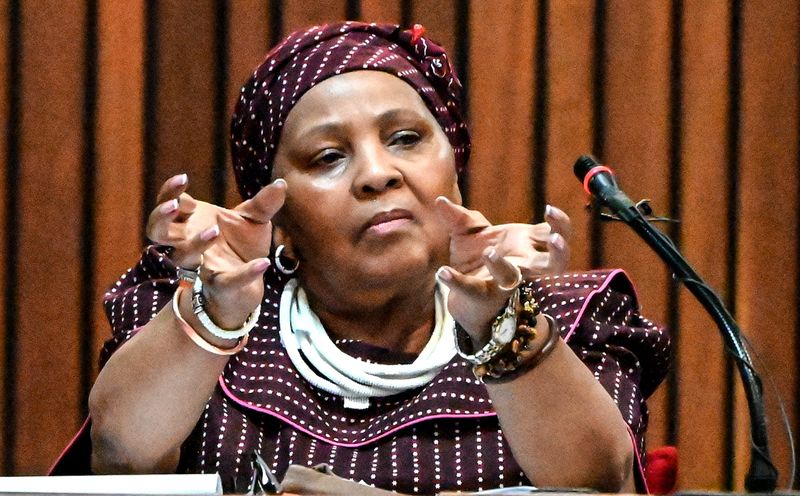
Former defence minister Nosiviwe Mapisa-Nqakula has closed her defence case in her corruption trial after calling witnesses to explain her travel allowances and the handling of gifts, but their evidence has not fully accounted for the money allegedly used to renovate her Johannesburg home.
The defence concluded its case in the Gauteng Division of the High Court in Pretoria on Tuesday, 17 November, after Mapisa-Nqakula’s former personal assistant, Zukiswa Mahabeni, denied knowing about alleged cash payments made to the former minister by businesswoman and defence contractor Nombasa Ntsondwa-Ndhlovu.
Mahabeni’s testimony came a day after a senior state accountant confirmed that Mapisa-Nqakula received almost half a million rands in foreign travel advances between 2016 and 2019.
While the figure supports the former minister’s claim that she had access to travel allowances, it is far less than the R1.7-million to R1.8-million the court has heard was spent renovating her home in Bruma, Johannesburg.
The State alleges that Mapisa-Nqakula used money received from Ntsondwa-Ndhlovu to pay for the renovations, an allegation she has denied. She maintains that the work was funded through her salary, travel allowances and her husband Charles Nqakula’s income.
Mapisa-Nqakula faces 12 counts of corruption and one count of money laundering arising from allegations that she solicited about R4.55-million in bribes from Ntsondwa-Ndhlovu between 2016 and 2019, while serving as defence minister. She has pleaded not guilty.
A wig that was too ugly to register
Much of Mahabeni’s testimony on Tuesday focused on a wig brought by Ntsondwa-Ndhlovu to the former minister at the Defence VIP Lounge in OR Tambo International Airport, which the State alleges was used to conceal a R300,000 cash payment.
Mahabeni told the court that she received a paper bag from the former minister and placed it in her own bag before travelling to Addis Ababa, Ethiopia.
“There was no money in that bag which I received in Mam’s hands and placed in my bag,” she testified.
However, when the Investigating Directorate Against Corruption (Idac) prosecutor asked whether she had checked what was inside the bag when it was handed to her, Mahabeni said she had not.
She explained that she only saw the wig when she unpacked the minister’s belongings after arriving in Addis Ababa. She described the paper bag as small, soft and foldable.
Mahabeni said it was normal for her to pack items given to Mapisa-Nqakula and unpack them when they reached their destination.
The prosecutor challenged her version, suggesting that the bag contained more than just a wig.
“I put it to you that on the events of the day in question, when the accused met with Nombasa, who brought the wig, it was not only the wig. There was also money inside; what do you say to that?”
Mahabeni denied that there was money in the bag.
The questioning then turned to the registration of gifts received by ministers and members of Parliament. Asked whether ministers were allowed to receive gifts, Mahabeni said she did not know the rules, but understood that gifts received by the minister had to be registered.
“I don’t know if they are allowed or not. All I know is that when they receive the gifts, we register them,” she said.
But when asked whether she had registered the wig, Mahabeni admitted that she had not.“I said to her that we are not going to register this ugly thing and it’s even cheap,” she said.
The prosecutor then asked whether there were other gifts received by Mapisa-Nqakula that had not been registered.
Mahabeni said she could not recall any, but conceded that it was possible.
“Yes, maybe, but right now I can’t think of anything.”
She also agreed with the prosecutor that she would not necessarily know what Mapisa-Nqakula discussed or received when interacting with other people.
Mahabeni was further questioned about several alleged cash transactions involving amounts ranging from R100,000 to R350,000, which the State claims were paid to Mapisa-Nqakula.
“I don’t know,” she repeatedly responded.
A relationship beyond official duties
Mahabeni’s testimony also gave the court a glimpse into her close relationship with Mapisa-Nqakula, which went beyond managing the minister’s official schedule.
She said she had kept Mapisa-Nqakula’s diary from 2013 until 2024 and was also responsible for travel arrangements and other personal errands, including grocery shopping.
Their relationship was such that Mapisa-Nqakula’s children would sometimes contact her directly for assistance with everyday needs, including buying electricity.
Mahabeni, who was present on three occasions when Mapisa-Nqakula allegedly met Ntsondwa-Ndhlovu, told the court that she never witnessed any money changing hands between the two women. These included a February 2019 meeting at OR Tambo International Airport, where R300,000 was allegedly concealed beneath a wig, the 2018 Spousal Forum and a Women in Defence event.
During the Spousal Forum, Mahabeni said she accompanied Mapisa-Nqakula to a holding room, but did not go inside. She also testified about a gift handed to security personnel for screening, although she did not witness the screening process herself.
Travel allowances account for only part of renovation bill
On Monday, the court heard evidence from Esmeralda Stellenberg, a senior state accountant in the SANDF's financial division, who was subpoenaed by the defence to explain the foreign travel allowances paid to Mapisa-Nqakula.
Stellenberg confirmed that the former minister received R468,747.91 in foreign subsistence and travel advances between 2016 and 2019.
She presented financial records covering 53 foreign trips between January 2016 and September 2020 and explained how advances were issued and reconciled after official travel.
Stellenberg also told the court that more than R80,000 had been transferred to the department’s salaries section to be deducted from Mapisa-Nqakula’s final salary when she left the department.
However, under cross-examination, she acknowledged that she could not confirm whether the money had actually been deducted or repaid because she did not work in the salaries department. She could only confirm, based on the documents before her, that the amount had been referred to that section for deduction.
This is significant, because the travel advances form part of Mapisa-Nqakula's explanation of how she funded renovations at her Bruma home in Johannesburg, which the court heard cost between R1.7-million and R1.8-million.
The advances were intended to cover official travel expenses and were subject to reconciliation, meaning the full amount cannot automatically be treated as money available for personal use.
In August, the court heard from a chief financial investigator who testified that even if Mapisa-Nqakula and her husband, Charles Nqakula, had saved every cent they withdrew in cash from their bank accounts over two years, they would still not have had enough money to pay for the extensive renovations at their home.
Wynand Wessels, a former Idac chief financial investigator, said the use of cash in circumstances where the source of the funds could not be accounted for was typical of money laundering, Daily Maverick has reported.
The renovations included a walk-in dressing room, a remodelled main bathroom, underfloor heating, R600,000 motorised curtains, a solar power system and gold-trimmed wardrobes. The entrance hall alone cost R500,000, while luxury furniture, including couches, display units and ornamental chairs cost a further R375,000.
While Stellenberg’s evidence confirmed that Mapisa-Nqakula received travel advances, it did not establish how much she ultimately retained or whether the outstanding amount of more than R80,000 was recovered.
Mapisa-Nqakula has maintained that she funded the renovations using her salary, travel allowances and her husband Charles Nqakula’s income. The State, however, alleges that some of the money used for the renovations came from bribes paid by businesswoman and defence contractor Ntsondwa-Ndhlovu.
From wigs, padkos to closing arguments
At the heart of the case are allegations that Mapisa-Nqakula solicited about R4.55-million in bribes from Ntsondwa-Ndhlovu in exchange for using her position as defence minister to benefit her company, Umkhombe Marine. In 2016, the company secured a R104-million defence contract, which was cancelled days later, before she was allegedly offered a R79-million replacement tender she had never applied for.
At the start of the trial in July, the court heard allegations that words such as impepho, snuff, padkos and wig were used as code for cash payments. The former minister denied this, maintaining that their relationship was personal and involved shared spiritual practices.
With the defence having called its final witness, the case now heads to closing arguments on Monday, 23 November 2026, when both sides will make their final submissions before the court. DM
KioskNews shows a cleaned-up reading view extracted from the publisher’s page — the original always lives on their site, not ours.