Edward Witten: ‘I don’t know what world will be like when AI understands physics’
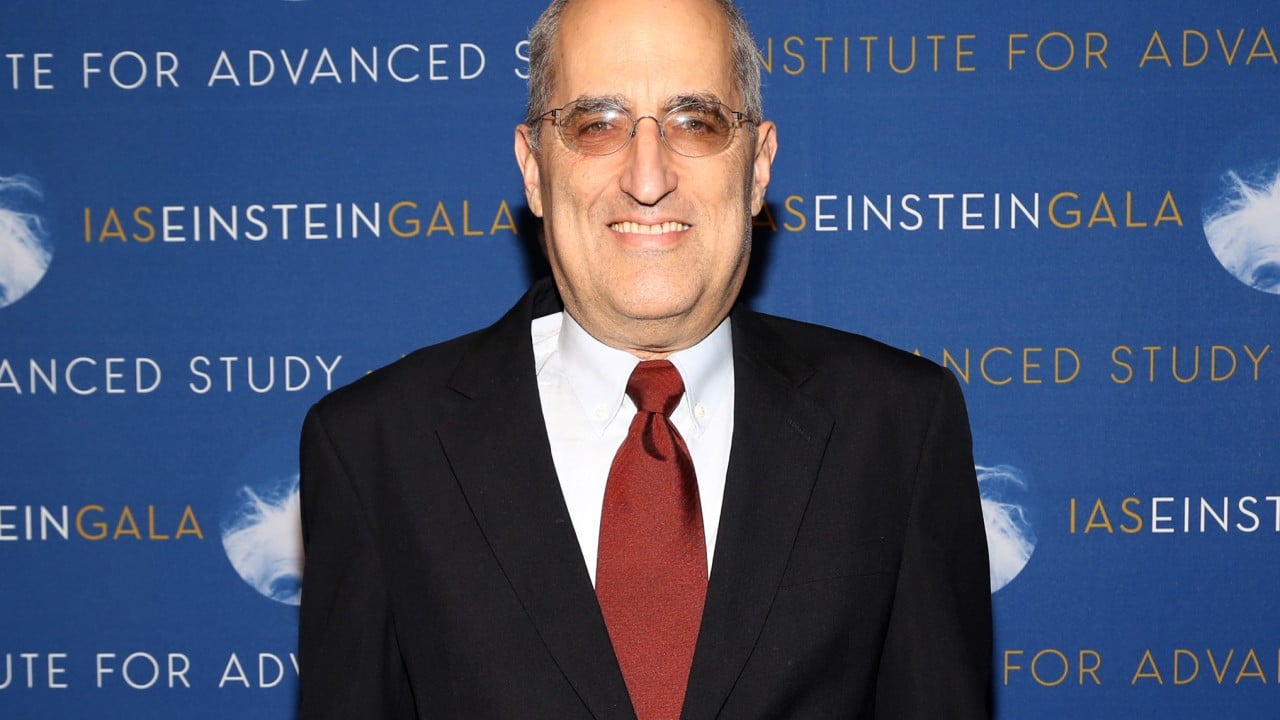
Recent AI breakthroughs in solving mathematical problems could mark a turning point in understanding modern physics, according to one of the world’s top physicists.
American Edward Witten, an emeritus professor at the Institute for Advanced Study (IAS), is a leading figure in the fields of theoretical and mathematical physics.
In 1990, Witten became the first physicist to be awarded the Fields Medal – widely regarded as the highest honour in mathematics – for applying ideas from theoretical physics to solve major mathematical problems.
01:52
Xi says China and US have responsibility to ‘manage AI for good’
Witten, who has cited AI as an assistant in his recent research, said he was not hesitant about integrating AI into his research workflow.
“But I do not know what the world will be like when AI really understands physics well,” he said on November 18.
“That is something that mathematicians are grappling with now, because AI has developed in some ways superhuman powers in mathematics.”
In October, OpenAI released hundreds of preprints covering mathematical problems generated by its models. Earlier this month, a mathematician at Anthropic said he and AI assistance Claude had solved the 167-year-old Riemann hypothesis.
Witten, who has spent some time looking at the OpenAI proofs, said the proof of a fundamental statement about the quantum Yang-Mills theory “could be a turning point in mathematical understanding of modern physics”. The theory, introduced in the early 1950s by physicists Chen-ning Yang and Robert Mills, is a foundational framework for the Standard Model of particle physics.
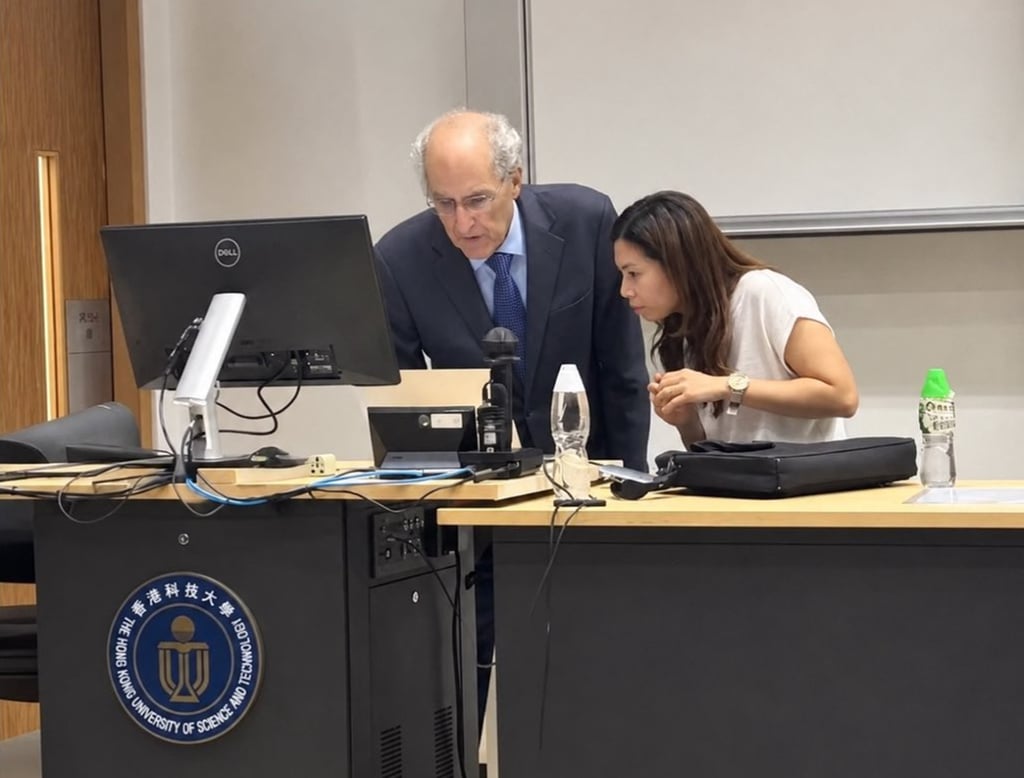
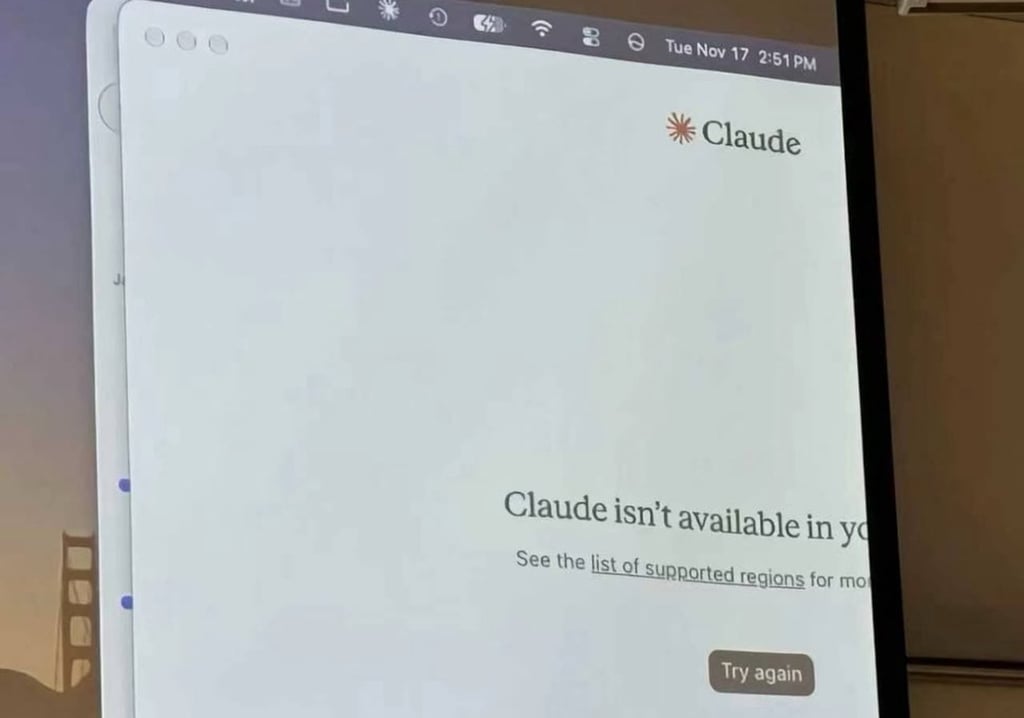
While visiting Hong Kong for a lecture this month, Witten became a trending topic on Chinese social media after a photo circulated showing his computer projecting a Claude pop-up that said the AI assistant was not available in the region.
Anthropic, Claude’s creator, blocks access to the large language model in mainland China, Hong Kong and Macau. In papers published this year, Witten has credited Claude as an assistant in his research.
Witten is a member of an independent advisory group hosted at IAS that helps advise OpenAI and any other companies on the communication of their results in line with academic mathematics standards.
While mathematicians are already having to grapple with how to interact with AI and channel it to advance their research, Witten said physicists were a couple of years behind because it was harder for AI to understand physics.
“But I am not making predictions about the future. It caught up in math incredibly fast. And who knows what it will do in physics in a couple years,” he said.
“I look forward to being able to discuss physics with a machine that is interested in physics and able to discuss it.”
Witten earned an undergraduate degree in history before receiving a doctorate in physics at Princeton University in 1976. He was a professor at the university from 1980 to 1987.
In 1987, he became a faculty member at IAS – which has been home to researchers such as Albert Einstein and Robert Oppenheimer – where he became an emeritus professor in 2022.
He has won several prestigious awards for his work in both maths and physics, including the Breakthrough Prize in Fundamental Physics in 2012.
Following a proposal in 1995, Witten helped unify various versions of string theory into a single framework called M-theory.
String theory is a theoretical framework that proposes that the universe’s fundamental building blocks are tiny vibrating strings rather than point-like particles. Much like notes on a violin, the specific ways these strings vibrate determine the type of particles we observe.
The theory has led to scepticism, as it lacks direct experimental confirmation and the conditions needed to test it remain out of reach.
Witten, who is revisiting work he did decades ago in open string field theory, said it was understandable that some physicists were sceptical, as the “reasons for thinking that string theory is important are largely circumstantial”.
“There’s not a bulletproof argument that it’s definitely part of the way to describe the natural world,” he added.
Witten’s lecture in Hong Kong was on black hole thermodynamics, a field that he said teaches us something “amazing and bizarre” about the relationship between gravity and quantum mechanics – the two main theories that form the basis of modern physics.
While Einstein’s theory of gravity – based on curved space-time – is important for planets, stars and the universe, quantum mechanics is important for microscopic things, like atoms, molecules and subatomic particles.
However, contradictions emerge when these two theories are combined. According to Witten, there are two areas where useful insights have been seen beyond this contradiction.
The first is string theory, where he said the contradiction was apparently avoided, but noted that we do not really understand the theory. The second is black hole thermodynamics, where curved space-time is related to thermodynamics.
“One thing everyone knows about a black hole is that what falls in doesn’t come out. It’s a one-way trip. So falling into a black hole is irreversible,” Witten said.
However, in physics, it is believed to be impossible for a black body to only absorb and not emit. In 1974, Stephen Hawking discovered that quantum-mechanically, black holes do emit radiation at a very low temperature.
“Falling into a black hole is like breaking an egg. In practice, it can’t be reversed,” Witten said.
“But if you were incredibly powerful and could precisely set the right initial conditions, then you could put the egg back together again and get somebody to come out of the black hole.”
While Einstein’s theory describes black holes classically, Witten said there was more to the story quantum-mechanically, which is why physicists investigated black hole thermodynamics.
Owing to new techniques emerging over the past decade, “observationally, black holes are much more alive than they were in the past”, he said.
Witten, who was a speaker at the Riemann Bicentennial Conference held in the southern Chinese city of Shenzhen this month, said it was “very important for science to be borderless”.
“It’s terrible that in many fields, collaboration with China is so difficult now,” he said.
Witten noted that while in purely theoretical areas there were fewer obstacles to the exchange of ideas, there remained barriers to the movement of people, such as obtaining visas.
02:36
Chinese mathematicians Wang Hong and Deng Yu win prestigious Fields Medal
On US-China collaboration, Witten said it was a “shame that the world, in some ways, has moved in the wrong direction in that regard”.
In an article he wrote with American theoretical physicist David Gross in 2015, the two said a proposed “Great Collider” in China had the potential to transform particle physics.
The ambitious plan for the Circular Electron Positron Collider, led by physicist Wang Yifang, hit a roadblock last year when it was not put forth for consideration in China’s latest five-year plan. Wang said his team planned to submit the proposal again in 2030 unless CERN’s similar project received official approval before then.
“It would be great if China would revive that in the next five-year plan,” Witten said.
He pointed to a similar proposal at CERN that did not yet have an ironclad commitment from countries, noting that China could also join that project if it went ahead.
KioskNews shows a cleaned-up reading view extracted from the publisher’s page — the original always lives on their site, not ours.