US State Dept. sanctions Iranian military activities, fuel export in Operation Economic Outcast
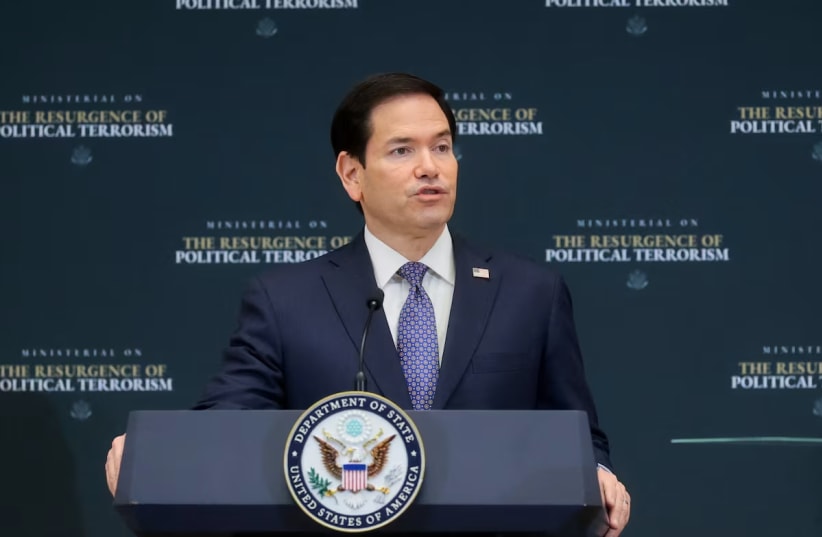
The US State Department implemented sanctions against Iranian military activities, cyber threats, and illicit oil trade, according to a statement from US State Department Spokesperson Tommy Pigott on Monday evening.
"Today, the United States took sweeping action against multiple entities, individuals, and vessels enabling the Iranian regime’s destabilizing activities," Pigott said.
"The measures target Iranian military officials responsible for procuring weapons and directing attacks against US servicemembers and regional partners, Iran-based entities that gathered intelligence for targeting US forces and allies, and a procurement ring supplying Iran’s military and missile programs," he added.
"The US will continue to disrupt, expose, and dismantle Iran’s military and proliferation activities, procurement schemes, malicious cyber operations, and illicit oil trade that sustains the regime’s malign behavior."
Sanctions target groups for supporting Iranian military actions
The sanctions targeted two Iran-based groups that were involved in procuring images used to attacks US forces and bases located across the Middle East.

DadeNegar Startup Studio and the Iranian Islamic Revolutionary Guard Corps Cyber-Electronic Command (IRGC-CEC) were named in the sanctions package.
DadeNegar was sanctioned for supporting the "targeting of US and partner facilities in the Middle East for the Iranian military during Operation Epic Fury." The State Department said DadeNegar used commercial Chinese satellite imagery to support Iran's military in its efforts to target and damage US forces and bases in the region.
The IRGC-CEC was sanctioned due to obtaining information about US forces and bases that was used to support Iran’s targeting of US assets during the conflict.
Both groups were designated "for having engaged, or attempted to engage, in any activity that materially contributes to, or poses a risk of materially contributing to, the proliferation of arms or related materiel or items intended for military end-uses or military end-users, including any efforts to manufacture, acquire, possess, develop, transport, transfer, or use such items, by the Government of Iran."
Individuals also sanctioned by US State Department
Monday's announcement also targeted seven individuals responsible for directing the use of conventional weapons against US forces.
Sanctions targeted members of Iran's Supreme National Council, several commanders of various military branches of the IRGC, the country's deputy defense minister, and the spokesperson for Iran's Defense Ministry.
Former Secretary of Iran's Supreme National Security Council Mohammad Bagher Zolghadr, was targeted for having "an active role advocating for Iran’s continued support of its so-called Axis of Resistance."
Zolghadr "was designated by the UN Security Council in Annex I of UN Security Council resolution (UNSCR) 1747 (2007), reimposed on September 27, 2025, in response to Iran’s 'significant non-performance' of its nuclear commitments," the statement added.
Ahmad Vahidi, Commander-in-Chief of the IRGC, and Ali Abdollahi, Commander of the Khatam al-Anbiya Central Headquarters, the Iranian government branch responsible for wartime operations were sanctioned for their roles in driving military decisions made by Iran during Operation Epic Fury.
Sanctions also targeted Commander of the IRGC Aerospace Force Sayyid Hossein Mousavi Eftekhari, and Amir Hatami, Commander Iran's conventional military. Both were sanctioned due to their responsibility for Iran’s ballistic missile and drone programs.
Deputy Defense Minister for Industrial and Research Affairs Seyyed Mahdi Farahi was sanctioned by the US for "directing the procurement of arms and related materiel and has demonstrated in-depth knowledge of various missile systems, including those that Iran has reportedly used against US forces and allies."
Reza Talaei-Nik, spokesperson for Iran's main defense ministry body was sanctioned for "engaging in activity that materially contributes to the supply, sale, or transfer, directly or indirectly, to or from Iran, or for the use in or benefit of Iran, of arms or related materiel, including spare parts."
US sanctions also target fuel exports, shadow fleet
The Department of State also sanctioned companies that "engaged in the illicit trade of Iranian petroleum and petrochemical products, activities that have generated millions of dollars in revenue for the Iranian regime," the statement said.
"These Iranian petroleum, petroleum products, and petrochemical cargos," the statement added, "are frequently transported by shadow fleet operators, including vessel management companies that regularly engage in dark activity and other deceptive shipping practices, endangering other vessels and trade flows."
Sanctions targeted both Iranian and international companies that facilitated the trade of petroleum and petrochemical products with Iran.
Implications of the sanctions
The sanctions coming following US Treasury Secretary Scott Bessent's announcement of the start of Operation Economic Outcast and the implementation of an "economic D-Day" against Iran.
Monday's sanctions mark the start of US action aimed "to sever every economic lifeline that sustains this tyrannical regime until Tehran stands alone," said Bessent.
"We are no longer managing the Iranian threat," he emphasized. "We are ending it."
KioskNews shows a cleaned-up reading view extracted from the publisher’s page — the original always lives on their site, not ours.