China’s thorium-229 nuclear clock beats Vienna’s on stability, studies show
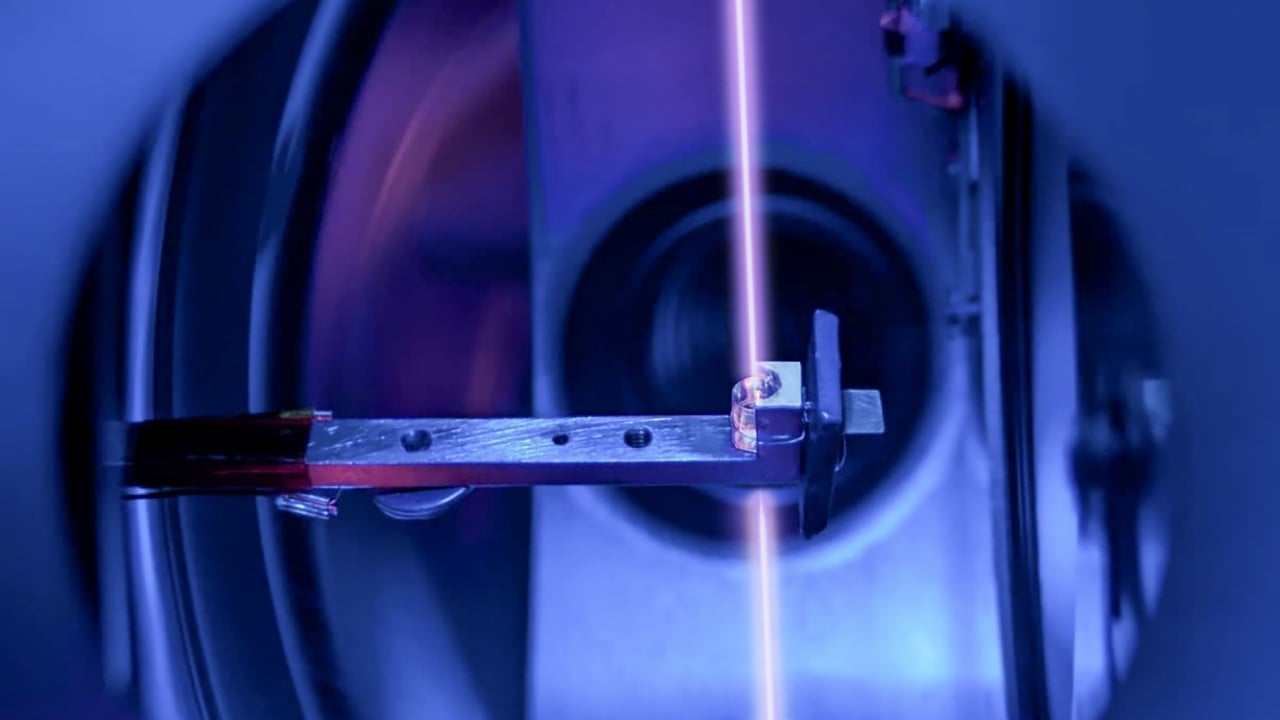
Initial results from the world’s first two working nuclear clocks indicate that China’s timepiece is about six times as stable as the one in Vienna, according to papers published this week by the journal Nature.
The clocks were developed independently but both the Chinese team, led by Tsinghua University in Beijing, and the researchers at Vienna’s TU Wien used thorium-229 nuclei embedded in crystals to keep time by the steady rhythm of the atom’s core, rather than the electrons whirling around it, as in atomic clocks.
When Nature reported in June that the two teams had separately developed the radical new devices, Thorsten Schumm, a member of the European team, said that “now we have a fierce but friendly global competition”.
According to the latest papers, the Beijing scientists also showed that two crystals grown separately kept the same time – a sign such clocks could be reliably reproduced, they said. Meanwhile, the Vienna team used its clock to hunt for dark matter, without success.
Ding Shiqian, who led the Tsinghua team, told the South China Morning Post that moving the clock’s tick from electrons to the nucleus mattered because the nucleus was much smaller than the atom and less disturbed by stray electric and magnetic fields.
“In the long term, this could allow nuclear clocks to reach extremely high accuracy,” he said.
But the significance went beyond simply building a “better clock”, he added. The thorium nucleus reacted to the laws of physics very differently from the electrons in atomic clocks, so comparing the two kinds of clocks could reveal tiny shifts in nature’s constants or traces of dark matter.
The clocks could also have practical uses, Ding said. Today’s best atomic clocks are extraordinarily precise, but they remain complex laboratory systems.
“A solid-state nuclear clock could potentially be made much more compact, robust and easier to operate. If that becomes possible, it could bring optical-clock-level precision out of specialised laboratories and allow such precision to be deployed much more broadly in the real world,” he said.
His team also found that two crystals made separately gave the same tick, agreeing to within about three parts per 10 trillion. The tick also matched earlier measurements by physicist Jun Ye’s group at JILA, a research institute run by the University of Colorado Boulder and the US National Institute of Standards and Technology, which used different crystals and different equipment.
That showed the clock’s tick “is not simply a property of one particular crystal, but can be reproduced across independently prepared samples and laboratories”, Ding said. He called it “an important step” towards turning the nuclear clock from a laboratory demonstration into a reliable standard.
In the long term, this could allow nuclear clocks to reach extremely high accuracy
While the work heralds a new generation of more precise, robust and compact timekeepers, for now neither nuclear clock is as stable as the best atomic clocks, which keep time by tracking electrons as they jump back and forth between two energy levels.
For more than seven decades, atomic clocks have been the world’s most precise timekeepers, underpinning everything from satellite navigation to the official definition of the second.
In 2003, Germany-based physicists Ekkehard Peik and Christian Tamm proposed a clock built around the atom’s nucleus instead, as it was so tiny and tightly bound that it would be less disturbed by stray electric and magnetic fields that can throw off atomic clocks.
However, most nuclei need far more energy to make such jumps than any existing laser is capable of triggering. Thorium-229, a rare radioactive form of the metal, is the exception: its nucleus can be switched with a nudge of ultraviolet light.
That quirk – which comes from a near-perfect balance between the forces holding the nucleus together – also makes thorium-229 extremely sensitive to tiny shifts in the basic forces of nature.
This characteristic makes physicists hopeful that nuclear clocks could help in the hunt for dark matter and eventually test whether the constants of physics are truly constant.
It took many years to pin down the exact energy of the thorium jump, with scientists first managing to trigger it with lasers only in 2024.
For the latest studies, both teams shone ultraviolet laser light through a tiny crystal laced with thorium-229 and tuned the laser until the nuclei soaked up the most light. That point became the clock’s “tick”.
The Chinese team made its ultraviolet light by firing laser beams through cadmium vapour heated to 600 degrees Celsius (1,112 Fahrenheit) – hotter than a wood-fired pizza oven.
The Tsinghua researchers used this bright beam to light up a crystal that was smaller than a grain of rice yet packed with about a million billion thorium nuclei, according to the paper.
The Vienna team’s crystal held about 200 times as many thorium nuclei, and its ticks were checked against an atomic clock across the city through 10km (6.2 miles) of optical fibre.
But the researchers in Vienna found the tick varied slightly depending on which part of the crystal the laser passed through, so that the clock kept a slightly different time each day it was switched on.
Both teams said the road ahead would have its hurdles. According to the Tsinghua team, thorium-229 is so scarce there is almost no room left to experiment with how the crystals are made.
Better crystals – with the thorium spread more evenly and with fewer internal flaws – would help every part of the crystal keep the same time and sharpen the tick, the Vienna team wrote.
Together with more powerful lasers, such improvements could eventually make nuclear clocks competitive with – or even better than – today’s best atomic clocks, the researchers wrote.
Passionate about science? Dive deeper with the Dark Matters newsletter, a weekly in-depth analysis on China’s rise in science, technology and military that goes beneath the surface. Sign up for free now.
KioskNews shows a cleaned-up reading view extracted from the publisher’s page — the original always lives on their site, not ours.