Chinese ambassador says Li Qiang’s visit deepened Thai ties, pledges action over pollution
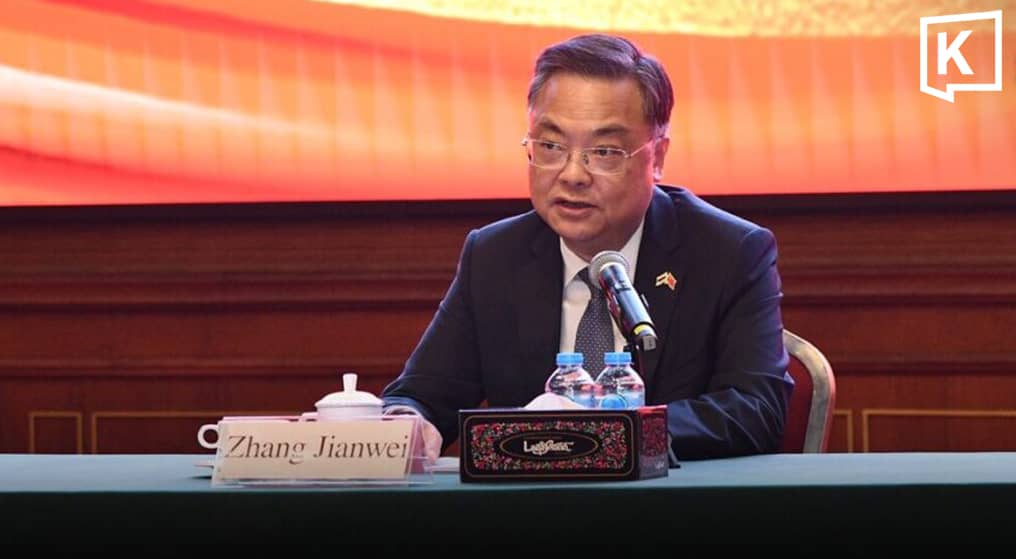
BANGKOK — 26 November 2026, China’s ambassador to Thailand has described Chinese Premier Li Qiang’s official visit to Thailand as a successful milestone in bilateral relations, saying the two countries signed eight cooperation documents and that frequent high-level exchanges reflect the close bond of family members. He also pledged that China would take legal action if Chinese companies were found to be involved in water pollution affecting tributaries of the Mekong River, while offering to send experts and help establish a water-quality testing laboratory in northern Thailand.
At a press conference at the Chinese Embassy in Bangkok on 26 November, Chinese Ambassador Zhang Jianwei reviewed Li’s official visit to Thailand from 13 to 15 November.
Zhang noted that the Thai and Chinese prime ministers had exchanged visits within a four-month period. Thai Prime Minister Anutin Charnvirakul had travelled to China again after a four-month interval to attend the 33rd APEC Economic Leaders’ Meeting in Shenzhen, Guangdong province. The APEC Year of China had concluded successfully, he said.
Zhang said the frequent high-level exchanges between the two countries were like visits between relatives, reflecting the longstanding friendship captured in the Thai saying: “Thailand and China are not strangers, but brothers.”
China and Thailand are now working together to build a new “golden 50 years” of friendship, with bilateral relations remaining at a high level, Zhang said.
He described Li’s visit as one of friendship and cooperation, noting that Anutin personally welcomed the Chinese premier at the airport and that people from all sectors of Thai society gave him a warm and grand reception.
During an audience with Their Majesties the King and Queen, both sides recalled the Thai royal family’s state visit to China, which Zhang said demonstrated the monarchy’s firm support for friendship between the two countries.
China firmly supports the Thai government’s efforts to govern the country smoothly and encourages Chinese businesses to integrate more closely into Thai society, helping ensure that local communities benefit from bilateral cooperation, he said.
Strategic cooperation between China and Thailand had also been strengthened, with both sides agreeing to enhance coordination within multilateral frameworks such as ASEAN-China cooperation, Lancang-Mekong Cooperation and APEC.
China offers help with northern water pollution investigation
In response to a question from Matichon about cooperation between Thailand, China and Myanmar to address cross-border pollution and water-quality problems, Zhang said China was deeply concerned about pollution in tributaries of the Mekong River and understood the impact on the livelihoods of people in northern Thailand.
He said the Chinese government understood and supported the Thai government’s efforts under Anutin to prioritise public health and take proactive measures to address water pollution.
China had maintained close coordination with Thailand on the issue, and both Xi and Li had recently discussed it with Anutin, Zhang said.
He stressed that the Chinese government had consistently required Chinese companies operating overseas to strictly comply with the laws and regulations of their host countries, and opposed any activities that damage the environment and ecosystems.
However, water pollution could be caused by multiple factors, including geological conditions, climate change and human activities. Investigations therefore needed to be based on facts, science and professional expertise to identify the sources and determine appropriate solutions, he said.
Zhang said China supported Thailand and Myanmar sending a joint working team to inspect the affected areas as soon as possible.
“If Chinese companies are found to be involved in the pollution, the Chinese side will take serious action in accordance with the law,” he said, adding that no party should be presumed guilty before the investigation had established the facts.
Zhang said China had accumulated considerable experience in tackling domestic water pollution, including water-quality monitoring, tracing pollution sources, ecological restoration and integrated pollution management.
China was ready to work with Thailand at various levels, including government agencies, water-quality monitoring bodies, experts and academic researchers.
It was also willing to send specialists to help Thailand monitor water quality, jointly establish a water-quality testing laboratory in northern Thailand and provide relevant technical support, he said.
Zhang added that he had attended a meeting at the Thai Ministry of Foreign Affairs the previous day, accompanied by Chinese technical experts. He was also scheduled to visit areas in Chiang Rai province with Thai and Myanmar representatives.
A joint working group between Thailand and Myanmar was already meeting, he said, expressing hope that the countries would continue friendly discussions and coordinate closely to conduct a joint, science-based investigation.
The aim, he said, was to find appropriate solutions and genuinely protect the health and well-being of people in affected communities.
“Looking back at the many meetings and exchanges over the past few days, I feel that the leaders of both countries deeply value and cherish the longstanding friendship between our two nations,” Zhang said.
“They are personally working to strengthen Thai-Chinese relations, regard people’s well-being as the fundamental driving force behind cooperation, and work together to address specific challenges arising in the course of development.
“China has full confidence in carrying forward and further developing the friendship between our two countries,” he said.
KioskNews shows a cleaned-up reading view extracted from the publisher’s page — the original always lives on their site, not ours.