The folk artistry and architecture of dreams
The Seashell Temple in Changhua County’s Fuxing Township represents one man’s persistence to honor the living and the dead
By Shane O’Reilly / Contributing reporter


Known colloquially as Fuxing Township’s (福興鄉) Changhua Seashell Temple, the correctly named Sanqing Sanyuan Temple (三清三元宮) is the incredible work of just one man.
Its story began when businessman Huang Chi-Chun (黃奇春) purchased a plot of land opposite Xiuan Cemetery (修安公墓) and launched a successful tropical fish farm.
Years later, in the mid-1970s, plagued by very specific dreams, or possibly prophetic visions, Huang was instructed to erect a monumental edifice in honor of the local spirits.
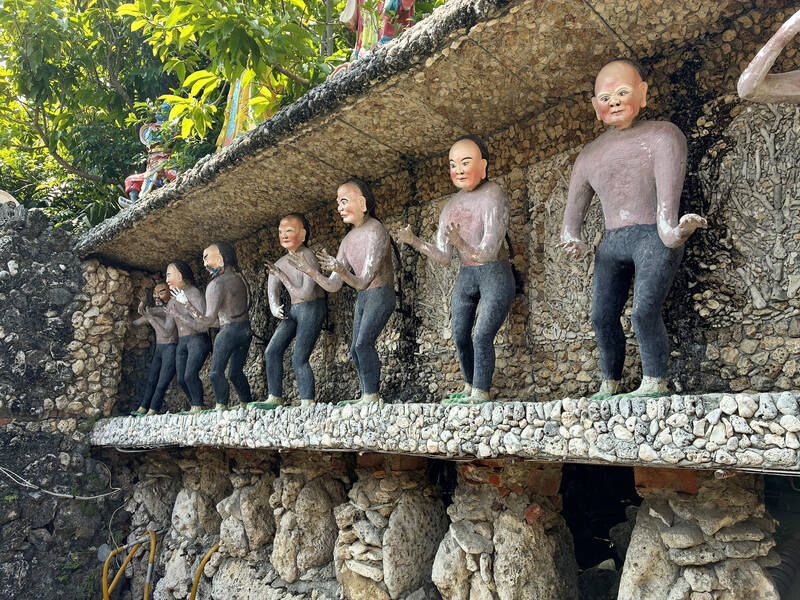
Some humane figurines on view at the Seashell Temple.
Photo: Shane O’Reilly
He had full faith in his precognition, and it became his life’s calling to build what would evolve into Taiwan’s very first Seashell Temple (貝殼廟).
This was a true labor of love that would take him over 20 years to fulfill.
The dreamlike directions he received demanded an incredibly detailed, decorative aesthetic. As such, he gathered thousands of mollusk, snail and conch shells from the surrounding coastal waters and imported coral and seaweed from abroad.
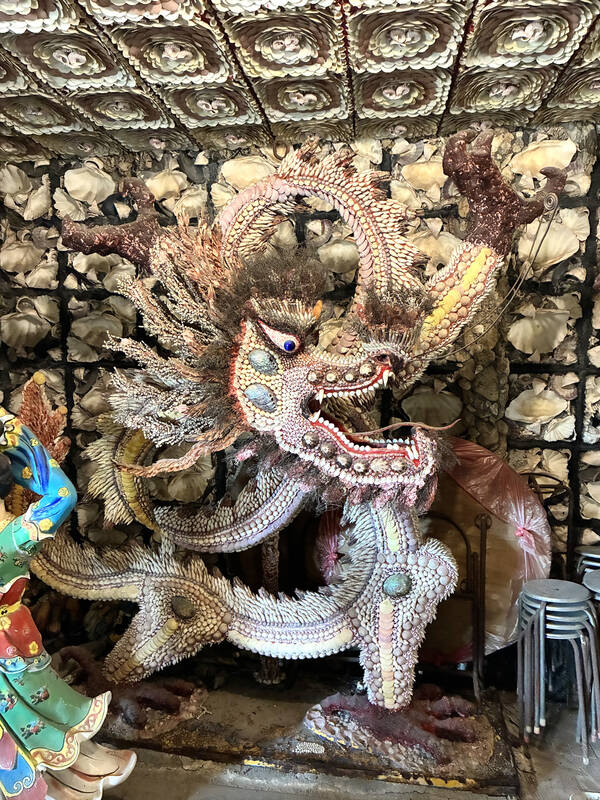
The collage-like temple dragon.
Photo: Shane O’Reilly
Working with compliant sandstone on top of a wire and concrete foundation, he was able to easily affix and bind the precise pieces of his assemblage with little help.
As the project unfolded, many locals thought Huang was crazy. But as Huang’s artistic flair became apparent, respect grew.
The circular entrance acts as a portal to an almost carnivalesque 200-square-meter realm watched over by a crenelated arch and high boundary walls fastened with an assortment of colorful figurines.
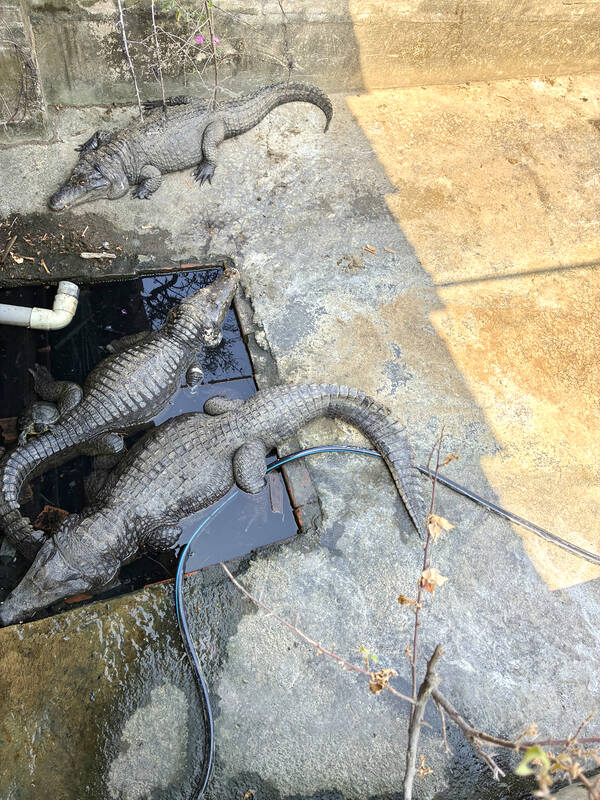
Crocodiles penned at the Seashell Temple in Changhua County’s Fuxing Township.
Photo: Shane O’Reilly
Beyond the ubiquitous Tiangong Censer (天公爐) dedication to the Jade Emperor, a variety of deities in all shapes and sizes come into focus, ranging from the reverent to the fantastical.
A collection of idolatrous human figures, dragons, phoenixes, various mythical creatures and farm animals peer out from every ledge, grotto and wall.
In certain sections, colonies of coral are used to create decorative waves of symmetrically aligned formations with a highly defined porous texture.
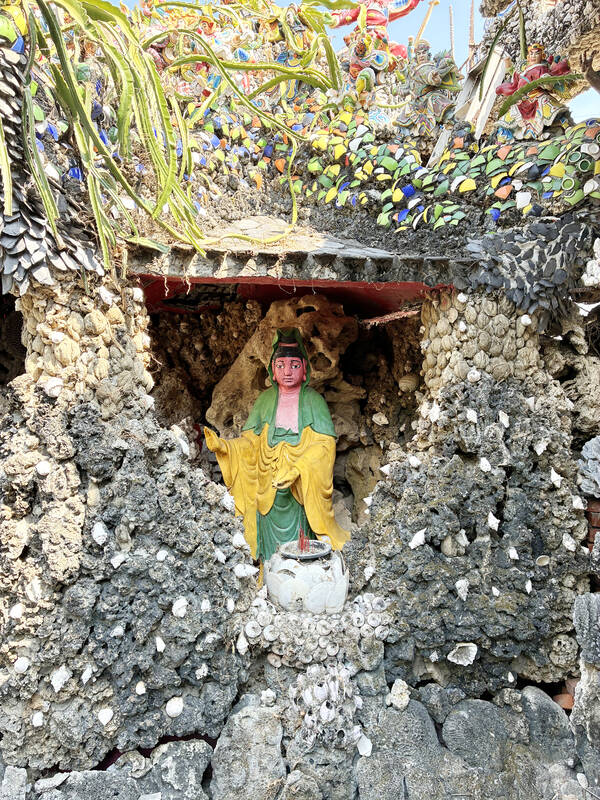
A closer look at one of the many grottos and many characters hidden within Sanqing Sanyuan Temple.
Photo: Shane O’Reilly
Other designs, more mosaic in nature, are created in an almost pointillist manner, necessitating tiny seashells arranged by color within the weaving of marine sea fans (海樹) for added dramatic effect.
Visitors are flanked by all manner of exquisitely intricate depictions that continue around the back of the altar room along a highly ornate walkway.
Deep within this central chamber, the highly venerated Taoist deities, the Three Pure Ones (三清道祖), representing all cosmic energy and wisdom, preside over the space.
It’s here that visitors will find a stairway that leads down to a long, neon-lit and similarly adorned corridor guiding them to what remains of Huang Chi-Chun’s initial venture, the tropical fish farm.
Alternatively, a separate entrance can be found next to the temple gateway. There the beautiful grave and monument dedicated to Huang’s late wife stands.
Upon entering the farm, to the sounds of cackling chickens, you’ll find a large open grid of concrete ponds inhabited by crocodiles, enormous turtles, nests of terrapins, diverse shoals of fish and tanks of koi.
Adjacent to this is a barn-like inventory space, crystal warehouse and shop selling everything from bags of shells to semi-precious stones, handmade jewelry, figurines and trinkets.
For your information
IF YOU GO
GETTING THERE The temple is located at 10-1 Zhenxing Lane, Funan Village, Fuxing Township, Changhua County (彰化縣福興鄉福南村振興巷10-1號). Admission is free and the temple is open daily from 8am to 5pm. Tel: (04) 778-7469 (Chinese only).
KioskNews shows a cleaned-up reading view extracted from the publisher’s page — the original always lives on their site, not ours.