Threat from China looms large over Taiwan’s local elections

Taiwanese voters go to the polls on Saturday in closely watched local elections that will shape the fortunes of the ruling Democratic Progressive party (DPP) as it navigates an increasingly precarious set of relationships on the global stage.
Saturday’s vote will choose mayors, council members and other local leaders across 22 districts. Unlike the presidential elections, in which foreign policy is often a key issue, the local elections, held every four years, are largely focused on bread-and-butter issues such as housing affordability and wealth distribution.
Nevertheless, China looms large over the vote, which takes place against the background of intense military pressure from Beijing. China claims Taiwan as part of its territory despite never having ruled the self-governing island. Taiwanese officials have raised the alarm over thousands of incidents of suspected misinformation or election interference, and certain candidates have been subjected to harassment from the Chinese authorities. There have also been reports of hundreds of China-linked AI-generated videos spreading disinformation about Taiwanese politicians disliked by Beijing.
Beijing calls the allegations of election interference “completely fabricated”. Zhu Fenglian, a spokesperson for China’s Taiwan affairs office, said the allegations “stir up anti-China sentiment to win votes”.
Wei-Ting Yen, a political scientist at Academia Sinica, Taiwan’s national research academy, said: “Even though local elections are not about China, the outcome of local elections will have huge implications for cross-strait relations.”
Most races are a tight competition between a candidate from the ruling DPP and the main opposition party, the Kuomintang (KMT). The KMT promotes closer ties with Beijing, and its chair, Cheng Li-wun, travelled to China this year to meet Xi Jinping, China’s leader. Xi has vowed to unify China with Taiwan, and has not ruled out using military action to achieve that aim.
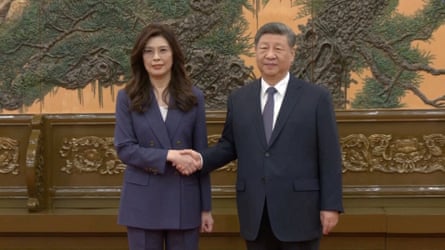
Yen said if the KMT loses some of its traditional strongholds, Beijing “may need to reconsider what is the most effective strategy for influencing Taiwanese people”.
One of the most contentious votes is the race for Taipei mayor, an office that has been held by the KMT for three decades. The DPP has selected as its challenger Puma Shen, a national legislator whom Beijing declared a “diehard separatist” in 2024. It is the first time a candidate under sanctions by Beijing has run to be mayor of Taiwan’s capital city. In the neighbouring New Tapei City race, the DPP’s Su Chiao-hui is also proving to be a ferocious challenger to the incumbent KMT.
Shen said in a recent interview that even if he didn’t win, the capital’s mayoral race was “a slap to China” because it proved that “democracy works here in Taiwan”.
Huang Bo-kai, a 23-year-old law student, said his top concern was cross-strait relations and how US-China relations were evolving. “The world’s three major powers are increasingly willing to flex their muscles: the US attacking Iran, Russia attacking Ukraine. I think Taiwan could very well be the next target [of China],” he told the Guardian.
Taiwan’s president, the DPP’s Lai Ching-te, is detested by Beijing and has taken a bolshier stance on cross-strait relations than his predecessor, Tsai Ing-wen, who was admired for her ability to drum up support in Washington while walking a delicate tightrope to avoid angering China.
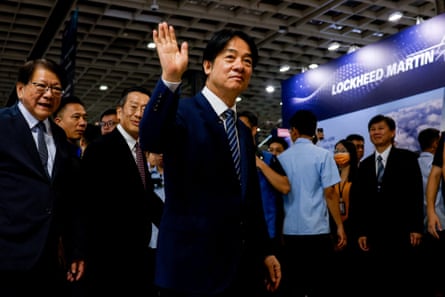
Lai has pushed for greater spending on weapons to deter military aggression from China. The government has proposed a record 18% increase in defence spending for next year, including for drones and missiles, taking it above 1tn Taiwan dollars (£23bn) for the first time.
But many Taiwanese voters would rather that money was spent on more immediate economic issues. Lev Nachman, a political scientist at National Taiwan University, said the national leaders of the DPP and KMT had been notably absent from the mayoral races, reflecting the extent to which campaigns were focused on local issues.
Going into the campaigns for the 2028 presidential elections, Lai would “try to take advantage of the momentum that [Chen] and Su have built for the DPP,” Nachman said, noting that support for those candidates would not necessarily translate into support for Lai.
Tony Yeh, a Taipei man in his 70s, said: “To put it simply, the authorities should do more to boost the economy and buy fewer weapons.”
Taiwan’s economy has boomed this year, largely thanks to the pivotal role that its semiconductor industry plays in the global artificial intelligence rally. The economy grew by more than 14% in the first nine months of the year, the fastest rate in 50 years. But nearly 70% of workers earned less than the average monthly wage of 49,152 Taiwan dollars (£1,137) in the same period.
Yeh said: “Most traditional industries are having a really tough time.”
William Yang, a senior analyst at the International Crisis Group, said: “The issues that really are going to determine their votes are livelihood issues including the stagnant wage, the astronomically high housing price, the affordability issue, and how the government can better make sure Taiwan’s incredible economic boom fuelled by the global AI growth is going to be distributed more evenly.”
Other voters have more niche concerns. Walking her dog in a park, Kuo Wei-tong, a nail salon worker, said policies affecting pets were among her top concerns.
“People are having fewer children and getting more cats and dogs,” she said. “I think that’s something worth giving serious consideration to as well.”
KioskNews shows a cleaned-up reading view extracted from the publisher’s page — the original always lives on their site, not ours.