Marc-Olivier Fortin: Debate seals the CAQ’s fate, as it faces annihilation

Quebec voters had one last opportunity Wednesday to hear the party leaders during the final televised debate. Parti Québécois leader Paul St-Pierre Plamondon (PSPP) rose to the occasion and stood out as a premier in waiting, more than ready to take the reins of power on Oct. 5.
Sign In or Create an Account
A Léger poll published on Tuesday put the PQ ahead at 29 per cent, the Quebec Liberals at 23 per cent, the governing Coalition Avenir Québec at 20 per cent and the Conservative Party of Quebec at 17 per cent. But the most important finding is where support lies among francophone voters, with the PQ sitting at 37 per cent and the CAQ behind13 points at 24 per cent. This advantage among francophone voters puts the PQ within striking distance of a majority government.
CAQ Leader and Premier Christine Fréchette, who tried to play the Trump card early in the campaign and build her electoral narrative on the need to protect Quebec’s economy from the Americans, is witnessing her house of cards collapse around her. As the campaign progressed, she could not keep the narrative alive. Her momentum deflated, she desperately needed a strong performance during this final debate.

Columnist Jesse Kline keeps you up to date with what’s happening in Israel and the effects of antisemitism on life here in Canada. Friday mornings.
By signing up you consent to receive the above newsletter from Postmedia Network Inc.
A welcome email is on its way. If you don't see it, please check your junk folder.
The next issue of Channel Israel will soon be in your inbox.
We encountered an issue signing you up. Please try again
Unfortunately for her, the CAQ’s record kept holding her back. While she tried to talk about new initiatives in health care, her opponents were quick to remind viewers that during eight years of the CAQ government, emergency room waiting times increased by more than 40 minutes, or that her government failed to deliver on its promise to ensure everyone in the province had a family doctor. Fréchette tried to argue the economy was her strength, but she could not hide from the fact the province is facing some of the largest deficits in history. Liberal leader Charles Milliard had a good moment when he said that Quebec faces two major problems: the state of its economy and immigration, and pointed out that Fréchette had been the minister responsible of both during the François Legault years.
Fréchette sounded like a candidate running on a record from which she was also trying to escape. Whenever she could, she tried to bring the debate back to the possibility of a referendum on Quebec independence under a PQ government, but her rehearsed lines fell flat and uninspired. The CAQ does still retain meaningful support, but it is spread inefficiently across the province, leaving the party at risk of winning only a handful of seats or potentially none at all.
While Fréchette was busy sinking her own boat, the PQ leader did not miss his chance to showcase that he was ready to become premier. He was true to his principles, calm and held fast when attacked by the other leaders. He needed to show Quebeckers that his party, despite winning only three seats in the previous election, was mature enough to assume the reins of power and he did so successfully. PSPP was natural and appeared to speak from the heart. In his first 45 seconds, he wasted no time reminding voters the PQ was the party of change. Curiously enough, he was the weakest on sovereignty. Clearly, the threat of Trump’s tariffs has complicated his referendum ambitions, and he appeared uncertain at times about his own plans for independence.
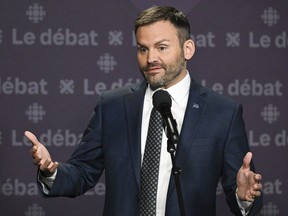
One of the leaders who shone on the referendum issue was Conservative leader Éric Duhaime, suggesting he could become the leader of the federalist “No” camp in any referendum campaign. He was passionate and energetic, noting that he had voted Yes in 1995, but argued that it would be crazy to go down that route again, as it would weaken Quebec’s political power.
Despite leading a party with no members in the National Assembly, Duhaime continues to run a disciplined and principled campaign. He was unapologetic when talking about more private sector involvement in health-care to take pressure off the public system. He was not afraid to declare he would cut subsidies to businesses and made clear he favours cutting red tape and brining in substantial tax cuts. Duhaime brilliantly portrayed his four opponents as offering more of the same, with him being the one to offer a break with the Quebec model of massive state intervention in the economy. Without question, his best debate yet.
While Duhaime knows he won’t be able to form government, he asked Quebecers to elect as many Conservative MNAs as possible to hold the parties that refuse to break with the status quo to account.
As for Milliard, while in good spirits, he could not create a big enough moment to set himself up as a serious challenger to PSPP. Milliard might have succeeded if he worked harder at portraying himself as the candidate of stability now that Fréchette has failed at occupying that space.
Far left Quebec Solidaire leader Ruba Ghazal performed well enough, given that her party sits at 10 per cent in the polls. She will likely be able to save a handful of ridings on the island of Montreal. However, with Quebec Solidaire proposing more of the same state intervention, Ghazal could hardly position herself as a change candidate.
Change is coming. PSPP and the PQ may fall just short of a majority, but one does not have to look far to see who could help keep them in power. Éric Duhaime is on the rise. We could see an alignment of autonomists and sovereigntists in power for years to come. Duhaime, who could deliver the party’s first representation in the assembly since 1935, might be in a position to influence the course of Quebec politics for the next decade.
This last debate has consolidated the PQ’s path to government and the Conservatives readiness for the big stage.
National Post
Marc-Olivier Fortin is the former national Vice-President of the Conservative Party of Canada (2016-2018) and campaign manager for the CPC in Quebec (2021). He is now a regular commentator at RDI and on COGECO radio and works for Transfert, a firm specialized in social acceptability in mining, energy and heavy industry sectors.
Join the Conversation
This website uses cookies to personalize your content (including ads), and allows us to analyze our traffic. Read more about cookies here. By continuing to use our site, you agree to our Terms of Use and Privacy Policy.
KioskNews shows a cleaned-up reading view extracted from the publisher’s page — the original always lives on their site, not ours.