Coalition fight emerges as Taylor urged to ‘stand up’ to Nationals on EU free trade deal
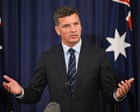
A split is emerging in the Coalition as multiple Liberals privately call for the opposition to negotiate with Labor to support the EU free trade agreement, with some fearing they were being wedged by the Nationals.
The deal has faced stiff opposition from the Nationals whose leader labelled it “the worst deal ever”, as well from some farmers over export levels for agricultural products and a climate clause binding Australia to meet its obligations under the Paris agreement.
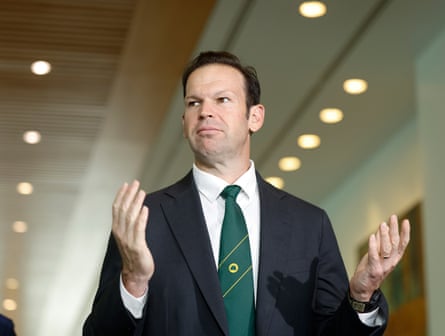
Guardian Australia spoke to six Liberal MPs and senators who raised concerns that Matt Canavan’s attempt to block the trade deal before a formal Coalition decision had been reached had backed the opposition leader, Angus Taylor, into a corner.
Several Liberals, speaking on the condition of anonymity, said the Coalition was the party of free trade agreements, and that wholly opposing the deal would “not be a good sign” for a party of government.
One Liberal MP said the party needed to “stop pandering to the Nationals”.
“They are destroying our reputation in the cities by their pandering to the dark vested interests that sustain them,” they said.
“Gus must stand up and be strong for our values and economic common sense. Otherwise his leadership will be questioned.”
A second, who also asked not to be named, said a group of MPs, largely moderates, were “a bit incensed” by Canavan’s intervention and that the party should “hold their nose” and support the agreement, while negotiating for additional domestic provisions for farmers.
They said the Nationals leading the public debate before the issue had been discussed internally was the “tail wagging the dog”, but that this would not result in a “Sussan-esque fall out” and that the relationship between Taylor and Canavan was still solid.
The former cabinet minister Alex Hawke said the US midterms were an important reminder for the Nationals that protectionist policies did not win votes.
“It’s not a perfect agreement, but I am on the side of letting the government sign the agreement,” he said, adding that to vote against it would be against the national interest.
“I would like Matt Canavan and the Nationals to have a bigger think about the impact of protectionism and tariffs and the catastrophe it’s caused for the global economy.”
The outspoken Liberal senator Andrew McLachlan, who has flagged voting in favour of the agreement, said there were “still many real Liberals in the party room that believe the EU trade deal should be supported”.
“Being a traditional Liberal and one that has consulted on the EU agreement in my state, I see no merit in any of the arguments that suggest that we should oppose the deal,” he said.
A third MP said most Coalition members did not actually understand the agreement, which would be examined in detail by the treaties committee next year.
“Most party room members have no idea what’s in the FTA and keep reading about it in the newspapers,” they said.
Regional voices now ‘louder’ than in the past
They estimated roughly half the party room would support the agreement with caveats such as more money for farmers and clarity on climate provisions.
But they noted that unlike other free trade agreement negotiations, the Coalition now largely consisted of regional MPs representing those regional and agricultural industries, “therefore the voices on the ag side are much louder than they’ve previously been”.
A senior Liberal backed in this view.
after newsletter promotion
“Since we came into opposition, the Nationals have been expanding their reach and control over the Coalition’s messaging, and every leader has to wrestle with it – Dutton, Sussan, and now Angus,” they said.
“We’re hoping Angus will understand that free trade is in the DNA of the Liberal party and we need to have a strong position on this.”
Five other Liberals disagreed with the “perception” that Taylor had been wedged.
One said it was “entirely appropriate” that the leader of a party committed to agricultural regions would lead the debate.
“Particularly the [deal’s] constraints on Australia’s governance on climate would be unacceptable to most voters,” they said.
“The economy is everything that matters and any conditions that would be detrimental needs to be debated.”
The MP said given the party room rejected net zero just over 12 months ago, raising concerns about the cost of policies is legitimate.
After almost a decade of negotiations, Labor hammered out a deal with the bloc in March, expected to be worth $10bn a year.
The deal contains a commitment to respect the Paris climate agreement, which Australia is already a signatory to.
The shadow foreign minister, Ted O’Brien, has asked Labor to push for a letter from Europe clarifying that as long as Australia remains a signatory to Paris any future government will maintain sovereignty to make other climate policy changes.
Labor, which holds 30 seats in the Senate and needs nine more to reach a majority, says it could cobble together a “Frankenstein” agreement with crossbenchers and renegade Liberals to pass legislation in the upper house. It could also secure the support of the Greens.
There is no single bill for the deal, but smaller pieces of legislation that need to be passed to implement the agreement.
The trade minister, Don Farrell, said his door was “always open” to parliamentarians.
“My aim is that every single vote is in favour of this deal, which is crucial for Australia’s future,” he said.
Taylor has previously said Labor would be in breach of the trade agreement “almost immediately” as the government wasn’t on track to meet its own climate targets.
KioskNews shows a cleaned-up reading view extracted from the publisher’s page — the original always lives on their site, not ours.