On Sun Yat-sen anniversary, Xi calls for dialogue on Taiwan with ‘people of vision’
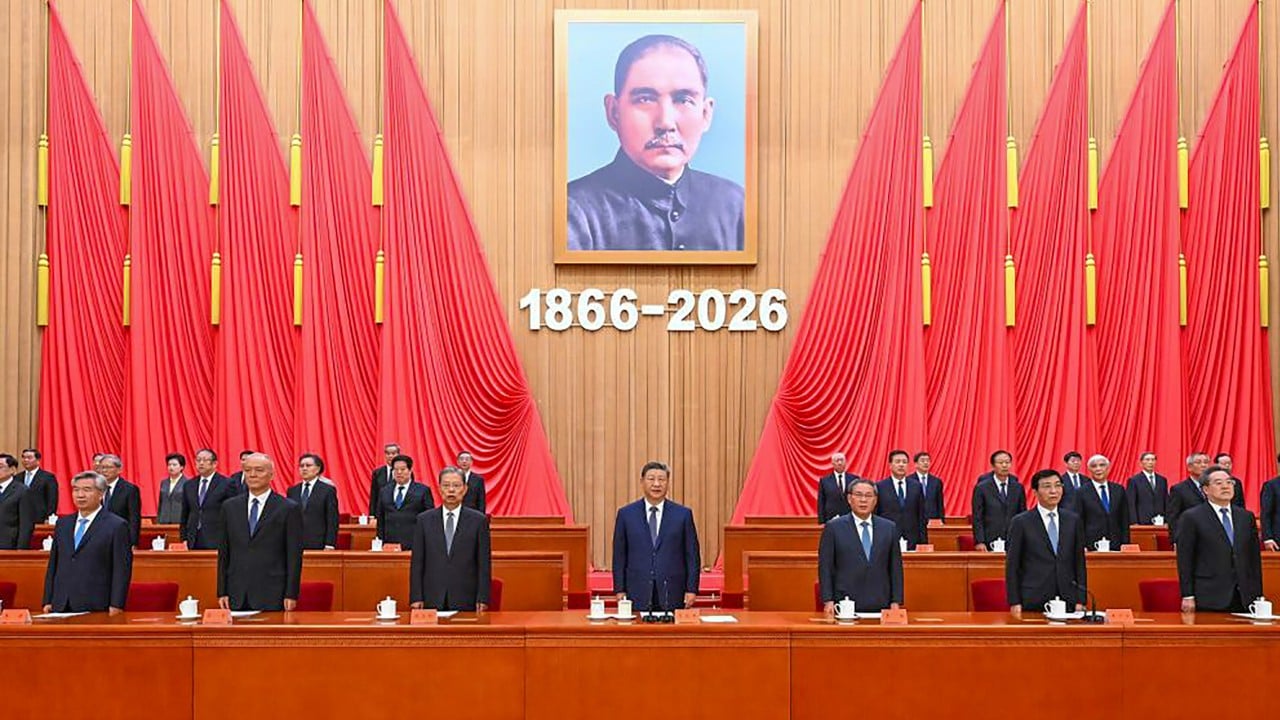
“We will certainly take full account of Taiwan’s realities and fully accommodate the interests and feelings of Taiwan compatriots, but we will never leave any room for any form of Taiwan independence separatist activities.”
The 1992 Consensus is an informal agreement that there is only one China, but the two sides may disagree on what that means.
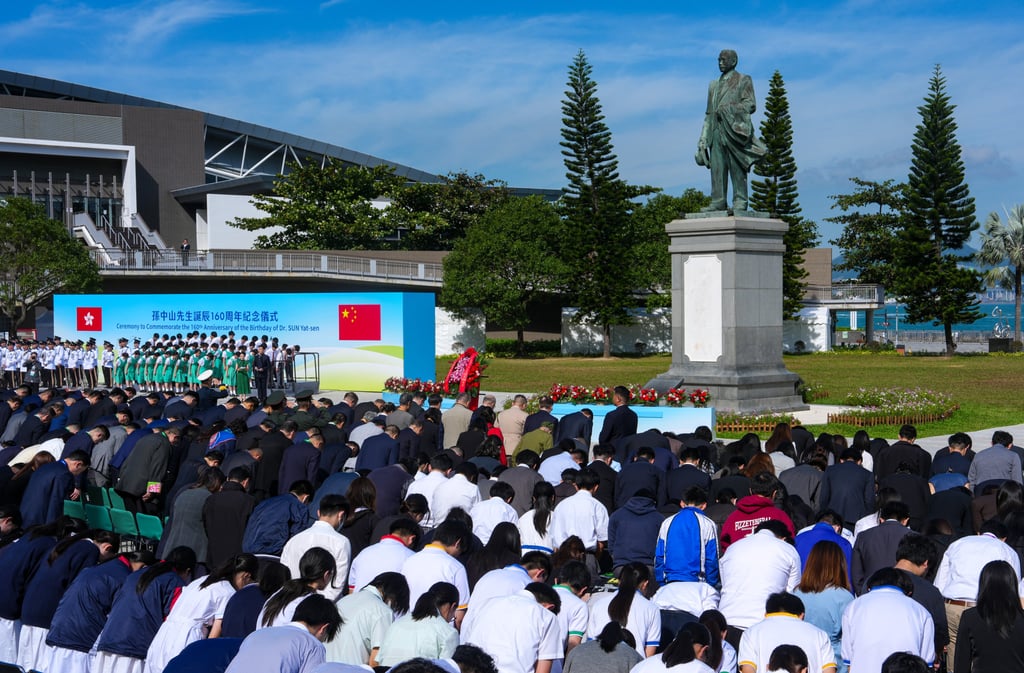
Other commemorative events included one in Hong Kong, where the city’s Chief Executive John Lee Ka-chiu led the tributes in Sun Yat-sen Memorial Park in Sai Ying Pun alongside community representatives.
Citing Sun’s maxim that “the greatest thing in being a person is knowing how to love one’s country”, Lee said the Hong Kong government was committed to strengthening patriotic education and fostering mainstream values centred on loving the country and Hong Kong.
He said this aligned with the one country, two systems framework, and urged residents to safeguard national unity and contribute to national modernisation.
He used the city as a crucial base to raise funds and plot early uprisings against the Qing dynasty through his Revive China Society.
Sun went on to found the Kuomintang (KMT) and spearhead the 1911 revolution that overthrew the Qing and ended more than two millennia of imperial rule before establishing Asia’s first republic the following year.
He also told students during a 1923 speech at the University of Hong Kong that his revolutionary and modern political ideas had originated entirely in the city.
Xi’s speech highlighted Beijing’s dual-track approach of seeking to reach out to the Taiwanese public while putting military and other forms of pressure on the pro-independence camp.
Beijing says peaceful reunification is the best solution for Taiwan, but has never ruled out the use of force.
02:20
US accuses mainland China of targeting Taiwan leader’s family in surveillance case
Meanwhile, policy advisers in Beijing are mapping out detailed proposals on how to govern the island after reunification, suggesting it may offer a high degree of autonomy if the island is willing to start talks without being coerced.
Xi quoted Sun’s statements that “China is a unified country” and that unification was “the shared hope” of all Chinese nationals.
He also said people on both sides of the strait were “members of one family bound by blood”, adding that “there were no disagreements that could not be resolved through calm discussion and consultation”.
“Taiwan’s future lies in national reunification, and the well-being of Taiwan compatriots rests on the great rejuvenation of the Chinese nation,” Xi told the commemoration, warning that complete reunification “must be achieved and will certainly be achieved”.
Born in 1866 in the southern province of Guangdong, Sun is honoured across the political divide as the architect of modern China.
He occupies a rare dual status in contemporary Chinese politics: he is officially venerated as the “Father of the Nation” in Taiwan, while Beijing also hails him as the great “forerunner of the democratic revolution” whose unfulfilled vision of national renewal the Communist Party says it has realised.
In Beijing, it is traditional to display Sun’s portrait in Tiananmen Square during the Labour Day and National Day holidays.
Meanwhile in Taiwan, the oath laws state that office-holders have to be sworn in under the Republic of China flag and a portrait of Sun – a ritual even the island’s leader William Lai Ching-te, of the independence-leaning Democratic Progressive Party (DPP), observed upon taking office in May 2024.
However, some lawmakers have questioned its symbolic relevance. In 2020 and 2022, several DPP lawmakers made a failed attempt to remove the requirement for elected officials to face Sun’s portrait while taking their oaths.
Cross-strait relations have come under increasing strain since the DPP returned to power in 2016, and Beijing has repeatedly described Lai as a “troublemaker” and separatist.
Beijing regards Taiwan as part of China and has never renounced the use of force to reunite it with the mainland.
Most countries, including the island’s main international partner the United States, do not recognise Taiwan as independent, though Washington is legally committed to supplying it with defensive weapons and opposes any forcible takeover.
Zhu Songling, a professor at the Institute of Taiwan Studies at Beijing Union University, said Xi’s remarks came at a critical juncture, citing the heightened cross-strait tensions and this month’s local elections in Taiwan and Asia-Pacific Economic Cooperation summit in Shenzhen, where the Chinese leader is expected to meet Donald Trump.
“Against this backdrop, the speech re-emphasises the mainland’s policy direction and political bottom line on resolving the Taiwan question,” Zhu said.
Zhu added that Xi made a comparable appeal in 2019, when he proposed exploring a one country, two systems framework for Taiwan and called for consultations with representatives from the island.
“While 2019 focused on putting forward a political vision for resolving the issue, this one is about further underscoring the continuity of existing policies – something we will need to watch following this speech,” Zhu added.
Xi’s speech also presented the Communist Party as the legitimate custodian of Sun’s legacy, saying party members were the “staunchest supporters, most loyal collaborators and most faithful successors to Dr Sun Yat-sen’s revolutionary cause”.
He described Sun as “a great national hero, patriot and pioneer of China’s democratic revolution” and also cited his Three Principles of the People – a doctrine based on nationalism, democracy and the well-being of the people – and cooperation with the Communist Party.
Xi also outlined several ways to carry forward Sun’s call to “rejuvenate China” by linking Beijing’s current foreign policy agenda with the revolutionary leader’s vision of China “bearing a great responsibility for the world” and helping “all humanity to share a brighter future”.
Xi projects confidence for China’s Communist Party at 105th anniversary event
Xi said Sun had championed a policy of “openness” and mutual learning between civilisations, while insisting that China must not “follow the old path of Western civilisation”.
Invoking Sun’s concern for people’s livelihoods, Xi pledged to make concrete progress towards “common prosperity” so that the gains of modernisation would be distributed more equitably.
He also highlighted Sun’s perseverance through repeated setbacks while urging officials to cultivate a “fighting spirit” and bolster national security capabilities as China navigated “high winds, choppy waters and even dangerous storms” in a turbulent domestic and international environment.
The ceremony in Beijing – which took place under a large portrait of Sun – featured the full line-up of China’s top political leadership. All seven members of the Politburo Standing Committee attended the event, which had roughly 3,000 attendees according to Xinhua, and representatives of Sun’s family were also present.
Meanwhile in Taipei, the KMT – the party Sun founded – paid its own tributes as party chairwoman Cheng Li-wun led senior party executives in laying flowers before a bronze statue at his memorial hall.
In Macau, Chief Executive Sam Hou-fai and senior officials opened a commemorative series and photo exhibition featuring more than 100 historical artefacts, including an audio recording of Sun speaking in Cantonese.
In his speech, Sam urged Macau residents to uphold the “patriots administering Macau” principle, leverage the city’s role as a bridge between China and the world, and rally broader support at home and abroad for peaceful reunification and one country, two systems.
KioskNews shows a cleaned-up reading view extracted from the publisher’s page — the original always lives on their site, not ours.