‘Nobody showed up but me’: will Friendsgiving survive gen Z?

It’s a TikTok scene straight out of a stress dream: two men stand in their freshly cleaned apartment, explaining how all but one of the people they invited to Friendsgiving flaked out at the last minute. There is a can of whipped cream on the table and a 6lb ham in the oven. According to the video, posted by pop-culture podcaster Jackson Strike, those who ditched were either tired, or sick, or had a difficult day at work.
More than 1.5 million people liked the video and many flooded to the comments section to express their disappointment at what they saw as an epidemic of antisocial behavior. “Everyone wants a village until they have to be a villager,” one user wrote. “Time to get new friends,” quipped another.
Elsewhere on the app, a user showed off a woman’s hard work decorating for Friendsgiving: an autumnal mise en place with pumpkin and gourd centerpieces and no fewer than four desserts. Except, there were no guests. “Nobody showed up but me,” the user captioned the clip, punctuated by three broken-heart emojis. Again, outrage in the comments. “Dump them quick,” one advised.
For a certain type of urban transplant, Friendsgiving is an enduring tradition. It’s supposed to be a fun, informal hang as well as a communal affair, with guests splitting up the labor and cost that comes with serving a feast. But for burned-out younger people who extol the pleasures of Jomo (that would be “joy of missing out”, a reframing of millennial-era Fomo), Friendsgiving may feel less obligatory now than it did in the very recent past.
The ritual is the stuff of sitcom TV tropes – Friends made nine Thanksgiving episodes – and gives people a chance to celebrate with their chosen family, especially if their biological one lives too far away for a quick trip home. It was first put in print in 2007, when Usenet and Twitter users coined the term. The next year, according to Merriam-Webster, human interest stories about Friendsgiving started popping up in newspapers. (“Friends, coworkers, neighbors and ‘holiday orphans’ can celebrate a fantastic ‘Friendsgiving’ instead,” wrote the Pensacola News Journal in 2008.)
Soon, Friendsgiving became an advertising concept (have a “Friendsgiving with Bailey’s”) and a Real Housewives of New Jersey plot point (Teresa Giudice abstained from gathering with family to feast with her girlfriends instead). Millennials who came of age after the 2008 financial crisis saw it as an opportunity to cosplay as Boomer parents in their salad days, recreating the cozier trappings of suburban life that now felt economically out of reach.
But how does gen Z, an infamously lonely and friendless cohort, handle a tradition that requires old-school socializing? Some might be cancelling at the last minute, or abstaining altogether. “Millennials create shit like ‘Friendsgiving’ like that’s not the most low key depressing thing ever,” read a recent post on X, which led to significant backlash from older users. (“Zoomers are just too young to understand the pre-2010s world dominated by obligation and tradition for tradition’s sake that prioritized repetition over enjoyment,” wrote one user, who called the holiday an “incredible Millenial invention”.)
“It’s like a bunch of performative friend groups,” went another TikToker’s anti-Friendsgiving rant. “Go call your mom.”
There is another reason gen Z might opt out of Friendsgiving, and it’s not of their own making: 31% of the cohort said in a study conducted by the financial services company Empower that they will skip Thanksgiving due to rising grocery costs.
Among other friend groups, the tradition holds strong. One survey conducted by consumer research brands Ogilvy and Ideally found that 41% of gen Z adults consider Friendsgiving “equally or more meaningful than Thanksgiving with family or relatives”. They were twice as likely than the general population to call it “their most meaningful celebration”.
Like their millennial elders, gen Z feel stilted in their maturity as the traditional milestones of adulthood such as buying a house remain hopelessly out of reach. Fortune called Friendsgiving a “social anchor” for young people, and a means of self-expression: last week, K-pop fans in Dallas threw a BTS-themed gathering. It’s also a break from family, which gen Z is more likely to live with (nearly half of all US adults under 30 room with their parents).
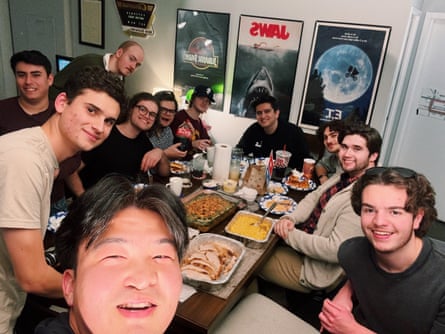
A representative for the Partiful app, which is favored by younger generations, said that Friendsgiving events in 2026 have doubled year over year. Olivia Pollock, a party data analyst and etiquette expert at the invitation app Evite, says that 43% of all Thanksgiving-related Evites are Friendsgivings, an increase from 37% back in 2022.
“There’s an uptick in the casual, less formal, millennial-style dinner parties,” Pollock said. “The word ‘cozy’ has really been popping up in invitations this year.” She also noted a rise in “PJs and TJs” parties – TJs meaning Trader Joe’s. “Trader Joe’s has a magic spell over gen Z, and so that theme is falling into Friendsgiving as well.”
Carlos Lerma, a 23-year-old living in New York, will join about nine of his friends for a Thanksgiving celebration this week. Lerma, who works in post-production for a tech company, grew up in Mexico; he never observed the tradition until he moved to the states at age 19. This year, he’s making mac and cheese for the table.
“It’s a really nice opportunity to get together with a chosen family,” Lerma said. “Especially as gen Z, we all kind of want to grow up too fast, so it’s a really cool thing to experience with people our age, making dinner and dressing up as if it were a nice family reunion at your aunt’s house.”
KioskNews shows a cleaned-up reading view extracted from the publisher’s page — the original always lives on their site, not ours.