Indonesia scheme turns hunters into protectors
AFP, KAPUAS HULU, Indonesia


Indonesian villager Octavius wades through the forest in rubber boots and tattered joggers, ears pricked, eyes peeled, a telephoto lens on his phone primed to capture orangutans, monkeys or birds.
The daily photograph hunt earns Octavius and hundreds of others in Borneo cash as part of a conservation program seeking to make animals worth more alive than dead.
Locals on the island have long made money from hunting wild songbirds and selling them, mainly to domestic customers.
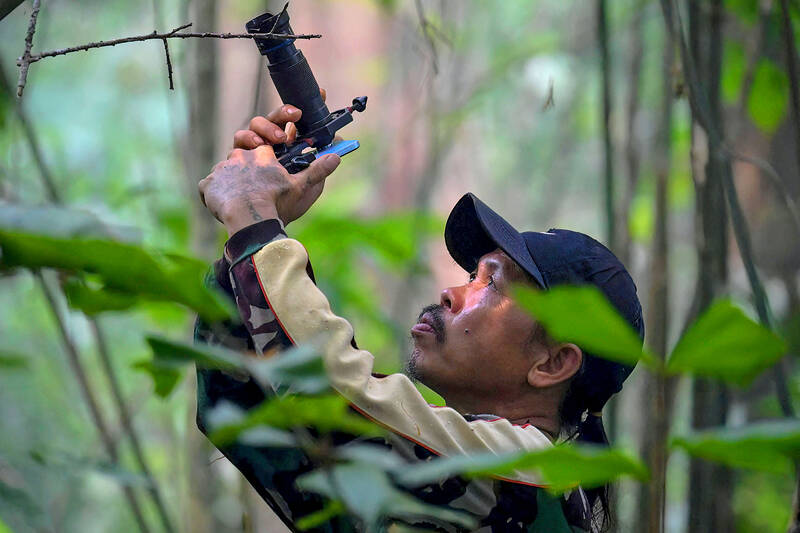
Wildlife observer Octavius photographs wildlife in a forest near Labian, Indonesia, on Sept. 2.
Photo: AFP
The KehatiKu project aims to break that cycle by paying people in nine participating villages in West Kalimantan Province for photos or recordings of animals instead.
Payments range from 5,000 rupiah (US$0.30) for observing a common bird, to 130,000 rupiah for an endangered orangutan — the top prize.
The most successful observers earn up to 10 million rupiah a month, several times an average farmworker’s income.
The extra cash “really helps, especially to pay for my children’s college,” said 50-year-old Octavius, who like many Indonesians uses a single name.
The program, run by environmental consultancy Borneo Futures, began two years ago and produces data on wildlife distribution and population changes.
Most participants are small-scale farmers of rice, cacao, durian and the stimulant kratom.
Early signs suggest that the scheme is working.
“People have started to realize that where previously they caught one bird and it was worth 50,000 rupiah, now they just need to take a photo, send it to us, and they can receive a payment of 5,000 to 10,000 rupiah,” Borneo Futures Indonesia director Nardiyono told reporters. “If they take just five photos, they [may] earn 50,000 rupiah, and the bird is still in their environment, still observable, and still able to reproduce, so the potential income from observing birds is far greater than from hunting birds.”
That shifting logic has prompted two participating villages to voluntarily introduce hunting bans since the project started, Nardiyono said.
The program is funded by philanthropic foundations and has received about US$300,000 to date, Borneo Futures said.
Half has gone toward development, including a mobile app for uploading animal sightings and an artificial intelligence system that helps humans verify observations.
So far, users have submitted more than 350,000 observations, about half of which have been validated and paid for.
Invalid entries might include multiple observations of the same animal, or a species that is not on the program’s list.
This month, Octavius and dozens of others gathered at the tiny office in Labian village — population 683 — for their monthly payments.
His share was 4 million rupiah, or nearly US$230.
“This is a side-job; it doesn’t interfere” with farming, he told reporters as he showed off a patch where he grows kratom and cacao. “Sometimes when we’re working, when everyone is gathered to collect kratom leaves, we hear birds calling, so we go over, observe them — if we can take a photo, we take a photo; if not, we just make a sound recording.”
The program’s model is “likely better for both environmental and social impacts than an unincentivized, top-down conservation project design,” said researcher Paul Ferraro of the Baltimore, Maryland-based Johns Hopkins University.
The main challenge will be maintaining funding, Ferraro said.
“People may revert to their prior behavioral patterns because the incentive payments are insufficient when the enthusiasm has waned,” said Ferraro, an expert in human behavior and public policy.
For now, Borneo Futures has funding secured through 2028, and two more villages are to join next month.
It pays for observations of 73 species, including birds, monkeys, wild cats and deer.
KioskNews shows a cleaned-up reading view extracted from the publisher’s page — the original always lives on their site, not ours.