Scientists spot elusive South American bush dogs just 12 times in 25 years
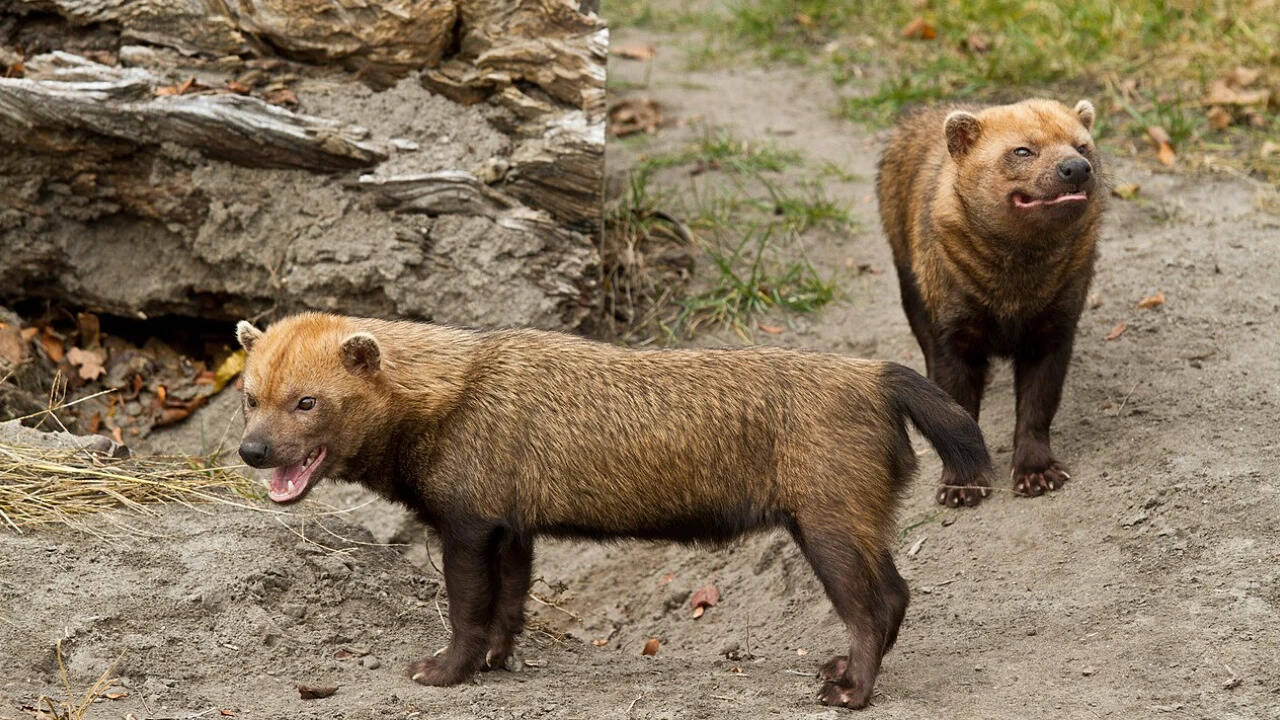
Image Courtesy: Wikimedia Commons
Some of us would love to go through life unseen, hiding in the shadows. For those who would like a life of the unknown, could all take a page out of bush dog’s book.The bush dog is a small, forest-dwelling carnivore native to Central and South America.
Despite decades of wildlife monitoring across the continent, researchers have managed to photograph this elusive animal remarkably few times.
And a new study suggests that it may be even rarer than scientists previously thought.The numbers are rather difficult to wrap your head around. Researchers at Wildlife Conservation Society examined 611,159 camera-trap nights collected over 25 years across 7 South American countries. Out of all that footage, bush dogs appeared on just 12 occasions.
That is a surprisingly small number for an animal that occupies such a large geographical range, and it has prompted fresh questions about how well scientists understand its population and conservation status.
About the bush dog
The bush dog is not quite what its name might suggest. Scientifically known as Speothos venaticus, it belongs to the canid family, which also includes wolves, foxes and domestic dogs. It is a relatively small animal, weighing up to around 7 kgs, with a stocky body, short legs, rounded ears and a rather unusual appearance that makes it look almost like a cross between a dog and a weasel.
It lives in tropical forests and forest-grassland landscapes across Central and South America, from Costa Rica to parts of Brazil and Argentina.Unlike many of its better-known relatives, the bush dog is also a social animal. It can live in groups of up to 12 and hunts cooperatively, feeding on a variety of prey. Its large home range means that a family group may travel considerable distances in search of food. Yet, despite its wide geographical distribution, researchers know surprisingly little about its population.
How many bush dogs are there?
To understand just how uncommon these animals might be, scientists from the Wildlife Conservation Society (WCS) brought together camera-trap data collected between 2001 and 2025. The research, published in Canid Biology & Conservation, covered 97 sites across Bolivia, Brazil, Colombia, Ecuador, Paraguay, Peru and Venezuela. A total of 6,756 camera stations were used, producing more than two million photographs of wildlife.Of these, only 55 photographs showed bush dogs, representing 12 independent sightings and 14 individual animals.
The animals were recorded in just four countries: Bolivia, Brazil, Colombia and Ecuador. In Paraguay, Peru and Venezuela, not a single bush dog was photographed, despite more than 80,000 camera-trap nights across the three countries.The comparison with other carnivores makes the findings even more striking. According to the WCS research, bush dogs were detected around 50 times less frequently than short-eared dogs, 100 times less frequently than jaguars and almost 280 times less frequently than ocelots.
Even animals that are generally considered difficult to spot were appearing on camera considerably more often.
Could their small size contribute to fewer sightings?
Researchers also considered whether the bush dogs were simply harder for cameras to capture. Their small size and low stature could make them less visible to equipment positioned above the ground. However, the cameras regularly photographed pacas, mammals of a broadly comparable size and shape. Bush dogs also tend to travel in groups, which should theoretically make them easier to detect.
This suggests that their absence from the footage may have less to do with camera limitations and more to do with just how few animals there are.Robert Wallace, senior conservation scientist at WCS and lead author of the study, said the findings provided compelling evidence that bush dogs exist at extraordinarily low densities, rather than simply being difficult to photograph.The researchers estimate that there may be fewer than one bush dog per 100 square kilometres across much of its range.
In Amazonian forests, where much of its population is believed to live, the density could be even lower, potentially fewer than one animal per 350 square kilometres. These estimates are still uncertain, but they offer an indication of how widely dispersed the animals may be.And being so spread out comes with its own set of problems. Habitat destruction, forest fragmentation, wildfires, climate change and road development can all affect the areas these animals depend on.
Disease is another concern. Domestic dogs can transmit infections such as canine distemper, parvovirus and rabies, which could have devastating consequences for already small and isolated bush dog populations.The species is also currently classified as Near Threatened on the International Union for Conservation of Nature's (IUCN) Red List, based on an assessment published in 2011. The new research adds substantial evidence that its conservation status may need to be reassessed.
Limitations of WCS’ findings
However, the scientists are careful not to treat the findings as a complete picture. Much of the camera-trap data came from continuous rainforest in the western Amazon, meaning other ecosystems within the bush dog's range still need to be studied. Further research across regions such as the Cerrado, Pantanal and Llanos could help establish whether similarly low numbers are found elsewhere.For conservationists, the challenge now is not simply to find more bush dogs, but to understand where they live, how many remain and what might put them at risk. Sometimes, what a camera does not capture can be just as important as what it does.
KioskNews shows a cleaned-up reading view extracted from the publisher’s page — the original always lives on their site, not ours.