It’s the world’s largest city, but you won’t see many tourists
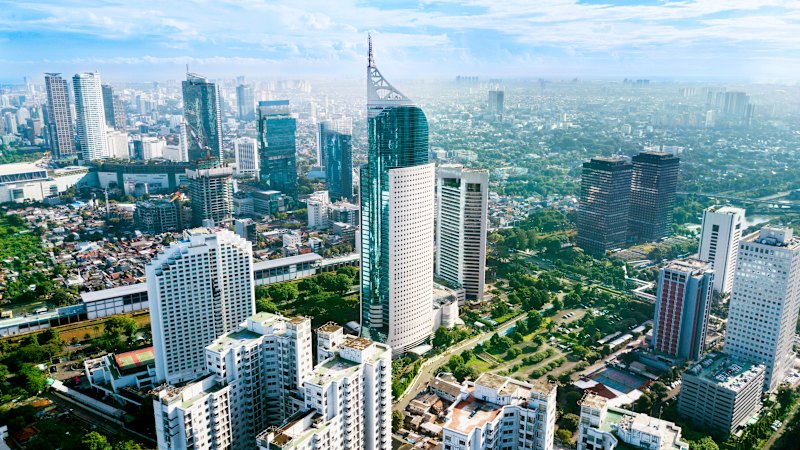
Each Sunday the central streets of the world’s largest city are closed to its relentless traffic between 6am and 11am. It’s a once-a-week opportunity for residents to breathe easy, or at least a little easier, and to enjoy some open space in a place chronically deprived of such a thing.
This Sunday is special, however, as it’s the occasion of the urban behemoth’s 499th birthday, with the usual roar of vehicles replaced by a mass celebration complete with a raucous on-stage ceremony. You could be forgiven for presuming that the city in which I find myself is Tokyo. Or perhaps Delhi. Maybe even Cairo. Think again. This is Jakarta.
As a kind of surprise birthday gift, the United Nations crowned the Indonesian capital as the world’s newest most populous city, with nearly 42 million residents. It was followed by Dhaka, Bangladesh, with almost 40 million people, and Tokyo with a comparatively meagre 33 million (presumably falling due to Japan’s rapidly declining population).
Why am I here? It’s a good question. Gertrude Stein, the American novelist, poet and playwright, could have been thinking of Jakarta, rather than Oakland, California, her childhood home, when she coined the immortal line: “There’s no there there.”
True enough, Jakarta remains one of South-East Asia’s least visited and appreciated cities, at least by Westerners, and true again, I’m literally the sole Caucasian I notice among the throng at its birthday party. But what Jakarta does offer is an authenticity largely untainted by mass tourism.
Sign up for the Traveller Deals newsletter
Get exclusive travel deals delivered straight to your inbox. Sign up now.
The news of Jakarta’s newfound status as the world’s most mega megacity intrigued me, and it’s always been my policy as a traveller to give every place a go. Of course, it helped that I’d been invited to spend some time at The Legian, an upscale beachside resort in Seminyak, Bali. So, why not make a detour via the city unflatteringly nicknamed The Big Durian, after the malodorous tropical fruit banned on many a South-East Asian train line?
“I’m convinced that Jakarta will become a destination city like Bangkok in a few years,” Hans Joerg Meier, managing director of Legian Hotel Management (LHM), told me. “Visit now before everyone goes.”
Visit I do. But for me, there’s another compelling personal reason to visit. I’ve long been a fan of The Year of Living Dangerously, both the 1978 Christopher Koch novel and the 1982 Peter Weir film on which it is based, starring Mel Gibson and Sigourney Weaver.
The most notable performance in the underrated film – set in 1960s Indonesia, during the overthrow of President Sukarno – is by actress Linda Hunt, who won the 1983 best supporting actress Oscar for her portrayal of the diminutive character Billy Kwan, becoming the first actress to win an Oscar for playing a man.
One of the most dramatic scenes in the film is when the idealistic Kwan hangs a sign, “Sukarno feed your people”, from what doubles as the Hotel Indonesia, as a public protest against the controversial inaugural Indonesian president, who served in the role between 1945 and 1967.
The Hotel Indonesia is still there, complete with a huge black-and-white photograph off the lobby of President Sukarno with Marilyn Monroe, in which he appears to be admiring her breasts. Now rebranded as the 289-room Hotel Indonesia Kempinski and directly linked to the gargantuan Grand Indonesia shopping mall, it opened in 1962, becoming Indonesia’s first five-star property.
Symbolising the emergence of the former Dutch colony as a modernising, forward-thinking independent nation, the hotel sits immediately opposite Bundaran HI, a massive roundabout with the welcoming bronzed Selamat Datang Monument as its centre. The roundabout is among Jakarta’s most photographed landmarks, and one that’s particularly impressive illuminated after dark.
So difficult is it to negotiate on foot, with its incessant multi-lane traffic, there’s a government plan to build an underground pedestrian tunnel as a safer link to the five-star hotels huddled around it. In a city full of stellar and affordable accommodation, the retro Hotel Indonesia Kempinski, where I appear to be the only Western inhouse guest, is itself a worthy reason for visiting Jakarta, though there’s an even better excuse.
Named as one of TIME magazine’s “world’s greatest places” for 2026, the 25-room House of Tugu is a living museum in which you can stay. Its historic eight-storey facade almost entirely enveloped in vegetation, the hotel is located in Old Jakarta (Kota Tua), where architectural remnants of the Dutch colonial rule survive.
Opened last year after two decades of planning and development, the hotel is a repository of Peranakan heritage in the form of 1000 or so antiques, each collected over nearly 60 years by Anhar Setjadibrata, co-owner of Indonesia’s Tugu Hotels & Restaurants group, his wife Wedya Julianti and daughter Lucienne Anhar.
This is calculated and considered hoarding on the grandest scale; so much so that the House of Tugu team is building a new museum wing, due to open early next year, to house and exhibit yet more items that are now in storage.
“Jakarta is still misunderstood as a destination,” says Lucienne Anhar. “For many foreign visitors, Indonesia means Bali. And Bali is wonderful, but Indonesia is much bigger and culturally much more complicated than Bali alone.”
True enough. What little many Australians do know about Jakarta is that it’s to be largely replaced by a new capital, Nusantara, which is rising, rather slowly, but impressively, in the jungles of East Kalimantan, on the island of Borneo.
Another known fact is that Jakarta’s traffic is even worse than Bangkok’s. In fact, the Hotel Indonesia Kempinski dedicates a whole page on its website advising ways to cope with traffic in a city largely starved of public transport. Then there’s the fact that Indonesia’s largest and low-lying city is sinking, probably faster than its replacement’s construction, which Indonesia’s incumbent president seemingly doesn’t support with the same vigour as his predecessor.
I witness the sinking problem myself when I visit Sunda Kelapa, Jakarta’s old port. It’s still replete with 18th-century whitewashed Dutch colonial-era maritime administrative buildings, but seawater is visibly inundating the immediate wharfside area where classic wooden sailing ships, known as pinisi, are moored. Ominously, by 2050, parts of Jakarta are predicted to be submerged. One area, North Jakarta, has sunk 2.5 metres in the past decade.
“Jakarta is not an easy city in the conventional tourist sense,” says Lucienne Anhar, in something of an understatement. “It is huge, busy, chaotic and sometimes exhausting. But that is also what makes it interesting. It is the place where so many different Indonesians meet.
“As a capital city, it hosts performances of the most talented artists representing cultures of the different islands. We know Jakarta also has extremely exciting nightlife, fantastic restaurants, really great food and very welcoming people.”
I have to agree. Indonesia is known for its friendly people, but the citizens of Jakarta are even friendlier still, and this among the stresses and strains of the biggest city in human history.
Jakarta’s not for everyone, but I have nary a scintilla of regret in spending five intriguing, and, yes, at times, challenging, nights here. In fact, I can’t wait to return for the grand opening, if they’ll have me, of the House of Tugu’s new museum. I gave it a go, and I’d give it a go again.
THE DETAILS
STAY
Rooms at the Hotel Indonesia Kempinski, Jakarta, are from $190 a night; at the House of Tugu, Jakarta, rooms are from $224 a night; at The Legian Seminyak, Bali, rooms are from $617 a night. Additional taxes and fees may apply. See tuguhotels.com; kempinski.com; lhm-hotels.com
FLY
Garuda Indonesia operates six flights a week between Sydney and Jakarta, and four flights a week between Melbourne and Jakarta.
Connect to Denpasar, Bali, from Jakarta on regular domestic services that take under two hours. See garuda-indonesia.com
MORE
indonesia.travel
The writer travelled with the assistance of The Legian Seminyak, Bali resort and paid for his accommodation in Jakarta.

KioskNews shows a cleaned-up reading view extracted from the publisher’s page — the original always lives on their site, not ours.