What is Ebola and why is the outbreak in DRC causing so much concern?

Health authorities in the Democratic Republic of the Congo are losing their battle to contain the country’s deadliest Ebola outbreak.
DRC’s health ministry declared an outbreak in Ituri province on 15 May, though sequencing shows it had begun in February. It has since spread to five other provinces and is on track to overtake the 2014-16 west Africa outbreak as the largest in history.
As of Sunday, 2,325 people had died and the number of confirmed cases stood at 4,945, according to DRC government data. “Ebola is winning in the Democratic Republic of the Congo,” the UN humanitarian affairs chief, Tom Fletcher, said on Friday. “We cannot let the virus outrun our response.”
Neighbouring Uganda, which recorded 20 cases and two deaths, was declared Ebola-free on 28 July.
What is Ebola?
Ebola is a highly contagious and often fatal disease. Caused by different viruses mostly associated with fruit bats, the infection often results in viral haemorrhagic fever. More than 40 outbreaks have been documented since it first emerged in 1976. This is the 17th outbreak in DRC.
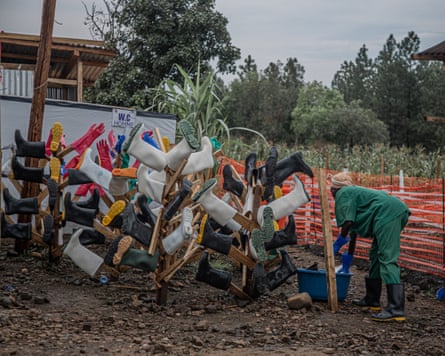
Outbreaks result from zoonotic spillover – animal to human transmission. Infected humans, which can include dead bodies, then pass on the disease to others through bodily fluids such as vomit, blood and semen. Symptoms include fever, fatigue, muscle pain and headache followed by vomiting, diarrhoea, rash and internal and external bleeding. It has a 50% death rate.
There are four types or strains of Ebola that affect humans: Zaire, Sudan, Bundibugyo and Tai Forest. The latest outbreak involves the rare Bundibugyo virus. There have only been two previous outbreaks involving this strain, in 2007 and 2012.
Why is this outbreak causing such concern?
There are many factors, including the lack of a vaccine or treatment for this strain of Ebola, conflict, mistrust towards health workers in the affected areas, misinformation, and global development aid cuts.
Clinical trials of two possible treatments for the Bundibugyo strain began last month, and two vaccines developed for it are being tested on people for the first time. While no vaccine is available, infection control usually involves bringing those affected into treatment centres to minimise transmission.
This effort, however, is being stymied by attacks on healthcare facilities, often sparked by misinformation about safe burial practices, and fuelled in the longer term by the impact of decades of unrest and outside interference on traumatised communities.
The outbreak is also centred on a mineral-rich region fought over by armed groups. The government still largely controls Ituri, but insecurity there had been worsening there before the outbreak was declared. Almost a million people in the province have been displaced by conflict, according to the UN’s humanitarian office.
The outbreak has also spread south to rebel-held areas of North Kivu and South Kivu provinces, where the Rwandan-backed M23 group controls large swathes of the region.
Humanitarian funding for DRC declined sharply in 2025, largely because the Trump administration froze foreign aid assistance to programmes funded through the state department, weakening local health systems and surveillance networks.
Health workers at a treatment centre in Ituri went on strike recently, leading to the temporary its closure, saying they had not been paid for three months.
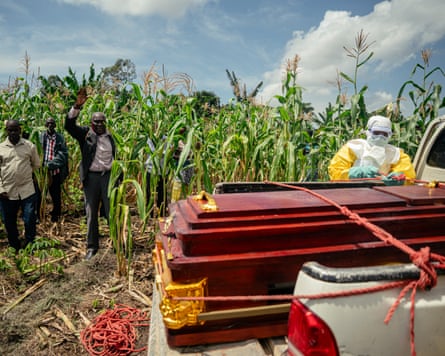
Why was the outbreak not detected sooner and why does that matter?
The earliest-known suspected victim, a 59-year-old man, developed symptoms on 24 April and died three days later. Health authorities were only alerted to the outbreak through social media on 5 May. Fifty people had already died by then, according to the Africa Centres for Disease Control and Prevention.
The World Health Organization says sequencing now shows the outbreak had begun in February.
Slow detection gave the outbreak time to spread. Any delay in responding to an Ebola outbreak “can have catastrophic consequences”, said Dr Anne Cori, an associate professor in infectious disease modelling at Imperial College London. Undetected outbreaks “can make standard control measures, such as contact tracing, considerably more difficult to implement effectively, especially in a setting which already faces other challenges such as conflict”.
How big could this outbreak get?
A lot bigger, potentially. It is on track to surpass the previous largest Ebola outbreak, when more than 28,600 people were infected and 11,325 died in Guinea, Liberia and Sierra Leone between 2014 and 2016, according to WHO data.
It is also the fastest-growing outbreak in the known history of Ebola. It took almost five months for the west Africa outbreak to reach 1,000 deaths, compared with more than 2,000 deaths in less than three months in this outbreak.
The head of the WHO’s emergency response division, Abdirahman Mahamud, said recently that if the response was implemented at the same time across the five transmission zones, a turnaround in three months might be expected.
But even with that response, he said the outbreak would not peak for six months under a “moderate” scenario and that it could as long as 12 months.
KioskNews shows a cleaned-up reading view extracted from the publisher’s page — the original always lives on their site, not ours.