Rare Nanotyrannus skeleton found on Montana ranch could fetch up to $9 million
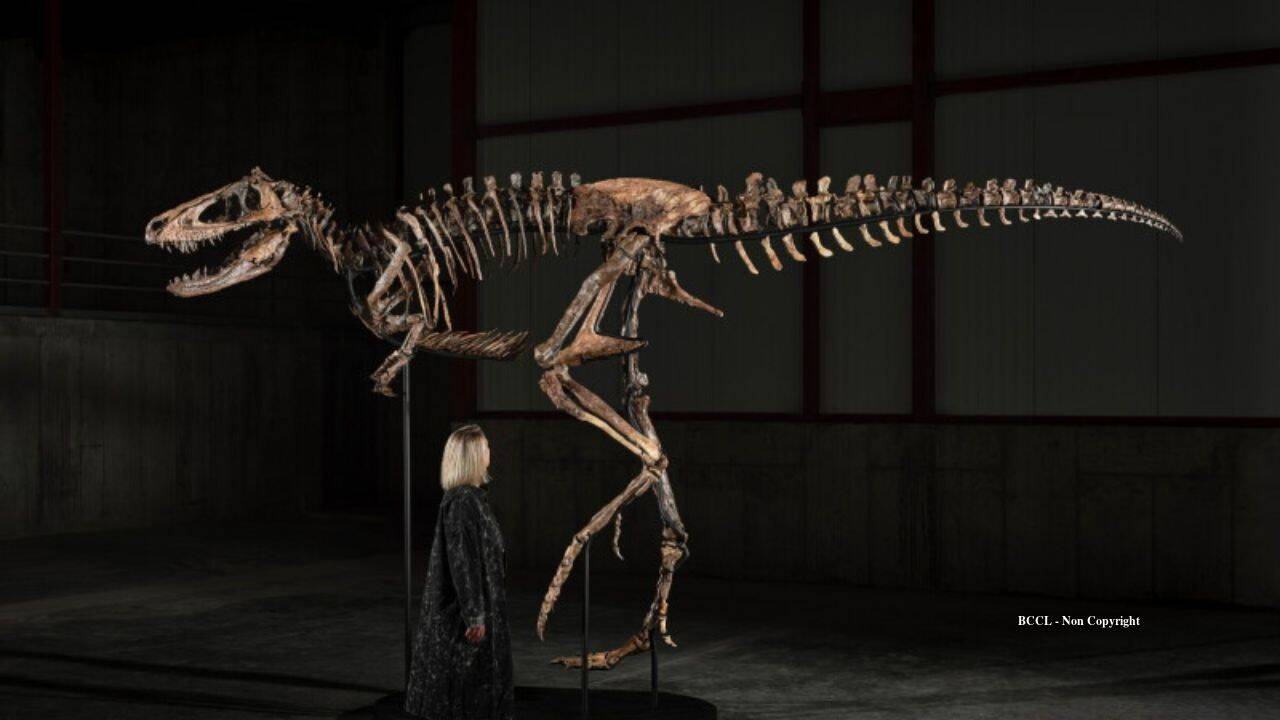
Photo credit: Sotheby’s
A dinosaur skeleton discovered by Montana rancher Jodi Pierson on her family’s land in 2019 is now on public display at Sotheby’s in New York ahead of an auction on October 27. Nicknamed “Jodi” after its discoverer, the mounted Nanotyrannus skeleton is nearly 70 percent complete, making it one of only three such skeletons known to science.
Sotheby’s has given the fossil a pre-sale estimate of $6 million to $9 million.The specimen is not a Tyrannosaurus rex, but a smaller and nimbler relative that lived roughly 67 million years ago during the Late Cretaceous period. It was found in Montana’s Hell Creek Formation in Garfield County, near Jordan, and is being offered as the finest and most complete Nanotyrannus skeleton currently available.
A discovery on a family ranch
Pierson spotted the fossil weathering out of a hillside on land her family had owned for decades.
The site lies about eight miles from the famous “Dueling Dinosaurs” dig site, an area known for exceptionally preserved Late Cretaceous fossils.The dinosaur was named after Pierson, giving the fossil a personal connection to the Montana landscape where it was found. Sotheby’s says the specimen comes from the Hell Creek Formation, a geological layer associated with the final age of the dinosaurs before their extinction.
The discovery became especially significant because Nanotyrannus fossils are extraordinarily rare. According to Sotheby’s, Jodi is one of only three known skeletons of the species, a scarcity that places it among the most important dinosaur specimens ever offered at auction.
A smaller, faster predator
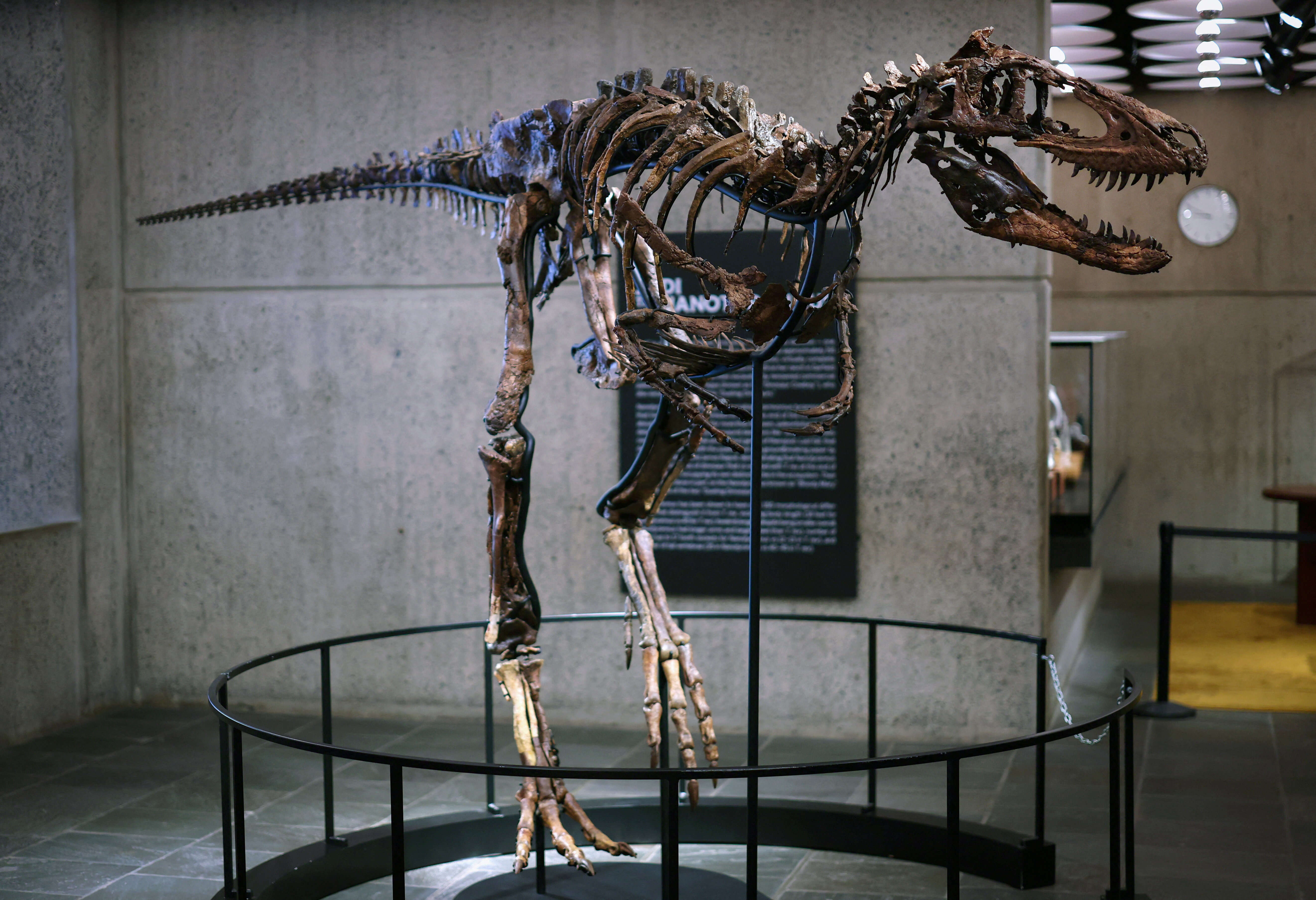
"Jodi" a rare mounted skeleton of Nanotyrannus and one of only three such dinosaur skeletons known to science, is displayed ahead of its October 27 auction at Sotheby's in New York City, US, October 13, 2026. REUTERS/Mike Segar
Nanotyrannus was a predatory dinosaur closely related to Tyrannosaurus rex, but it was smaller and more agile. Jodi stands about 6.5 feet tall and stretches nearly 20 feet long, giving visitors a sense of a predator built for speed rather than sheer size.Sotheby’s science and natural history specialist Cassandra Hatton said the animal was fast and would have hunted slower prey. She described it as a creature that would eat its prey whole, offering a vivid picture of how the predator may have lived.The skeleton includes a virtually complete skull and a jaw containing roughly 35 teeth. Those features make the fossil particularly valuable for scientists studying the anatomy, diet, and evolutionary relationships of tyrannosaurs.
A rare and nearly complete specimen
Sotheby’s bills Jodi as almost 70 percent complete, an exceptional level of preservation for a dinosaur skeleton. The auction house describes it as the finest and most complete Nanotyrannus skeleton currently available.The specimen consists of 191 bones, according to reports about the sale. Its near-complete skull is especially important because skulls can reveal crucial details about a dinosaur’s sensory abilities, feeding behaviour, and species classification.The fossil is identified as Nanotyrannus cf. lancensis from the Maastrichtian stage of the Late Cretaceous. Sotheby’s dates it to approximately 67 million years ago, placing it close to the end of the dinosaur era.
A long-running scientific debate
"Jodi" a rare mounted skeleton of Nanotyrannus and one of only three such dinosaur skeletons known to science, is displayed ahead of its October 27 auction at Sotheby's in New York City, US, October 13, 2026. REUTERS/Mike Segar
Nanotyrannus has been at the centre of one of paleontology’s most persistent debates. For years, scientists questioned whether it was a distinct species or simply a juvenile Tyrannosaurus rex.The debate matters because it affects how scientists understand tyrannosaur growth, diversity, and ecology near the end of the Cretaceous period.
A nearly complete specimen such as Jodi can provide more evidence than fragmentary fossils, helping researchers compare bone structure, skull features, and developmental patterns.Sotheby’s has framed the sale around that scientific controversy, describing Nanotyrannus versus T. rex as one of the biggest debates in paleontology. The specimen’s rarity and completeness make it a potentially important reference point in that discussion.
From Montana to Manhattan
Jodi is on view in the lobby of Sotheby’s New York headquarters ahead of the October 27 auction. The display allows collectors, scientists, and members of the public to see the skeleton before it changes hands.The fossil was previously exhibited at Frieze London in 2023 under the name “Chomper.” At that time, it carried a reported price tag of $20 million before being reclassified and given the current $6 million to $9 million estimate for the New York sale.Sotheby’s describes Jodi as second only to “Bloody Mary,” one of the famed “Dueling Dinosaurs,” in terms of Nanotyrannus specimens. That comparison underscores how exceptional the Montana skeleton is within the very small group of known examples.
Why the estimate matters
The $6 million to $9 million estimate reflects both scientific rarity and collector demand. Dinosaur fossils have increasingly entered the high-end auction market, where completeness, provenance, and visual impact can drive prices far beyond traditional natural-history collecting.Jodi’s value is strengthened by its nearly complete skull, substantial bone count, and documented discovery on private ranch land in Montana. Its status as one of only three known Nanotyrannus skeletons gives it a scarcity that few dinosaur specimens can match.The auction will also be watched by paleontologists and museum professionals. High-profile fossil sales can raise questions about whether major specimens should remain in private hands or be made accessible for public research and display.
A dinosaur with a human story
For Pierson, the discovery began on land her family had owned for decades. For scientists, Jodi offers a rare chance to study a little-understood predator from the final chapter of dinosaur history.The skeleton’s journey from a Montana hillside to a New York auction room shows how fossils can move between discovery, research, exhibition, and the commercial market. Its final destination may determine how widely future researchers and museum visitors can study it.Until the auction closes, Jodi stands in Sotheby’s lobby as both a scientific specimen and a piece of deep history. Nearly 67 million years after it lived, the dinosaur is once again drawing attention, this time with a price estimate that could reach $9 million.(With inputs from AP)
KioskNews shows a cleaned-up reading view extracted from the publisher’s page — the original always lives on their site, not ours.