UPSC Mains Answer Practice — GS 3: Impact of climate change on India’s economy and Agentic AI in digital payments (Week 173)
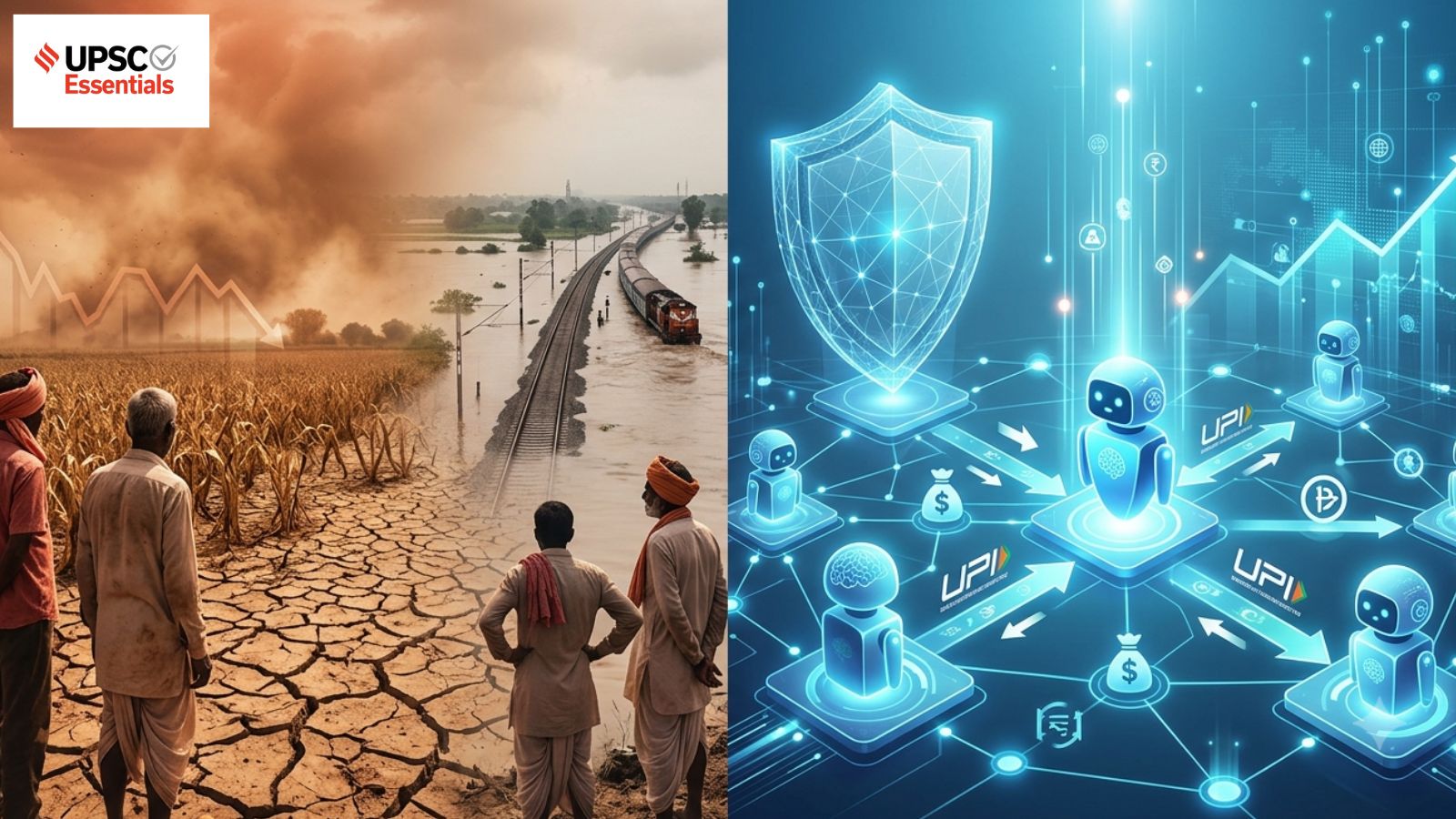
UPSC Essentials brings to you its initiative for the practice of Mains answer writing. It covers essential topics from both the static and dynamic portions of the UPSC Civil Services syllabus across various GS papers. The questions are carefully selected on the basis of their relevance to the UPSC examination and current developments, helping aspirants focus on themes that matter most for Mains. This answer-writing practice is designed as a value addition to your UPSC CSE Mains preparation. Attempt today’s GS-3 questions and check your progress.
🚨As we mark the 3rd anniversary of the UPSC Essentials magazine, we thank our readers for being part of this journey. Your trust, feedback and continued support have shaped the magazine and encouraged us to keep improving with every edition. Click Here to read the UPSC Essentials magazine for September 2026. Share your views and suggestions in the comment box or write to us at manas.srivastava@indianexpress.com.🚨
QUESTION 1
Climate change is increasingly becoming a threat to India’s macroeconomic stability rather than merely an environmental concern. Discuss with reference to the Himalayan region.
QUESTION 2
Agentic AI can transform digital payments from user-initiated transactions to AI-assisted financial decision-making. Examine the opportunities and challenges associated with this transition in India.
QUESTION 1: Climate change is increasingly becoming a threat to India’s macroeconomic stability rather than merely an environmental concern. Discuss with reference to the Himalayan region.
Relevance: The topic is relevant to GS Paper 3: Climate change, environmental degradation, disaster management and their implications for economic growth. The question links Himalayan glacier retreat with water, agriculture, hydropower, livelihoods and infrastructure, highlighting climate-induced economic risks.
Note: This is not a model UPSC answer. It only provides you with a thought process which you may incorporate into the answers.
Introduction:
Story continues below this ad
— Climate change in the Himalayas is becoming an economic and developmental challenge, rather than just an environmental issue.
— According to a recent report, the Himalayas support economic activity worth 21.5% of India’s FY24 GDP, primarily through water, agriculture, hydropower, industry and services. This statistic shows economic dependency, not the amount of GDP that would be lost due to glacier melt.
Body:
You may incorporate some of the following points in your answer:
How does Himalayan climate change threaten macroeconomic stability?
— The Himalayas act as crucial water towers, but climate-driven melting threatens long-term water security across the Indus, Ganga, and Brahmaputra basins. Following an initial rise in river levels, post-‘Peak Water’ declines will severely impact agriculture and rural economies across the Indo-Gangetic plains. Additionally, volatile river flows, landslides, and flash floods disrupt regional hydropower, particularly in the Northeast.
Story continues below this ad
— Frequent disaster damage to key transport, energy, and tourism infrastructure inflates reconstruction costs, diverting vital public funding from core development and climate adaptation initiatives.
— The economic significance of the Himalayas extends beyond mountain states. Agriculture, industries, services, and supply lines all rely on Himalayan-fed rivers. Climate-induced disturbances might thereby spread shocks from mountain ecosystems to the national economy.
— Agriculture, tourism, pilgrimage economies, and other mountain-based livelihoods are also susceptible to shifting climatic and hydrological circumstances. Thus, climatic hazards can lead to job losses, income instability, and increased pressure to migrate.
Conclusion:
— The climate crisis in the Himalayas illustrates how ecological fragility directly triggers economic vulnerability. As glacial retreat, shifting water supplies, and compounding disasters jeopardise agriculture, energy, infrastructure, and public budgets across entire river basins, piecemeal solutions are no longer sufficient.
Story continues below this ad
— To safeguard these far-reaching livelihoods, India requires a unified Himalayan strategy centred on climate adaptation, disaster-resilient infrastructure, robust scientific monitoring, emissions mitigation, and cross-border cooperation.
(Sources: Why melting glaciers could ‘put 20% of India’s GDP at risk’, and one change that can help, As glaciers melt, prepare for a Himalayan challenge, Nepal floods: The red flags in dam-building in the Himalayas, ‘Needles in haystacks’: An expert explains the challenge of early warnings in the Himalayas)
Points to Ponder
How can Himalayan glacier retreat affect India’s agriculture and food security?
How can better glacier monitoring and early-warning systems reduce economic losses?
Related Previous Year Questions
Story continues below this ad
‘Climate change’ is a global problem. How India will be affected by climate change? How Himalayan and coastal states of India will be affected by climate change? (2017)
How would the recent phenomena of protectionism and currency manipulations in world trade affect macroeconomic stability of India? (2018)
QUESTION 2: Agentic AI can transform digital payments from user-initiated transactions to AI-assisted financial decision-making. Examine the opportunities and challenges associated with this transition in India.
Relevance: The topic is relevant to GS Paper 3: Artificial Intelligence, digital economy, technological innovation and financial technology. The question enables discussion of innovation, cybersecurity, data governance, consumer protection and financial inclusion in emerging AI-driven payment systems.
Story continues below this ad
Note: This is not a model UPSC answer. It only provides you with a thought process which you may incorporate into the answers.
Introduction:
— India’s digital payments ecosystem is transitioning from user-initiated to AI-assisted and possibly agent-led transactions.
— Agentic AI refers to systems that can do tasks for users within specified parameters without constant prompting. Such solutions could make the payment process more frictionless while also enabling more agentic commerce.
Body:
You may incorporate some of the following points in your answer:
What are the opportunities?
Story continues below this ad
— AI agents may locate products, compare options, and decide appropriate payment methods, minimising the number of steps in the transaction process. Pre-authorized payments allow for routine, low-value purchases without requiring additional authorisation.
— Agents can reconcile bills, match purchase orders, arrange payments, and manage working capital. They can also help foresee cash-flow shortages, identify checkout errors, and begin refund or customer-recovery operations.
— AI-enabled prediction technologies can provide smaller organisations access to features that were previously reserved for larger enterprises and sophisticated ERP systems.
— AI is already being used to detect fraud, assess risk, and analyse transactions. Increased integration may make payment systems more responsive to odd transaction patterns.
— India’s large-scale digital payment infrastructure serves as a platform for building AI applications. Combining AI and Digital Public Infrastructure (DPI) has the potential to cut transaction costs, improve resource allocation, and solve information asymmetry.
Challenges
— Payment data is still scattered across banks, gateways, merchants, and legacy systems, making large-scale deployment of agentic AI problematic.
— AI can help detect fraud, but as AI systems get more powerful, they can also pose new threats to payment infrastructure. Rising security expenditures for UPI systems as they adapt to developing AI-related cybersecurity threats.
— Agentic systems require access to financial and behavioural information. Informed consent, limited data use, and ongoing customer oversight will be critical.
— Training AI models and integrating them into current payment infrastructure necessitates tremendous financial and technological resources. Some businesses may find the benefits insufficient to justify the costs at first.
Conclusion:
— Agentic AI has the potential to transform India’s digital payment ecosystem by moving beyond speedier transactions to intelligent, automated, and context-aware financial services. However, its long-term adoption will be dependent on overcoming fragmented data, cybersecurity, accountability, and cost concerns while maintaining significant user control.
(Sources: How agentic AI could reshape the way we make digital payments, As AI threats loomed, UPI platforms flagged rising security costs, How UPI became India’s biggest digital payments system — and its next challenge, Next governance leap will come from bringing AI and digital public infrastructure together)
Points to Ponder
How does agentic AI differ from conventional AI applications in digital payments?
Related Previous Year Question
What is agentic Artificial Intelligence (AI) ? Explain its working. Describe its applications with suitable examples. Discuss the advantages, risks and challenges associated with agentic AI systems. (2026)
Previous Mains Answer Practice
UPSC Essentials: Mains answer practice — GS 3 (Week 172)
UPSC Essentials: Mains answer practice — GS 3 (Week 171)
UPSC Essentials: Mains answer practice — GS 2 (Week 172)
UPSC Essentials: Mains answer practice — GS 2 (Week 171)
UPSC Essentials: Mains answer practice — GS 1 (Week 172)
UPSC Essentials: Mains answer practice — GS 1 (Week 171)
Subscribe to our UPSC newsletter and stay updated with the news cues from the past week.
Stay updated with the latest UPSC articles by joining our Telegram channel – IndianExpress UPSC Hub, and follow us on Instagram and X.
KioskNews shows a cleaned-up reading view extracted from the publisher’s page — the original always lives on their site, not ours.