Taiwan to continue fossil fuel phase-out: minister
TRANSITION: While electrification in Taiwan is close to the global goal of 35%, heavy fossil fuel use continues in transportation, buildings and industrial heating, critics said
By Huang Yi-ching and Esme Yeh / Staff reporter, with staff writer


Taiwan is reducing carbon emissions at an annual rate of about 2 percent and is continuing to phase out fossil fuels, Minister of Environment Peng Chi-ming (彭啟明) said yesterday after the COP31 climate talks in Turkey ended with no agreement.
The UN COP31 climate summit concluded in Antalya on Sunday following nearly 50 hours of prolonged negotiations. The talks failed to reach an agreement as member states of the UN Climate Change Conference could not find consensus on fossil fuel transition.
Nevertheless, many agenda items were agreed at the talks and the global climate governance would still be put into action.
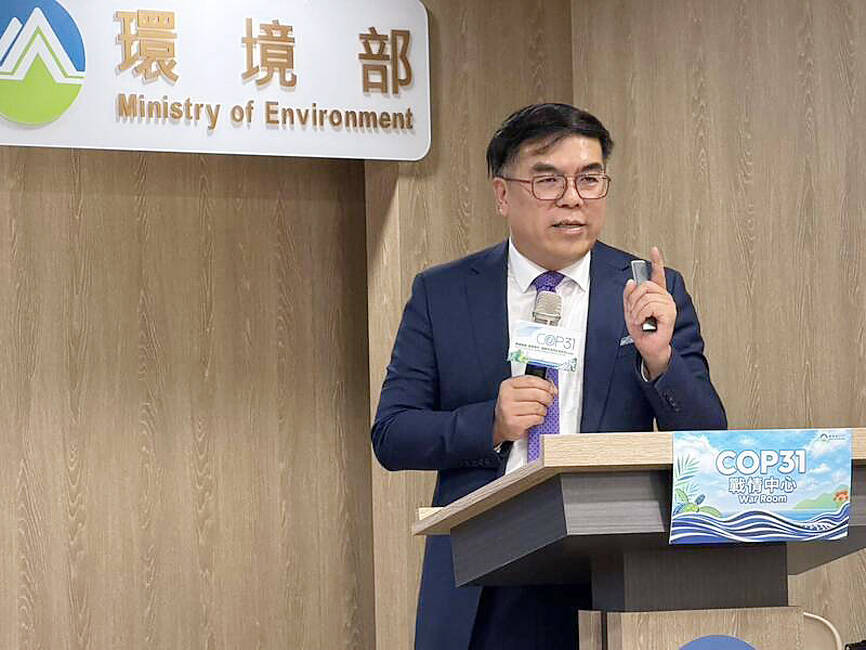
Minister of Environment Peng Chi-ming speaks at an event for COP31 in Taipei on Monday last week.
Photo: Yang Yuan-ting, Taipei Times
The Mom Loves Taiwan Association, Climate Era Catalyst and the Taiwan Youth Climate Coalition yesterday held a news conference urging the government to give equal importance to electrification and phasing out fossil fuels.
The COP31 host put forward a target of boosting electricity’s share of global energy consumption to 35 percent by 2035 — the “35 by 35” global electrification pledge — as electrification is considered a critical pathway to get rid of fossil fuels, the advocates said.
However, the 35 percent electrification benchmark measures only electricity’s share of total energy use, not how much oil and gas it actually replaces, they said.
While electricity accounted for more than 34 percent of Taiwan’s total energy consumption last year, putting it seemingly close to the target, heavy fossil fuel use continued in transportation, buildings and industrial heating, they said.
Peng said this year’s climate talks were not fully integrated, perhaps due to the Turkey-Australia copresidency, which was unprecedented.
That led to a misalignment between political agendas and negotiation rhythms, he said.
Oil-producing countries also became more sensitive about fossil fuel issues, given increased economic pressures due to Russia’s invasion of Ukraine and the Middle East conflicts, Peng said.
However, Taiwan will continue to transition away from fossil fuels toward net zero, he said.
Regarding the “35 by 35” target, Peng said Taiwan’s annual carbon reduction rate is about 2 percent and would continue to increase thanks to coal-to-gas switching.
Gas power plants could be replaced with hydrogen or ammonia facilities once such technology is fully developed, he said, adding that renewable energy use would also increase.
The nation’s overall grid emission factor could further be cut if the second and third nuclear power plants could be restarted after passing safety inspections, he added.
Taiwan plays a pivotal role in the global artificial intelligence supply chain, Peng said, calling on the international community to establish substantive partnerships with Taiwan.
Taiwan and Paraguay’s cooperation on a forest carbon sink project has entered the final agreement signing stage, he said.
Other allies and non-allied countries have also inquired about partnership opportunities with Taiwan’s carbon trading system, he said.
KioskNews shows a cleaned-up reading view extracted from the publisher’s page — the original always lives on their site, not ours.