20 Best Legend Of Zelda Games, Ranked

Updated
Adam Hayward is a former writer for Upside Hoops, and currently holds a side gig writing for BuffaLowDown over at Fansided. You can find him over on Twitter at @AdamHayward54. An alumnus of Midlands Technical College and the University of South Carolina, Adam Hayward has two college degrees - an Associate in Science in computer science and a Bachelor's Degree in media arts.
Even players with the highest standards would be hard-pressed to find a downright bad game in The Legend of Zelda's game catalog, but some are better than others. First debuting back in 1986, The Legend of Zelda has seen a long series of consistently engaging games for players to explore and conquer. Taking a look at this legacy helps reveal which Zelda titles stand out from the pack as truly exceptional experiences.
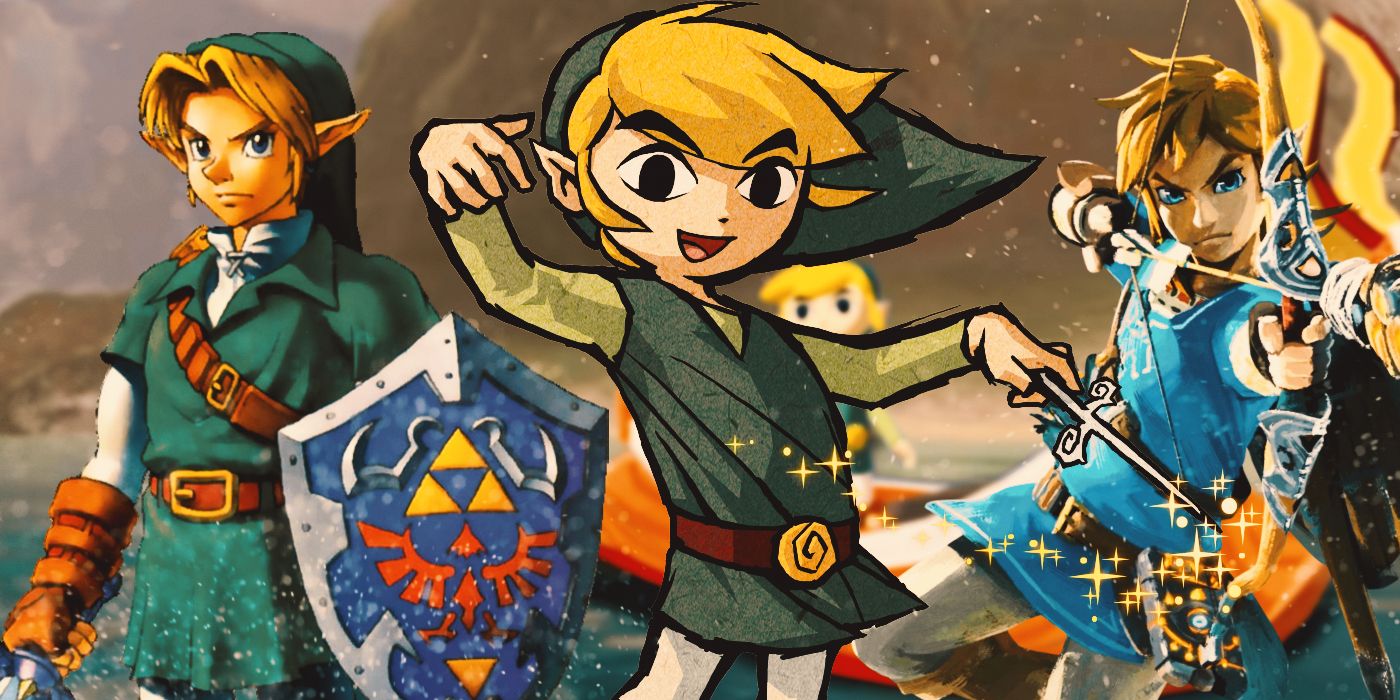
Every Zelda game follows the adventures of protagonist Link, most often on a quest to defeat the villain Ganon and save the kingdom of Hyrule. Despite maintaining these elements, the franchise has reinvented itself several times, with iconic games like A Link to the Past and Ocarina of Time providing new templates for successors. The best Zelda games are both innovative and thrilling to play in their own right.
The Legend Of Zelda: Four Swords (2002)
Released For The Game Boy Advance, Re-Released For DSi And 3DS

The Legend of Zelda: Four Swords is essentially bonus content for the Game Boy Advance version of A Link to the Past rather than a full-fledged installment in the Zelda series, dipping into multiplayer gameplay for those interested.
In it, up to four players can take control of Link and four color-coded clones on a quest to defeat Shadow Link and restore peace in Hyrule. It can be fun in short bursts, but it's hardly a standout experience.
The game was re-released in 2011 alongside The Legend of Zelda: A Link to the Past Anniversary Edition for the Nintendo DSi and 3DS.
The Legend Of Zelda: Tri Force Heroes (2015)
Released For The Nintendo 3DS

Tri Force Heroes is a minor evolution to the multiplayer Zelda experience, offering a perfectly enjoyable co-op experience but little more. It was the first Legend of Zelda game to offer online connectivity rather than relying on the use of link cables.
This time, three players could fight against an evil witch to lift a curse from the princess of the land—in this case, Styla, not Zelda. Short, puzzle-oriented levels can be fun with friends, but the breadth of exploration and discovery that usually colors Zelda games won't be found here.
The Legend Of Zelda: Four Swords Adventures (2004)
Released For The Nintendo GameCube

Four Swords Adventures is the most developed co-op Zelda game, with the strongest focus on story and the most polished single-player alternative. Unlike the other multiplayer titles, Four Swords Adventures still offers plenty for a solo player to experience.
It's earned enough respect from fans and critics to gain a Metacritic score of 86. With the advances in online multiplayer, it has left many hoping to see a remake of the game on the Nintendo Switch or the next console.
Zelda 2: The Adventure Of Link (1988)
Released For The Nintendo Entertainment System (NES) And Game Boy Advance

Zelda 2: The Adventure of Link was an early experiment for the series, abandoning the top-down gameplay of the first game and pivoting into side-scrolling action for dungeons and towns inside a larger world map.
Zelda 2's influence as a 2D action RPG can still be felt today, but players will need to surmount the brutal difficulty curve to find something to love here. The story was meant to be a direct sequel to the hit first title. Once again, Link is tasked with saving Zelda, this time from a sleeping spell, with the addition of RPG elements.
The Adventure of Link was re-released for the Nintendo GameCube as part of The Legend of Zelda: Collector's Edition set.
The Legend Of Zelda: Oracle of Seasons (2001)
Released For The Game Boy Color

The Legend of Zelda: Oracle games bear more resemblance to Link's Awakening than any other Zelda titles do, although developer Capcom brought a unique angle to these games.
Oracle of Seasons shakes things up with the ability to change seasons, shifting up the world around the player for a fresh experience. The Rod of Seasons requires Link to visit the four spirits of the seasons in their towers to learn how to wield the power of the rod.
The Legend Of Zelda: Oracle of Ages (2001)
Released For The Game Boy Color

Choosing between Oracle of Seasons and Oracle of Ages is largely a matter of preference, with Seasons offering a greater focus on combat and Oracle of Ages leaning into more difficult puzzle experiences. Link is whisked out of his world by the Triforce, and into a whole new land to explore.
Puzzles are often the real standout of 2D Zelda games, which may just give Oracle of Ages the edge. That being said, Oracle of Ages is not a game to enter into lightly. Some particularly cryptic dungeons can prove frustrating, and backtracking is a major necessity in this particular title.
The Legend of Zelda (1987)
Released For The Nintendo Entertainment System (NES)

The original The Legend of Zelda for the Nintendo Entertainment System is the game that started it all, and although it debuted in 1987, it is a classic title that holds up to this day. The graphics and story may be limited compared to later entries, but many aspects that still define the series were established in this groundbreaking title.
The Legend of Zelda places a lot of faith in players, taking on a particularly non-linear approach and hiding many of its secrets well. For those interested in challenging exploration, this still offers an experience unlike any other, although its fun may not be as refined as the very best Zelda games.
The Legend Of Zelda: Phantom Hourglass (2007)
Released For The Nintendo DS

One of the few Legend of Zelda games to be a direct sequel to a previous game, Phantom Hourglass picks up after the events in The Wind Waker and sees Link heading to save Zelda's alter ego, Tetra, from the game's bad guy, Bellum. The game largely takes place out on the open water aboard a ship, poviding a unique take on a Zelda game.
Phantom Hourglass makes creative use of the unique functions of the DS, asking players to blow into the mic and close the system for various tasks and utilizing touchscreen controls. Phantom Hourglass may not be at the top of many players' lists, but it still received a Metacritic score of 90. It
The Legend Of Zelda: Spirit Tracks (2009)
Released For The Nintendo DS

The Legend of Zelda: Spirit Tracks acts as a sequel to Phantom Hourglass, continuing Toon Link's adventures. Rather than sailing the sea, Link explores the world of Spirit Tracks via the titular railway.
This shift split players down the middle, with many preferring this change and others missing the sea. Because of this, although Spirit Tracks marks a general improvement by refining many of the game's ideas and eliminating some sticking points, its Metacritic score dropped to 87 compared to Phantom Hourglass's 90.
The Legend Of Zelda: Link's Awakening (1993, 2019)
Released For The Game Boy, HD Remake For The Nintendo Switch

Link's Awakening is unlike any other Zelda game, abandoning the Hyrule setting for the strange Koholint Island.
The strength of this particular title lies first and foremost in its atmosphere, which is just uncanny enough to give the game a uniquely enticing feel. This is exactly the feel director Takeshi Tezuka was going for, as the game was reportedly meant to emulate the feel of the cult hit TV show, Twin Peaks.
In both its original iteration and the Nintendo Switch remake, Link's Awakening is a fun and memorable diversion from the typical Zelda approach. The HD remake for the Nintendo Switch received a Metacritic score of 87 and 4 out of 5 stars in Screen Rant's review.
KioskNews shows a cleaned-up reading view extracted from the publisher’s page — the original always lives on their site, not ours.