Family tied to suspected Chinese spy gave $4.4M to Newsom, Calif. politicians
A California family gave over $4.4 million in political donations to Governor Gavin Newsom, Kamala Harris and other leading California politicians. And now, that family's alleged past links to infamous suspected honeypot spy Fang Fang, also known as Christine Fang, and other Chinese government officials have thrust them into an ongoing debate over foreign influence in American politics.
The Yin family made millions running McDonald's franchises in the Golden State — and became prolific donors to politicians, according to state and federal campaign records. Newly released FBI files about Fang describe the family patriarch Chei Chen Yin, commonly known by his initials "C.C.", as a one-time professional associate of Fang through an organization he founded.
And national security experts tasked with protecting U.S. institutions from infiltration by the Chinese government say they have documented alleged interactions between C.C. Yin's brother, Henry Yin, and the foreign influence wing of the Chinese government, the United Front.
Interactions between wealthy business leaders with direct ties to China have come under heavier scrutiny in recent years, as a series of scandals have erupted over alleged Chinese influence agents gaining access to elected officials from small town mayors to members of Congress and the governor of New York. Those relationships have often been facilitated with political donations.
Jacqueline Deal, a board member of State Armor, a company that helps lawmakers detect foreign influence operations, told CBS News that the Chinese government has a "broad-reaching, coordinated strategy for dominance that relies on shaping U.S. policy so that over time we get weaker and [China] gets stronger."
She said she suspects political donations are being used to help "disincentivize these leaders from noticing Chinese Communist Party political interference." There is no evidence the Yins have been co-opted in this way.
C.C. Yin told CBS News: "I love America, and I strongly condemn any effort by any foreign government to interfere in American politics or undermine our democracy." Henry Yin did not respond to requests for comment.
Yin family donated millions to political causes
C.C. Yin, 89, is known in Northern California for his philanthropy and rags-to-riches story of a Chinese immigrant arriving to the U.S. in the 1960s with just $100 and building a successful franchise business.
He and his brother Henry Yin founded and ran an organization called Asian Pacific American Public Affairs, or APAPA, organizing support for favored political candidates and helping place interns and advisers in the offices of local, state and federal officials, according to APAPA's website.
C.C. Yin told CBS News he started APAPA to help "young people and community members develop leadership skills, understand how government works, vote, serve their communities, and participate in our democracy."
"When this country gives us opportunity, we have a responsibility to give back," he said.
Some of the Yins' giving has come in the form of large political donations.
The family has donated nearly $3 million to state-level California political causes and an additional $1,455,027 to federal campaigns, directly and through C.C. Yin's McDonald's franchise business, according to state and Federal Election Commission records.
This includes $364,817 in donations to past campaigns supporting Gavin Newsom, $80,000 to his 2019 inauguration committee and $50,000 to a nonprofit at Newsom's direction.
The Yins as individuals and C.C. Yin's McDonald's franchise also gave California Lt. Gov. Eleni Kounalakis' campaigns $221,700 between 2018 and 2025, state records show. Former Vice President Kamala Harris' campaigns received $214,300 between 2019 and 2024, and former state Treasurer John Chiang's campaigns received $115,680.
Links to suspected spy Fang Fang
FBI files declassified by the White House in August point to a previous close working relationship between C.C. Yin and suspected Chinese spy Fang "Christine" Fang, who had a sexual relationship with disgraced former California congressman Eric Swalwell before fleeing to China in 2015.

The files include Swalwell's interviews with the FBI in 2015 and 2016, in which he identified Fang as his "point of contact" for APAPA. In one interview Swalwell said a top APAPA official directed him to Fang, according to the files. That official's name is redacted in the report, but two sources familiar with its content told CBS News it is C.C. Yin.
Fang appeared alongside C.C. Yin and Henry Yin at a 15-person APAPA event, in a photo posted on Facebook in 2013 by a City of Cupertino official.
APAPA president Kris Concepcion told CBS News that "current leadership is not aware of Fang Fang ever holding an official role with the national organization."
"Our understanding is that she was associated with a local chapter that is no longer operational," he said. "Like hundreds, or even thousands, of other community members who attend public events, being photographed with APAPA members does not mean she was an officer, board member, employee or representative of APAPA."
No evidence has emerged that Henry Yin or C.C. Yin knew about Fang's alleged espionage during her involvement in APAPA.
Chinese government meetings
After noticing APAPA's connection with Fang Fang, Deal dug into the background of Henry Yin, who previously served as national board chair of APAPA and is currently a board member.
She found a string of Chinese media reports of his attendance at 10 events in China hosted by officials from the Chinese government and its foreign influence wing, the United Front, since 2013. The United Front published Chinese-language write-ups of Henry Yin's reported meetings in 2015 and 2023.
Henry Yin has described his efforts as "networking." Deal said his relationship with China "seems to be one of open cooperation."
One article said Yin traveled to Baoshan in Yunnan province in June 2015 and held talks with the Municipal Party Committee United Front Work Department, reaching "a consensus on further strengthening contacts." It described Yin as their "designated contact person for California–China economic, trade, scientific and technological interaction".
Another 2013 article by a Chinese government office described a meeting between Yin and a Chinese government official in Chengdu, capital of Sichuan province, saying that he had been offered a position there with the title "Overseas Talent Recruitment Adviser for Sichuan Province." There is no evidence Yin accepted that offer, which was made during a friendlier time in U.S.-China relations.
A United Front statement from 2023 said a delegation of "Chinese Entrepreneurs from Silicon Valley" including Henry Yin, visited his hometown of Chengdu and "built a new bridge for investment cooperation between Chengdu and Silicon Valley."
Henry Yin told the East Bay Times in 2016, while he was serving on the California Commission for Economic Development, that his goal was to further business relations between China and the U.S., as part of his decades as a trans-national entrepreneur.
"I've done a lot of networking, and these days I'm glad to see these networks deliver results," he told the newspaper.
Neither Henry Yin nor his brother have been accused by U.S. law enforcement of working as a foreign agent or acting against American interests.
Foreign Policy Research Institute fellow and University of Miami professor June Teufel Dreyer told CBS News that, although political donations and advisory roles are patterns of influence used by the United Front, those actions and traveling to China for diplomacy and business trips could be entirely innocent.
"There's really nothing wrong with successful Chinese entrepreneurs wanting to help out the economies of the country they originally came from," Dreyer said, but added: "We should get rid of the idea that there's such a thing as a truly private business in China. They are all controlled at some level by the government."
Cheryl Yu, a fellow at foreign affairs think tank The Jamestown Foundation, told CBS News that the Chinese government attempts to exert influence on well-connected Americans, regardless of those individuals' intentions.
"This is how the United Front works. They build these friendly, long-term relationships, then at some point they make requests," she said.
The U.S. government has allegedly engaged in its own influence attempts against China, including a clandestine social media campaign to turn public opinion in China against President Xi Jinping's government, a 2024 Reuters report claimed.
Concepcion said his organization has "no relationship with the People's Republic of China, the Chinese Communist Party, or the United Front," and that "personal travel, relationships, employment histories, and views" of members "should not be attributed to APAPA."
Top political contacts
The Yins' foreign and domestic connections have at times placed them at the nexus of Chinese diplomacy and American politics.
C.C. Yin was credited with helping arrange Newsom's 2023 trip to China according to a story co-authored by his organization in New York-based Taiwanese newspaper the World Journal.
The newspaper article said that C.C. Yin began negotiating the visit "after being entrusted by the governor's office" to "formally [convey] Governor Newsom's desire to visit China to Consul General Zhang Jianmin."
His brother Henry Yin accompanied the governor as an adviser on the October 2023 visit, where Newsom met Chinese President Xi Jinping, the Journal reported.
Henry Yin has also been photographed with Newsom at APAPA events, which he shared on Facebook.
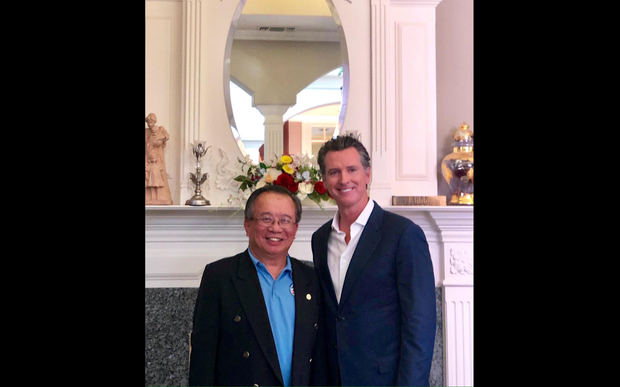
Newsom's spokesperson did not respond to a request for comment. The governor is among those expected to seek the 2028 Democratic nomination for president.
Henry Yin also acted as an adviser to California congressman Ro Khanna, who is similarly talked about as a potential Democratic 2028 presidential candidate and is currently the ranking member of the House Select Committee on the CCP, established with the purpose of monitoring Chinese government influence in U.S. politics. Henry Yin and C.C. Yin have personally donated $15,800 to Khanna's congressional campaigns since 2017.
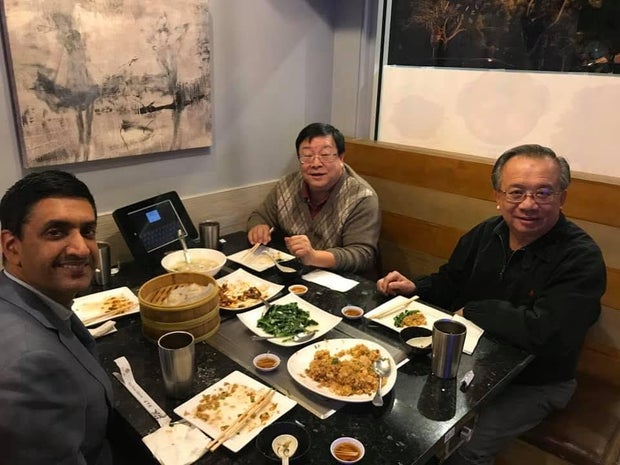
Khanna's spokesperson has since given statements about Henry Yin's relationship with the influential lawmaker that conflict with Khanna's own social media posts.
A 2019 Facebook post by Khanna included a photo of Henry Yin presenting the congressman with a birthday cake, with the caption announcing that "Henry will serve as my Senior Advisor on Foreign Trade and Economic Development." In a 2020 post he referred to Henry Yin as a "good friend."
Until this month, Yin listed on his LinkedIn page a current role as "Sr. Advisor to US House of Rep [Ro] Khanna," beginning in 2019. The page has since been deleted.
Khanna appeared alongside Henry in February this year at a Sunnyvale, California event run by APAPA-affiliated PAC, Asian Americans for Good Government. Both Henry Yin and C.C. Yin have been listed as board members of the PAC, according to archives of its website.
Earlier this month, his spokesperson told the New York Post that Henry Yin "has never held a formal role with the Congressman." In a subsequent statement to CBS News, Khanna's communications director Sarah Drory said that Henry Yin "served for a year as one of dozens of volunteer leaders."
Drory added in the statement that "APAPA has been a decades-long organization to empower Asian Americans and it's an ugly anti-Asian smear to suggest ties" to the Chinese government.
KioskNews shows a cleaned-up reading view extracted from the publisher’s page — the original always lives on their site, not ours.