Let’s be mindful of the sub judice rule — Hafiz Hassan
OCTOBER 20 — It wasn’t just about the use of the term “munafik” leading to RSN Rayer (PH–Jelutong) raising Standing Order (SO) 36(1) of the Dewan Rakyat Standing Orders.
Rayer argued that the term was offensive and inappropriate, particularly when aimed at the prime minister.
Rayer questioned why Deputy Speaker Alice Lau Kiong Yieng had allowed Takiyuddin Hassan (PN-Kota Bharu) to continue without intervening.
Speaking during the debate on the Supply (Budget) Bill 2027, Takiyuddin had also argued that the removal of 10 Negeri Sembilan state executive councillors (excos) by the State Ruler Tuanku Muhriz Tuanku Munawir, without the advice of Menteri Besar Ismail Lasim, was unconstitutional.
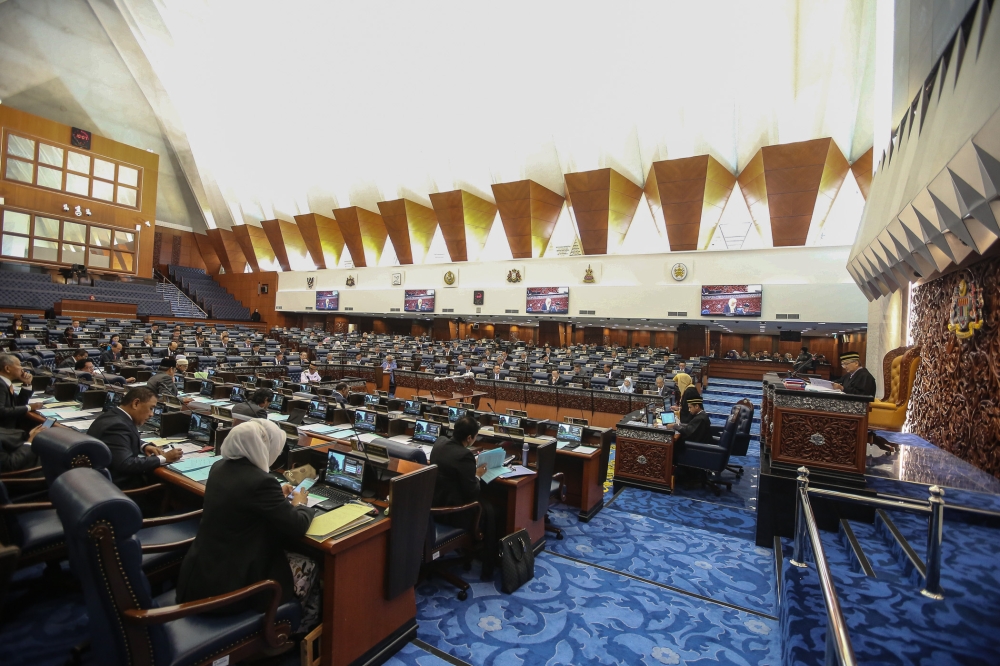
File picture of the Dewan Rakyat in session. The author argues that MPs should be mindful of the sub judice rule when discussing matters that are before the courts. — Picture by Yusof Mat Isa
He questioned why the Attorney General’s Chambers had deemed the action constitutional. Takiyuddin asserted that under the State Constitution, members of the state exco, other than the Menteri Besar (MB), hold office at the Ruler’s pleasure, subject to removal by the Ruler on the MB’s advice.
“This (removal) was unconstitutional. Unfortunately, the Attorney General, who advises the government, has stated that the action taken is constitutional,” he said.
“Which constitution are you referring to?” Takiyuddin questioned the Attorney General.
The Kota Bharu MP rightly referred to Article 38(5) of the State Constitution which says that “a member of the Executive Council other than the Menteri Besar shall hold office at the Ruler’s pleasure, unless the appointment of any member of the Executive Council shall have been revoked by the Ruler on the advice of the Menteri Besar but any member of the Council may at any time resign his office”.
But as I wrote in “About time the High Court determines the power to revoke appointments of exco members”, the above provision is clearly differently worded from the provision to be inserted in State Constitutions as set out in the Eighth Schedule of the Federal Constitution which reads that “a member of the Executive Council other than the Menteri Besar shall hold office at the Ruler’s pleasure, but any member of the Council may at any time resign his office”.
The provision in the Eighth Schedule is without the words “unless the appointment of any member of the Executive Council shall have been revoked by the Ruler on the advice of the Menteri Besar”.
I explained the word “unless” appearing in Article 38(5) of the State Constitution. https://www.malaymail.com/news/what-you-think/2026/10/08/about-time-the-high-court-determines-the-power-to-revoke-appointments-of-exco-members-hafiz-hassan/238261
Takiyuddin is entitled to his reading of the provision.
But the construction of Article 38(5) of the State Constitution is sub judice (before the court).
The 10 former excos have gone to court to challenge the revocation of their appointments, naming the state secretary and the state government as defendants in their originating summons seeking no less than 12 court orders, including declarations that:
- the power to revoke an exco’s appointment must follow the requirements and procedures in the State Constitution;
- the Ruler cannot revoke an exco’s appointment on his own, or at his pleasure alone, without the MB’s advice;
- the revocation, which was gazetted by the state secretary, is null, void and ineffective as the State Constitution requires the MB’s advice for such a revocation.
The ten, who are plaintiffs in the originating summons, also seek the court’s determination of constitutional questions concerning the power to revoke the appointments of state excos.
Now, besides SO 36(1), there is SO 36(2) which says that reference “shall not be made to any matter which is sub judice in such a way as might in the opinion of the Chair prejudice the interests of parties thereto”.
The SO was not raised in the Dewan Rakyat.
It should have been raised to remind MPs of the sub judice rule.
So too the public.
Let’s be mindful of the sub judice rule.
* This is the personal opinion of the writer or publication and does not necessarily represent the views of Malay Mail.
KioskNews shows a cleaned-up reading view extracted from the publisher’s page — the original always lives on their site, not ours.