Analysis: Fewer Fires, Same Fog: Punjab's Stubble Politics Before 2027 Polls
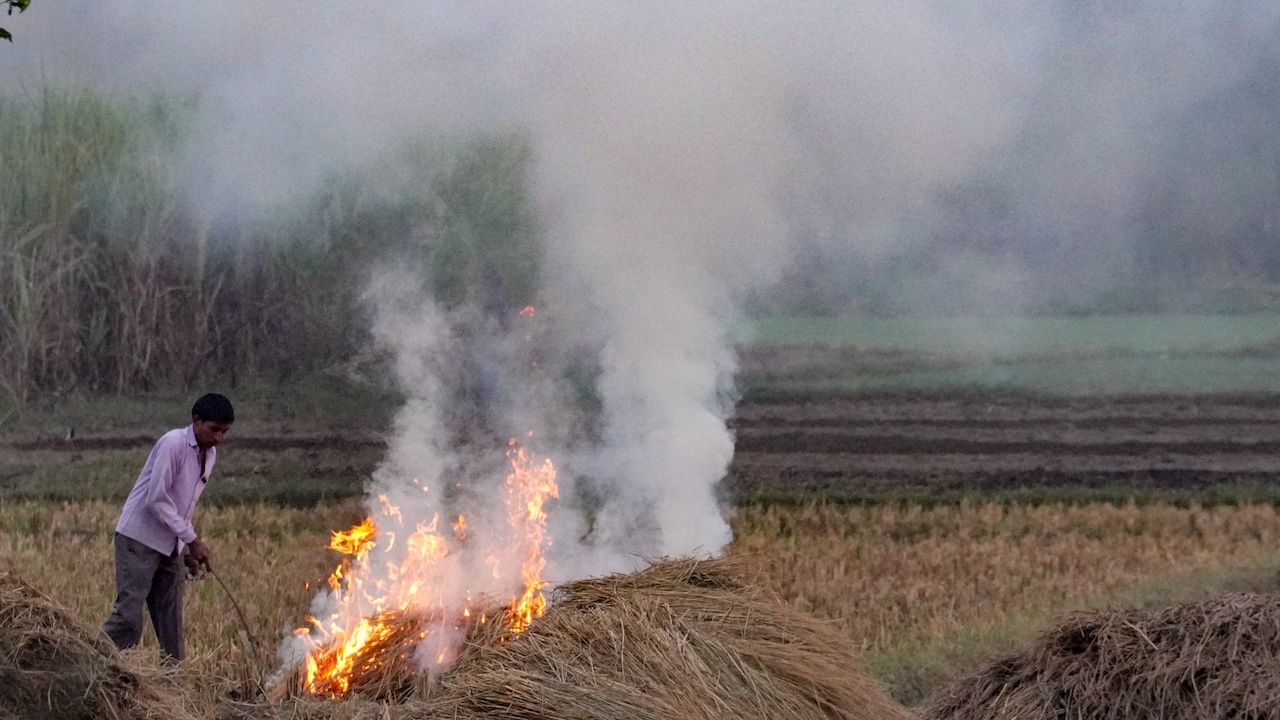
The six to eight weeks between late September and early October every year are hectic for three sections of society in Punjab - the farmers as the window to sow the winter crops is very short; the administration, which keeps an eye on satellite data and pictures to book farmers who burn paddy straw to clear fields and the news channel crews who are also despatched from Delhi to film farmers burning farm residue.
Months before Punjab votes for a neew government in 2027, the same arrangements will be in place. The farmers will not stop setting their fields ablaze but this year, it is likely that the administration will not challan them as this is an election year.
Farmers burn paddy in the dark or early morning but the satellite imagery exposes them. The farmer unions would come and burn stubble in front of the officials. There are instances when the farmers clashed with the administration and even media persons, compelling them to delete footage.
The enforcement mechanism itself has become a major political flashpoint.
The state authorities have registered thousands of First Information Reports under Section 223 of the Bharatiya Nyaya Sanhita, levied environmental compensation fines, and initiated "red entries" in land records.
Punjab recorded 36,663 farm fires in 2023, 10,909 in 2024, and 5,114 in 2025 - an 86 per cent drop from the 2023 peak, according to figures circulated by the state and IARI bulletins. Monitoring for 2026 began on 15 September. The first few days produced only a handful of confirmed cases, mostly in Tarn Taran and Ferozepur.
Between 2021 and 2025, stubble burning incidents witnessed a historic drop of 92.83 per cent, reflecting stricter administrative monitoring, satellite tracking, and increased adoption of in-situ management equipment.
The year 2024 recorded the sharpest decline (70.25 per cent), with cases plummeting from 36,663 down to 10,909.
While initial years saw a steady deceleration of about 26 per cent to 30 per cent, intensified regulatory enforcement and strict penalty structures in the final two years drove the numbers down past the 5,000 threshold.
Compounding the policy standoff is the heavy human toll documented by medical institutions. Those burning stubble also caught bronchitis, asthma and COPD.
Collaborative field studies by the Central Pollution Control Board and the All India Institute of Medical Sciences highlight a 30 per cent to 35 per cent seasonal spike in patient inflows across respiratory clinics in Punjab.
Objective lung capacity tests reveal a 10 to 14 per cent decline among men and a 15 to 18 per cent decline among women living in rural Punjab during the burning months, alongside a steep rise in acute respiratory symptoms - including wheezing, breathlessness on exertion, and persistent coughing - among vulnerable demographics like children and the elderly.
Over 12 people died and around 25 were injured in smog and farm fire related road accidents during the past eight years.
Why Punjab Farmers Still Set Fields Ablaze
The penal measures have drawn sharp pushback from farmer unions, who argue that penalties punish paddy farmers for structural and economic constraints. Cultivators point out that compressed harvesting windows, high diesel overheads, and the steep costs of operating in-situ machinery make residue management financially burdensome without direct income support - such as the long-standing demand for a Rs 2,000 to Rs 3,000 per acre cash bonus.
Farmer union leaders say that in-situ tools - Happy Seeders, Super Seeders, mulchers - work but require fuel. Some machines are not compatible with old tractors. Burning diesel to manage farm stubble raises input costs - that too when the margins are thin.
Joginder Singh Ugrahan, President BKU (Ekta Ugrahan) said farmers are being asked to absorb a public-good cost (cleaner air for cities) while diesel, fertiliser and seed prices rise. Without cash, burning is survival, not protest.
Chief Minister Bhagwant Singh Mann is critical of the Union government and has said he is not in favour of registering police cases against accused farmers who contribute about 180 lakh metric tonnes of paddy to the central pool.
Making a jibe at the Centre, he asked why the stubble - which is part of the crop - becomes a crime.
The Punjab government. while supporting farmers' demand for compensation, suggested a Rs 2,500 per acre cash incentive, proposed to be shared by New Delhi and Punjab - Rs 1,500 by the Union Government and Rs 1000 per acre jointly by the state governments.
The Centre had rejected Punjab and Delhi's joint proposal, maintaining that its budget prioritises subsidising machinery over direct cash payouts.
Under the Crop Residue Management or CRM scheme, the Centre has already released over Rs 1,680 crore to Punjab for 1.46 lakh in-situ machines. Both farmer unions and the Punjab government blame the Centre for rejecting the proposal.
Punjab's Fight Over Stubble Before 2027 Elections
While the pollution never finds a place in the poll manifestoes, the demand for cash incentives in lieu of not burning the farm residue can bring the issue in the limelight.
Farmers have also demanded that the 1,963 police cases registered against them in the past be dropped. Opposition parties will use missing machines, and Delhi's smog as governance failure. The state's ruling AAP is likely to blame the Centre for not compensating the farmers. It will, however, claim a sharp decline in the farm fire incidents.
The BJP, while citing the Central government grants for in-situ management, has maintained a sharp and critical stance against the ruling AAP and Congress governments that despite receiving central funding, the state failed to control air pollution.
When the neighbouring Haryana, which pays Rs 1000 to Rs 1200 per acre incentive to the farmers not burning stubble, can manage incentives, why Punjab was seeking Central funds, it has questioned.
The BJP leaders say the Punjab government failed to provide adequate ground-level execution and support, leaving farmers with few alternatives to burning crop residue. They also say that the Centre has prioritised machinery over direct cash payouts, and emphasise that existing funds must be managed efficiently rather than demanding additional cash packages.
A careful examination of statements given by the AAP leadership including party chief Arvind Kejriwal and Punjab Chief minister when they were ruling Delhi and Punjab and when they lost power, blatantly point out the double speak over the issue.
Before March 2022, AAP treated Punjab farm fires as Delhi's imported crisis. Then Chief Minister Arvind Kejriwal used satellite maps to pin winter smog on the neighbouring state. The message was 'Punjab burns, Delhi chokes'.
Bhagwant Mann, then Sangrur MP, struck the opposite note in the Lok Sabha in 2019 "do not scapegoat farmers; they grow paddy because it has MSP. Diversify the crop and the fire problem eases.'
After AAP won Punjab, the narrative changed.
In November 2022, Kejriwal accepted "responsibility" for stubble burning but asked for time, saying six months in office could not undo a system. By 2023 he was citing a 30 per cent drop and crop diversification under Mann.
Mann, now as Punjab chief minister, recast the issue as a Centre-state money fight. He demanded compensation, mocked Delhi, and in late 2025 asked "why the capital's AQI stayed hazardous when Punjab fires had fallen".
"We don't know if Punjab's smoke reaches Delhi," he said.
The pattern is political, not scientific. In Opposition and in Delhi, AAP externalised the problem. In Punjab, it defended paddy farmers, claimed falling counts, and pushed the cost onto the Union government. The smoke did not change sides. The talking points did.
KioskNews shows a cleaned-up reading view extracted from the publisher’s page — the original always lives on their site, not ours.