Singapore’s haze response could offer lessons for future climate crises
SINGAPORE – As Singapore prepares to deal with the impacts of climate change, from heatwaves to floods and future haze episodes, the country’s response to the recent bout of bad air quality could yield some lessons.
Steps taken during the recent bout of haze in September and October included the roll-out of mask distribution exercises and the opening of air-conditioned haze shelters. Singaporeans also received early warnings about an impending El Nino event that could exacerbate the haze situation well before the skies were clouded with smoke.
These efforts were an improvement on the national response during the last major haze crisis in 2015, largely because the authorities and the community acted before the worst air pollution hit.
But the way these initiatives were rolled out, and the public’s reaction to some of these efforts, point to some areas that can be improved on for future national response plans.
The lessons gleaned from this haze “rehearsal” could inform the activation of a similar response plan for heatwaves, which may be necessary from next year.
The authorities have warned that extreme temperatures associated with a decaying El Nino event could occur between March and May 2027. This coincides with the hottest period of the year.
Where Singapore did well
This year, the public was warned about a super El Nino and severe haze months before the brunt of it was felt.
In early May, Minister for Sustainability and the Environment Grace Fu warned that a “Godzilla El Nino” could trigger more intense forest fires and haze in the region.
Advance alerts are crucial to help the community prepare, so people can take steps to protect themselves, such as buying air purifiers and N95 masks. The early warnings could also help employers and schools start identifying individuals with existing health issues.
Even organisations such as the Singapore Red Cross stepped up to distribute care packs including face masks and portable fans to its beneficiaries as early as April.
When air quality turned unhealthy on Sept 4, the 28-agency Haze Task Force issued a statement outlining the measures that various sectors would take should the pollution worsen.
One of the plans that the public was alerted to in advance included the opening of haze shelters if the PSI reached very unhealthy levels, defined as readings above 200.
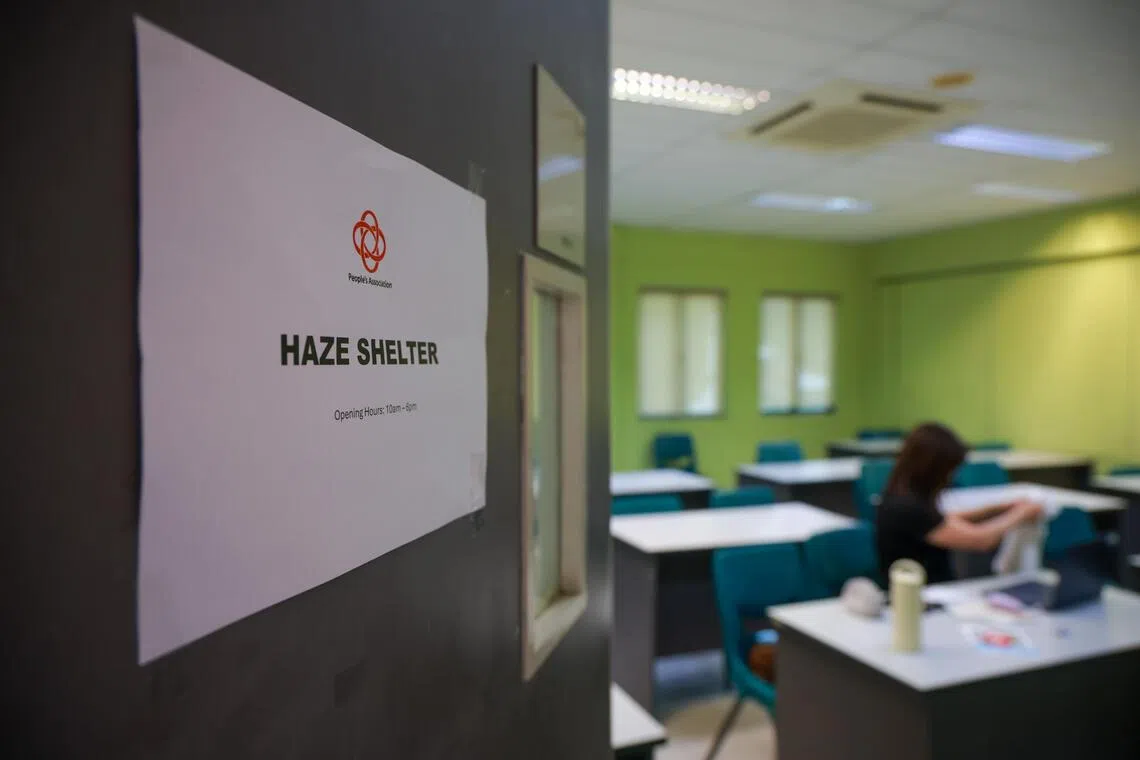
People’s Association staff at work in the haze shelter room at Kallang CC on Oct 15, 2026.
The Straits Times
This provided assurance that the authorities were ready to step up efforts if the haze worsened.
And when air quality visibly deteriorated, the authorities activated the plan to distribute masks and open haze shelters even before the original threshold of PSI levels above 200 had been breached.
The roll-out of these preemptive measures was an improvement on the 2015 haze response. That year, measures such as the opening of haze shelters were only implemented after air quality worsened to hazardous levels, when PSI readings exceeded 300.
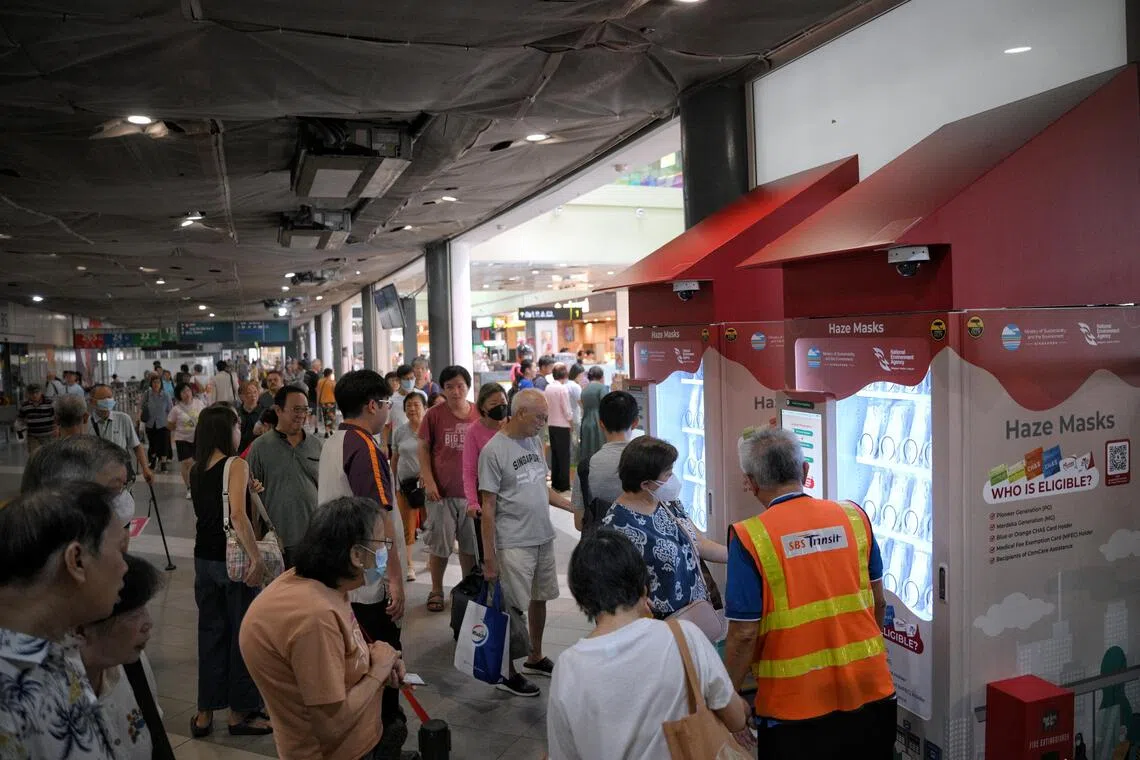
SMRT staff helping elderly residents redeem their face masks from a mask vending machine at Ang Mo Kio Bus Interchange on Oct 15, 2026.
The Straits Times
Confusion over shelters
There were some kinks to the opening of the haze shelters in 2026, however.
Since Singapore’s heatwave response plan includes the roll-out of similar cooling centres at community clubs, improving the awareness of and access to such facilities would be important.
More than 300 cooling centres will open islandwide if a heatwave hits Singapore, and the places include air-conditioned community centres and some indoor sports halls.
During my reporting, I found that not all haze shelters were ready to receive residents. A few were also hard to find.
For instance, when I visited some haze shelters on the morning of Oct 15, a day after their opening was announced, some community centres had signage guiding visitors to air-conditioned rooms that serve as haze shelters, but others did not.
In fact, a staff member of a community centre in the west rushed to open an air-conditioned room when I asked him where the haze shelter was. Chairs were still stacked up and pushed to the ends of the room.
It was 10.40am when this happened, although the shelter was supposed to have opened at 10am.
A Chinatown resident told me she went to a Residents’ Committee (RC) centre at Kreta Ayer but found it closed. She later found a shelter in a room at Kreta Ayer CC.
Several Residents’ Network (RN) centres now have digital door access systems that many residents may not be familiar with using. Signs explaining how to access the haze centres would have been helpful.
These air-conditioned spaces in community centres, as well as in RC and RN centres, are likely to remain as key facilities for respite during a heatwave. And during such an event, it is important that those spaces are ready, cooled and accessible to receive residents.
Confusion over air quality metrics
Another area that warrants further consideration is how the public will respond to “official” indicators when there is an abundance of “unofficial” sources online.
During the haze episode, the National Environment Agency and other authorities here kept reminding people to refer to the PSI and PM2.5 levels on www.haze.gov.sg and the myENV app.
Yet, some turned to sources such as the Air Quality Index, local website IQAir and aqicn.org, which have different ways of measuring air quality.
It is likely that there will be similar confusion over heat metrics in Singapore.
Singapore will declare a heatwave when the daily highest temperature averages 35 deg C for three consecutive days, with a daily mean temperature of at least 29 deg C. These official readings are taken from NEA weather stations across the island.
But members of the public may refer to temperature readings on their smartphones or the “feels-like” temperature, instead of the actual air temperature.
In April 2023, NEA had to debunk claims that the Republic might experience a heatwave with temperatures reaching 40 and 50 deg C. This rumour appeared after temperatures exceeded 36 deg C that month.
Moreover, people may wonder why Singapore has not declared a heatwave when Malaysia and Thailand have, for example, without realising that each country defines the phenomenon differently using local thresholds.
One possible solution is to embark on consistent public messaging campaigns on the various heat and haze definitions, similar to what has been done for dengue prevention.
For haze, such public messaging could have started earlier, as it takes a while for the public to understand and apply the alphabet soup of air quality terms.
While NEA had put up video explainers and social media posts on how to read the air quality metrics during the haze, more of this could have been done ahead of time.
It is better to be proactive rather than reactive. Communicating information clearly and in advance is crucial before a crisis hits.
Hiccups will be unavoidable during any crisis, but the key is to ensure that they are minimised as much as possible through proper foresight and anticipatory planning.
KioskNews shows a cleaned-up reading view extracted from the publisher’s page — the original always lives on their site, not ours.