New Taipei makes bus stops bird safe
By Lo Kuo-chia and Esme Yeh / Staff reporter, with staff writer


Nine bus shelters in New Taipei City have been fitted with bird-safe window decals featuring dot patterns and bird illustrations to reduce the risk of avian collisions, the city’s Animal Protection and Health Inspection Office said yesterday.
The office collaborated with the Raptor Research Group of Taiwan (RRGT) to apply markings to the bus shelters’ glass, making it more visible for wild birds while maintaining natural lighting for commuters.
The decals incorporate dots spaced no more than 5cm apart, illustrations of 15 common bird species in Taiwan that are at risk of glass collisions, and information in Mandarin and English on preventing such collisions, the office said.
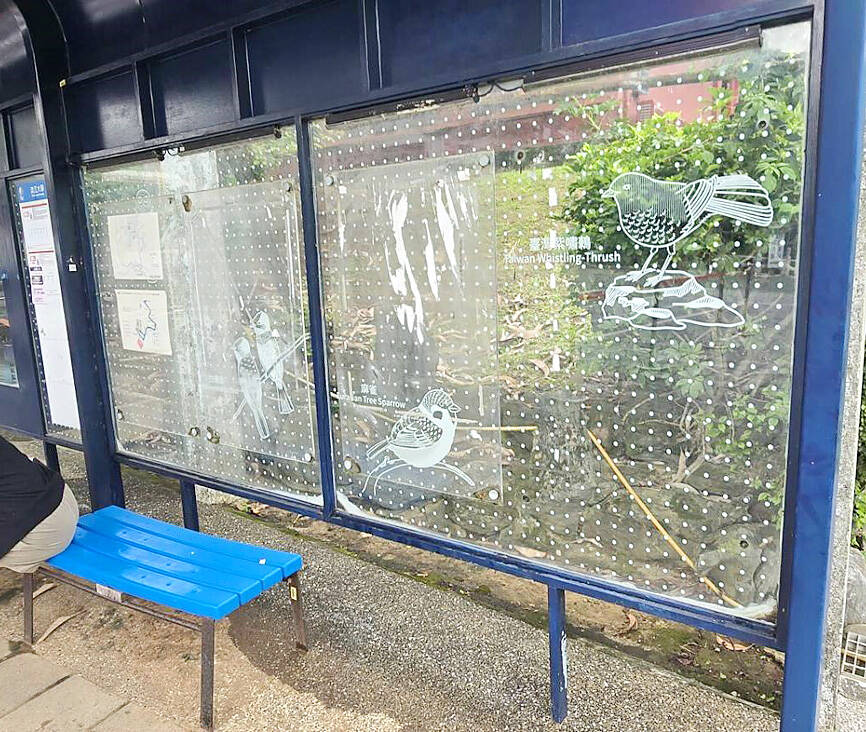
A bus shelter fitted with window decals to deter birds is pictured on Tamkang University’s campus yesterday.
Photo courtesy of the New Taipei City Animal Protection and Health Inspection Office
The office cited wildlife rescue statistics as showing that about 9 percent of wild bird rescues were related to collisions with glass, averaging 125 cases per year.
While most of the office’s glass-collision rescue cases involve the Taiwan barbet and spotted dove, protected species such as the crested goshawk have also been rescued, it said.
Glass transparency and reflectivity easily misleads birds into believing that the glass is a passable space, RRGT rescue station director and veterinarian Wang Ling-min (王齡敏) said.
Effective designs for reducing collisions feature dots, lines or other patterns that are dense enough to make the glass visible to flying birds, she said.
Bird-friendly glass designs can be used in public facilities and homes, the office said.
Places with large, transparent glass, such as residential homes, office buildings or schools, or those with a history of glass-collision incidents, could apply dot or line patterns or stickers to their glass to increase visibility for birds, it said.
People who find a bird that might have been injured in a glass collision should record the time and place of discovery and details of the surroundings when reporting it, the office said.
They should look for bleeding or drooping wings, an inability to stand or a prolonged inability fly away unaided, it said.
They can call the office’s 24-hour hotline at (02) 2959-6353 or the 1959 animal protection hotline for assistance, it added.
KioskNews shows a cleaned-up reading view extracted from the publisher’s page — the original always lives on their site, not ours.