Why Albanese will pay a domestic price for his Pacific diplomacy
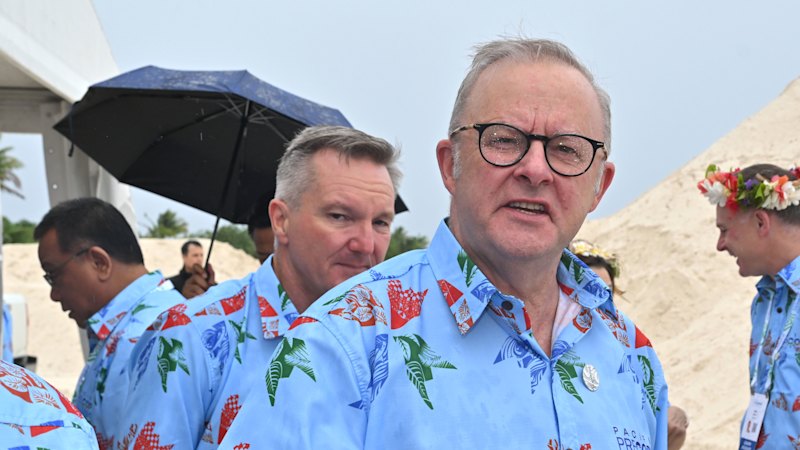
Whatever the success or failure of the pre-COP meeting in Fiji, it is clear the Albanese government will wear a political cost for putting it on.
Normally, these annual gatherings are small affairs attended only by officials whose job it is to narrow the scope of climate negotiations at the sprawling UN Paris Treaty negotiations to follow.
But after Australia lost the bid to host the next COP to Turkey, the price Climate Minister Chris Bowen extracted for conceding was his role as president of negotiations, and the agreement that a leaders’ level pre-COP would be held in the Pacific.
This way Australia could rattle the can for donations to the region from far-flung nations for the eye-bleeding cost of climate mitigation in the Pacific, elevate its climate concerns, and show off the damage already done to low-lying nations to demonstrate the immediate threat of climate change.
The problem is that few of those leaders made the trip. Indeed, just two from outside the Pacific fronted – those of Timor-Leste and Mauritius.
Having talked up the event, this leaves Albanese and Bowen in the awkward position of having to justify the $20 million-plus cost of hosting a party where the glamour guests did not turn up.
With a budget in deficit and interest rates climbing, Australian voters are getting twitchy with the government spending their tax money on their own needs, let alone those of their regional neighbours.
Little surprise that opposition energy spokesman Dan Tehan labelled the event a farce.
Despite the disappointment at the roll-call, the mood on the ground was more positive.
As Bowen kept saying whenever he was pushed on the issue, more senior officials – and leaders – attended this event than any other pre-COP.
“I get it,” he said in an interview with this masthead. “You know, you can cut it any number of ways you like. I’m told this is probably the largest pre-COP ever, with more than 3000 people. Certainly, the first that any world leaders have been to.”
He noted there was a good representation of senior ministers, including those of India, the UAE and Indonesia.
“In all my conversations, with the prime minister of Tuvalu yesterday, the minister from Tuvalu, the Secretary General of PIF, they couldn’t be happier with the focus we brought to the Pacific.”
The UK’s climate envoy, Professor Rachel Keyte, said the meeting had succeeded on this level, despite the increasing complexity of climate negotiations in a fragmenting world battered both by climate change and an energy crisis.
“We’re hearing very clearly from the Pacific what they need and want. We will now carry that back with us as we finalise our negotiating positions.”
This point was made hours earlier in Tuvalu when that nation received what is likely the largest single delegation of foreign dignitaries in its history.
For the Pacific, there was more on the table than acts of sovereignty. Senior climate negotiators now understand the region’s key demands of the COP talks in Turkey, particularly a recommitment to the Paris goal of stabilising the climate at 1.5 degrees, sufficient finance for adaptation, and the inclusion of ocean protection in the talks.
There was cash, too.
At a finance event on Wednesday morning, the Secretary General of the Pacific Island Forum, former Nauru president Baron Waqa, noted that the Pacific Resilience Fund had already attracted pledges of $US118 million dollars towards a target of $US500 million.
Minutes later, Albanese was dutifully boosting his call for more.
“My message today, unashamedly, to governments, development partners, financial institutions, philanthropic organisations, and investors is straightforward. Back a Pacific-owned and Pacific-led solution,” Albanese said. “This Pacific pre-COP and COP 31 gives us a unique opportunity to do so.”
So, what was in it for us?
“It’s very much in Australia’s geopolitical interest to be deeply present in the region,” Bowen said.
“If we’re not, the vacuum will be filled. Climate change is the number one, two, and three issue for Pacific countries. Bringing the pre-COP to the Pacific is being seen as Australian leadership. So, of course it’s good for the climate, but is this unquestionably in Australia’s geopolitical interest? Yes.”
Cut through the noise of federal politics with news, views and expert analysis. Subscribers can sign up to our weekly Inside Politics newsletter.
KioskNews shows a cleaned-up reading view extracted from the publisher’s page — the original always lives on their site, not ours.