South Korea tax windfall could top 50tn won: Yonhap
South Korea’s excess tax revenue might exceed 50 trillion won (US$36.9 billion) this year, according to a Yonhap News report, reflecting factors including a stronger-than-expected semiconductor cycle.
That could push the size of the Future Response Fund, a government tool that channels excess tax revenue into strategic investments and fiscal reserves, to above 200 trillion won, according to Yonhap’s calculations.
South Korean Ministry of Economy and Finance is expected to publish the figure in its revised 2026 national tax revenue estimate due later this month, according to the report.
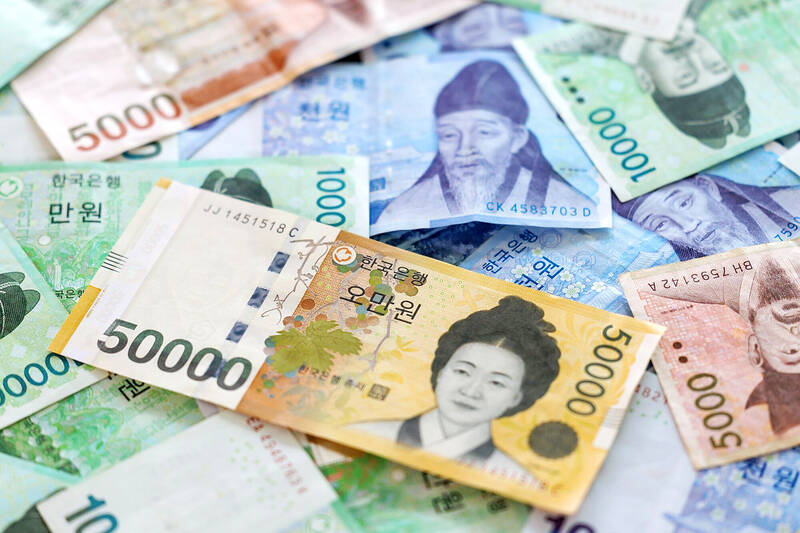
South Korean won banknotes are scattered in Seoul, South Korea, on June 18.
Photo: Bloomberg
The revenue windfall would give the government more room to increase spending without a corresponding rise in borrowing.
Under the 2027 budget proposal, much of the semiconductor-driven windfall is set to flow toward helping finance artificial intelligence (AI), chips and youth support while limiting bond issuance and building a fiscal buffer.
The finance ministry said in a statement on Sunday no decision has been finalized on the revised estimate of this year’s national tax revenue.
The Bank of Korea raised its benchmark interest rate by a quarter percentage point to 3 percent last month, its second consecutive hike, as stronger-than-expected growth and persistent underlying inflation prompted policymakers to act pre-emptively.
The central bank also upgraded its GDP growth forecast to 3.3 percent from 2.6 percent for this year, citing robust exports and investment driven by the global AI build-out.
The strength of the chip cycle has boosted corporate earnings and investment in South Korea, though policymakers are still waiting to see how much those gains boost household consumption and ripple through the rest of the domestic economy.
KioskNews shows a cleaned-up reading view extracted from the publisher’s page — the original always lives on their site, not ours.