THE FINANCIAL WELLNESS COACH: Family trust investments — a sinking fund may be the most tax-efficient route

We have a family trust that holds a portfolio consisting of unit trusts and shares. We recently sold some of these investments and were shocked to see how much capital gains tax (CGT) we are paying.
The trust will soon be receiving a lump sum from my late mother’s estate. Should we invest this money through the trust, or would it be better to distribute the funds to the beneficiaries immediately?
Answer:
Your concern is entirely understandable. Many families establish trusts to protect their wealth for future generations, only to discover that the tax treatment of investments held in those trusts can be particularly punitive.
Tax liabilities
Under the current South African tax rules, an ordinary family trust pays income tax at a flat rate of 45%. When an investment is sold at a profit, 80% of the capital gain is included in the trust’s taxable income. At a tax rate of 45%, this translates into an effective CGT rate of 36%.
Individuals, by comparison, include only 40% of their capital gains in taxable income, resulting in a maximum effective CGT rate of 18%. This means that a trust retaining a capital gain can pay twice as much CGT as an individual in the highest tax bracket.
There is an important exception. Under certain circumstances, capital gains realised by a trust can be vested in South African resident beneficiaries and taxed in their hands rather than in the trust. This needs to be done correctly and in compliance with the applicable tax rules.
A family trust can provide valuable protection and continuity. It allows trustees to manage investments for children and grandchildren and can help to preserve family wealth across generations.
Assets held in a properly structured discretionary trust will also generally fall outside the personal estates of beneficiaries who do not have vested ownership rights.
This can have important estate planning benefits. If you distribute the inheritance to the beneficiaries and they invest it in their own names, those assets will form part of their personal estates.
You may therefore reduce future investment taxes, but you could potentially increase estate duty exposure and lose some of the protection and flexibility the trust was intended to provide.
Sinking fund
A clever way to reduce tax payable by the trust is to have the trust invest the inheritance through a sinking fund. A sinking fund is an investment structure offered by life insurance companies. It works in much the same way as a modern endowment policy, except there is no life assured. This makes it particularly suitable for trusts.
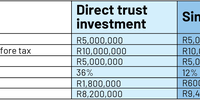
The important difference is how the investment returns are taxed. The tax rate for a sinking fund is 30%, whereas capital gains are taxed at an effective rate of 12%. The effective CGT rate in the sinking fund can be just one-third of the rate paid by the trust on direct investments.
Let’s assume that an initial investment of R5-million grows to R10-million, producing a capital gain of R5-million. If the entire gain is realised and taxed in the trust, the difference between the two investment structures would be as in the table below. The potential saving is R1.2-million.
Another advantage is that certain sinking fund structures allow trusts to invest offshore through a share swap arrangement.
I would be careful about restructuring your existing portfolio. If the trust owns shares or unit trusts with substantial unrealised capital gains, selling them to move the proceeds into a sinking fund could trigger another large CGT liability.
A more sensible approach may be to retain those investments and use the inheritance to establish a new, more tax-efficient portfolio. This would avoid crystallising existing capital gains while improving the tax efficiency of future investment growth. DM
Kenny Meiring is an independent financial adviser. Contact him on 082 856 0348 or at financialwellnesscoach.co.za. Send your questions to kenny.meiring@sfpadvice.co.za
This story first appeared in our weekly DM168 newspaper, available countrywide for R39. The e-edition of Daily Maverick’s weekly newspaper, DM168, is now free for readers who are signed into their Daily Maverick account. Click here to access the latest e-edition.
KioskNews shows a cleaned-up reading view extracted from the publisher’s page — the original always lives on their site, not ours.