Iran focused on attacking "harder targets," U.K. spy chief warns
London — Iran has made a "major shift" in its efforts to attack the United Kingdom, including going after harder targets such as military bases, the head of Britain's domestic spy agency MI5 warned Tuesday.
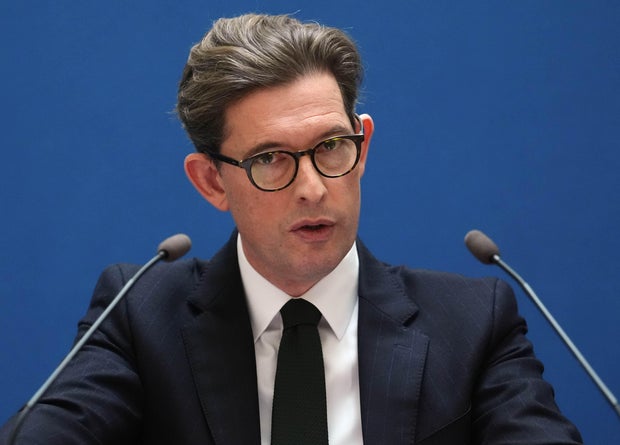
In his annual threat update at MI5 headquarters in London, Sir Ken McCallum outlined the growing challenges facing the country, from hostile foreign governments and terrorism to the potential misuse of AI. Iran, he said, has demonstrated that it is "keen on subcontracting its U.K. violence … using criminal proxies to try to intimidate oppositionists, Iranian media organizations, and Israeli sites."
"Sadly, much of this aggression has been aimed at British Jewish communities, with whom I want to express solidarity," he said.
"The other major shift this year has been Iranian ambitions to come at harder targets, like military sites," he added.
All of these alleged activities led to more than 50 Iran-linked arrests in the U.K. over the past year alone, McCallum said.
His comments come after a series of arson and sabotage incidents targeting Jewish communities and other sites in the U.K. and across Europe, which McCallum described as "sickening acts."
He declined to provide details about the military installations targeted, including the alleged plot against the U.K. air base RAF Fairford that was thwarted in late September, citing "ongoing investigations."
The U.S. moved all of its long-range bombers off the base in the wake of the incident.
U.K. Prime Minister Andy Burnham said Monday that the incident near the base, which was used by U.S. bombers to target Iran, was "almost certainly" directed by Iran's Islamic Revolutionary Guard Corps.
But as McCallum noted Tuesday with his reference to "subcontracting" and "criminal proxies," not all of Iran's suspected nefarious activities are easy to attribute to the regime in Tehran.
"Knowingly or unknowingly" working for Iran?
Britain's counterterrorism police unit said it was possible that the RAF Fairford incident "may be activity committed by proxies, or individuals either knowingly or unknowingly, working on behalf of a foreign state."
Iran, like Russia, has been accused repeatedly of using individuals who may be unaware they are even working for a foreign state to conduct sabotage attacks across Western Europe.
The Iran-aligned group Harakat Ashab al-Yamin al-Islamia — or The Islamic Movement of the Companions of the Righteous (IMCR) — claimed responsibility for a string of incidents earlier this year, including attacks on synagogues in the Netherlands and Belgium, and multiple attacks on north London's Jewish community.
A representative for the group told CBS News in March that it would "keep threatening U.S. and Israeli interests worldwide until we've avenged every child in Gaza, Iran, Lebanon, and the resistance nations," and it urged people "to stay away from Zionist and American interests."
Russia is "aggressor number one"
In his wide-ranging address, McCallum said the number of state-threat cases being handled by MI5 had quadrupled over the past decade.
"Since I started in this role in 2020, there has been another generational shift. We have again entered a new era of national security – requiring a new response," he said.
MI5 is devoting more resources to countering state threats in 2026 than it did during the Cold War, he said, highlighting the scale of the challenge posed by hostile foreign actors, and he said among those actors, Russia remains "aggressor number one."
McCallum said Moscow has escalated its attempts to wage "hybrid warfare" against Britain and its allies. That can include a wide range of cyberattacks, sabotage and other hostile activities that fall short of conventional military action, he said.
The intelligence chief suggested Russia's increasingly aggressive approach was linked to its difficulties on the battlefield in Ukraine, arguing that Moscow was seeking to unsettle other European countries "at a time when its military progress in Ukraine remained limited and came at a high cost."
He acknowledged longstanding conventional threats still exist, but were being "sort of well managed by military or other colleagues," while Russia, Iran "and others are seeking to do things beneath the level of conventional armed conflict."
Artificial Intelligence
Artificial intelligence was also a central theme of McCallum's address. He warned of the technology's rapid development amid the equally rapid changes in the security landscape, crediting AI with "supercharging the cybersecurity contest between attackers and defenders."
He said AI could be used to generate propaganda and radicalization material tailored to individuals, potentially making it easier for hostile actors to manipulate people and spread extremist ideologies.
Among the greatest concerns McCallum voiced was the possibility that AI could help people make existing biological weapons more dangerous, or help malicious actors develop entirely new ones.
In:
Former CIA official breaks down Iran war headlines as Houthis warn the U.S.
KioskNews shows a cleaned-up reading view extracted from the publisher’s page — the original always lives on their site, not ours.