Ocean acidification shrink squids’ brains, study finds
By Yang Mien-chieh and Jonathan Chin / Staff reporter, with staff writer


At the current pace of climate change, ocean acidification might shrink the brains of squids by the next century, impairing their ability to hunt, an Academia Sinica study showed.
Exposing Sepioteuthis lessoniana, or bigfin reef squid, to projected 2100 ocean acidity levels significantly reduced their brain volume, the academy’s Institute of Cellular and Organismic Biology said in a news release yesterday.
Institute assistant research fellow Tseng Yung-che (曾庸哲) and Acadia University assistant professor of biology Garett Allen coauthored the study, and collaborated with fisheries and scientific research groups affiliated with Taiwanese and Japanese governments, it said.
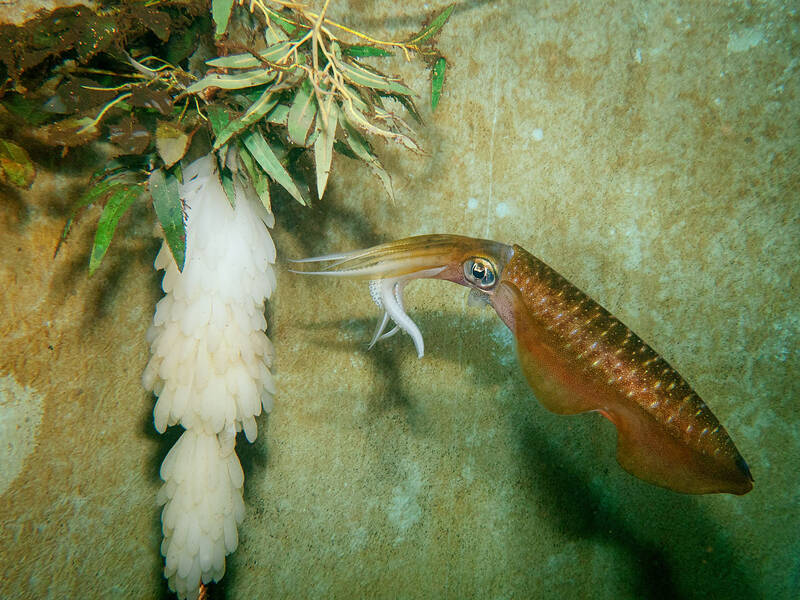
A bigfin reef squid is pictured in an undated photograph.
Photo courtesy of Academia Sinica
Exposing squid to seawater at pH 7.8 increased the time they needed to capture prey by 2.5 times and decreased their predatory willingness, the institute said.
The change in behavior stemmed from a disruption in higher-order neural integration circuits, not due to eye damage, as previously hypothesized, it said.
Being kept in an acidic environment for 90 days decreased squids’ brain size by 49 percent, and the increased acidity in optic lobes reduced the number of nicotinic acetylcholine receptors, which transmit visual information, the institute said.
The changes led to problems in energy metabolism and synaptic signaling, it said.
The affected squids were notably slower in defensive inking, finding concealment in corners and catching prey, the institute said.
The impaired cognitive capabilities of an apex predator are highly likely to have negative ramifications for the ecosystem, highlighting the threat climate change poses to the environment, it said.
However, the squids also showed surprising resilience by responding to long-term exposure to acidification with multi-layered neural adaptations involving building ribonucleoprotein complexes, maintaining Golgi apparatus function and transporting vesicles, the institute said.
The research team believes that using magnetic resonance imaging and machine learning could help scientists understand the climate’s impact on the brains of cenopods, which have implications for the ocean’s ecosystem, it said.
The study was published in Communications Biology on Jan. 8, and sparked interest in international publications, including the US-based Time magazine and the UK’s The Times, the institute said.
KioskNews shows a cleaned-up reading view extracted from the publisher’s page — the original always lives on their site, not ours.