TCC Group seeks purchase of Ukraine cement plant
TCC Group Holdings Co’s (台泥企業) board of directors has approved a plan for the company’s Dutch subsidiary to acquire Ukrainian cement company Ivano-Frankivskcement (IFCEM) and three other companies for about 750 million euros (US$857 million).
The transaction includes roofing materials company Ivano-Frankivsk-Dakh, gypsum products maker KRU Gips and dry-mix mortar producer KRU Mix, TCC Group Holdings vice president Shelly Yeh (葉毓君) said at a news conference yesterday.
The final acquisition price would be adjusted when the deal is finalized based on factors such as net debt and net working capital, Yeh said.
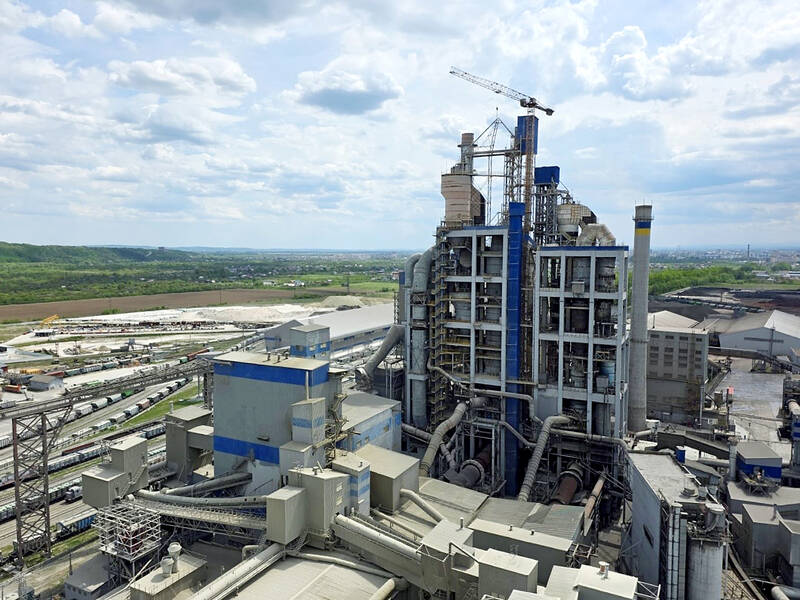
Ukrainian cement company Ivano-Frankivskcement’s cement plant is pictured in this undated photograph.
Photo courtesy of TCC Group Holdings Co
The plan is still subject to regulatory approval in Taiwan, Ukraine and other jurisdictions before the transaction can be finalized, Yeh cautioned.
The company is hoping to expand its European cement operations from southern and western Europe into eastern Europe and position itself to participate in Ukraine’s long-term reconstruction once the war ends.
IFCEM represents a strong vehicle through which to expand its European presence, with a roughly 36 percent market share in Ukraine and a sales network that extends mainly to Poland and Romania as well as Moldova, Slovakia and Hungary, TCC said.
Another major consideration was the growing importance of low-carbon practices in the cement industry, especially given the EU’s Carbon Border Adjustment Mechanism, the company said.
TCC expects to introduce its low-carbon cement technologies to the acquired businesses and advance its sustainability vision in leading post-war reconstruction, it said.
IFCEM’s production base is in Ivano-Frankivsk in western Ukraine, about 760km from the front lines in the southeastern part of the country.
The company’s plant has maintained production without interruption since Russia invaded Ukraine in 2022, TCC said.
According to IFCEM’s 2025 financial report, revenue rose 20.3 percent year-on-year to UAH16.25 billion (US$362.41 million), while gross profit climbed 40.3 percent to UAH6.44 billion.
Gross margin surged to 39.6 percent, up from 34 percent in 2024, while net income increased 44.5 percent. Net margin was about 26.4 percent.
TCC said it has appointed Morgan Stanley as financial adviser for the transaction, while international legal, accounting, tax and environmental consultants have conducted due diligence covering sanctions, labor, operations and foreign exchange controls.
The company said it retains the flexibility to bring in international financial institutions as co-investors, with interest already expressed by supranational investment funds.
The plant has installed 50MW of solar power capacity and 19MW of gas-fired power generation capacity to reduce its reliance on the external grid, the company said.
Ukraine’s reconstruction needs over the next decade could reach US$588 billion. Severely damaged housing, transportation and energy infrastructure are the most urgent needs, according to an assessment by the World Bank and the UN earlier this year.
KioskNews shows a cleaned-up reading view extracted from the publisher’s page — the original always lives on their site, not ours.